- Published on
A Guide to Clean Coding Principles
- Authors

- Name
- Gabriel
- @gabriel__xyz
Clean code principles are really just a set of professional standards for writing software that’s easy to read, understand, and, most importantly, maintain. Think of them as the guidelines that separate code that simply works from code that’s built to last. When you follow these principles, your projects can grow and adapt without collapsing under their own weight.
Why Clean Code Is Your Secret Weapon
We've all been there—staring at a tangled mess of code that feels like deciphering ancient hieroglyphics. It’s a universal developer experience, but it’s one that’s completely avoidable. Mastering clean code isn't just a "nice-to-have" skill; it's something that directly impacts project success, team morale, and your own sanity.
A great way to think about it is to imagine your codebase as a shared kitchen. When everything is organized, labeled, and put back where it belongs, anyone can walk in, find what they need, and get cooking. That’s a clean codebase.
Now, picture a kitchen where dirty dishes are piled high, ingredients are scattered everywhere, and nothing has a designated spot. Trying to make a meal becomes a frustrating, time-consuming nightmare. That’s a codebase drowning in technical debt.
Clean coding principles are the rules that keep that kitchen clean for everyone. They lay the groundwork for sustainable software development, helping teams move faster and build more reliable products. Adopting them brings a few immediate wins:
- Improved Readability: Let’s be honest, code is read far more often than it’s written. Clean code is practically self-documenting, which means new team members can get up to speed without needing their hands held the whole way.
- Easier Maintenance: When a bug inevitably pops up or a new feature needs to be added, a clean structure makes it simple to find the right spot, make the change, and deploy a fix with confidence.
- Fewer Bugs: Simple, well-organized code just has fewer places for bugs to hide. When code is clear, it reduces the mental gymnastics required from developers, which naturally leads to fewer mistakes in the first place.
The Tangible Impact of Cleanliness
The benefits aren't just theoretical; they translate into real, measurable gains. In fact, embracing clean code is one of the most powerful productivity strategies a development team can adopt.
Industry analyses have shown that teams who implement clean coding standards see a reduction in code review times by around 35%. They also report a decrease in post-release defects by nearly 40%. These numbers make it crystal clear: focusing on simplicity and readability directly improves both the quality of your work and the speed at which you can deliver it.
You can find more great insights about these clean code practices on Teamhub.com.
To put it all together, here’s a quick look at the core benefits you can expect when you start prioritizing clean code.
Core Benefits of Adopting Clean Code Principles
| Benefit | Impact on Development Lifecycle |
|---|---|
| Enhanced Readability | Speeds up onboarding for new developers and simplifies peer reviews. |
| Simplified Maintenance | Reduces the time and effort required to fix bugs or add new features. |
| Reduced Bug Count | Lowers the frequency of defects, leading to a more stable and reliable product. |
| Improved Collaboration | Creates a shared standard that makes it easier for team members to work together. |
| Long-Term Scalability | Prevents technical debt from accumulating, ensuring the codebase can evolve. |
Ultimately, writing clean code is an investment. It pays dividends by making your entire development process smoother, more predictable, and a lot less stressful for everyone involved.
The Three Pillars of Smart Coding

While the software world is full of complex design patterns, there are three simple, foundational philosophies that can instantly level up your work. Think of them less as rigid rules and more as guiding mindsets that help you make smarter decisions, write less code, and avoid future headaches.
Embracing these concepts helps you find a better balance between shipping fast and writing clean code—a constant tug-of-war in development. It's crucial for any team to understand the key trade-offs between code quality and speed if they want to build something that lasts.
DRY Dont Repeat Yourself
The DRY (Don't Repeat Yourself) principle is probably the one you've heard the most. Its core idea is that every piece of logic in a system should exist in only one place. Think about it like this: if you're sending out party invitations, you don't handwrite a brand-new one for every guest. You create a master template and just fill in the names.
In coding, that "template" is usually a function or a shared module. When you see duplicated code, it's a huge red flag. If you need to make a change, you'll have to hunt down every single instance and update them all—a perfect recipe for introducing bugs.
By defining a piece of logic once and reusing it, you create a single source of truth. This not only saves time but drastically reduces the risk of inconsistencies and errors down the line.
KISS Keep It Simple Stupid
Next up is KISS (Keep It Simple, Stupid), a principle that champions simplicity over needless complexity. It’s a gut check reminder that most systems work best when they're kept simple, not made complicated. The goal is to build a straightforward solution that solves the immediate problem without adding bells and whistles you think you might need later.
Imagine building a bridge. You could design a simple, sturdy structure that gets people from A to B. Or, you could create an over-engineered marvel with pointless loops and decorative towers that add no real value. The second one is harder to build, a nightmare to maintain, and far more likely to fail.
The KISS principle encourages you to find the simplest path that actually works. In practice, this means:
- Favor clear logic over clever one-liners that nobody can decipher six months from now.
- Avoid abstracting too early; sometimes abstraction just adds another layer of complexity.
- Write code for humans first, because you or someone else will have to read it eventually.
YAGNI You Ain't Gonna Need It
Finally, we have YAGNI (You Ain't Gonna Need It). This principle is a direct counterattack on speculative development—that nagging habit of adding functionality "just in case" it's needed down the road. YAGNI insists that you should only build what's necessary right now, not what you're guessing might be useful in some hypothetical future.
It's like packing for a day hike. You bring water, snacks, and a map—the essentials. You don’t haul your three-person tent and camping stove on the off chance you might decide to stay overnight. Adding all that extra weight (or code) just slows you down and complicates the trip for no immediate benefit.
This disciplined approach keeps your codebase lean, focused, and much easier to manage. By resisting the urge to gold-plate your features, you save time and effort that can be better spent on delivering real, immediate value.
Mastering the Five SOLID Principles
Once you've got mindsets like DRY and KISS down, the next big step is tackling the five SOLID principles. These aren't just abstract ideas; they're the battle-tested backbone of modern object-oriented design.
Think of them as the blueprint for building software that's flexible, logical, and doesn't fall apart as it grows. Mastering these is what separates good code from truly professional, clean code.
Imagine you're building a system with a set of high-end, modular power tools. You want each tool to do its job perfectly, be adaptable, and be easily swappable without breaking everything else. That's exactly what SOLID helps you achieve in your code.
S: Single Responsibility Principle
The Single Responsibility Principle (SRP) is the easiest one to grasp. It boils down to this: a class or module should have one, and only one, reason to change.
Let’s go back to our power tool analogy. Think of your drill. Its one job is to make holes. That's its single responsibility. You wouldn't build a drill that's also a circular saw, because a change to the sawing part could accidentally mess up the drilling part.
When a class tries to do too many things, it becomes a tangled, fragile mess. Fixing a bug in one of its "jobs" might create new bugs in another. Keeping classes focused on a single task makes them way easier to understand, test, and maintain.
O: Open/Closed Principle
The Open/Closed Principle (OCP) says that software components (like classes) should be open for extension but closed for modification. That might sound like a contradiction, but it's a game-changer for building scalable systems.
Think about that power drill again. The core tool is "closed"—you can't just crack open the motor and start rewiring it without voiding the warranty. But it's also "open" because you can extend what it does by adding different drill bits for wood, metal, or masonry. You're adding new features without altering the original, tested tool.
In code, we often do this with interfaces or abstract classes. This lets us plug in new functionality without touching the existing, stable code.
L: Liskov Substitution Principle
The Liskov Substitution Principle (LSP) sounds a bit academic, but it's vital for creating class hierarchies that you can actually trust. The core idea is that you should be able to replace any object of a parent class with an object of one of its subclasses without anything breaking.
If you have a PowerTool class and a Drill subclass, you should be able to use a Drill object anywhere a PowerTool is expected and have it work perfectly. If swapping them causes weird behavior—the classic example is a Square subclass breaking the logic of its Rectangle parent—you’ve violated LSP. Sticking to this principle makes your abstractions correct and predictable.
I: Interface Segregation Principle
The Interface Segregation Principle (ISP) is all about not forcing classes to deal with things they don't need. In simpler terms, it's better to have many small, specific interfaces than one giant, do-it-all interface.
Picture a multi-tool with a dozen attachments. If you only need the screwdriver, you're still stuck carrying around the weight and bulk of the pliers, knife, and can opener. ISP says it’s better to just have a dedicated screwdriver. In code, this means a class should only have to implement methods that are actually relevant to its job.
D: Dependency Inversion Principle
Finally, we have the Dependency Inversion Principle (DIP). This one flips traditional dependencies on their head. It states that high-level modules shouldn't depend on low-level modules; instead, both should depend on abstractions (like interfaces).
This is all about decoupling your code. Your high-level HouseBuilder class shouldn't know or care about a low-level SpecificBrandDrill class. Instead, both should depend on a general Drillable interface. This lets you swap out different drills without ever having to change the HouseBuilder code. It's the key to true modularity.
This infographic shows how core principles like DRY naturally lead to a single source of truth—a concept at the heart of modular design. 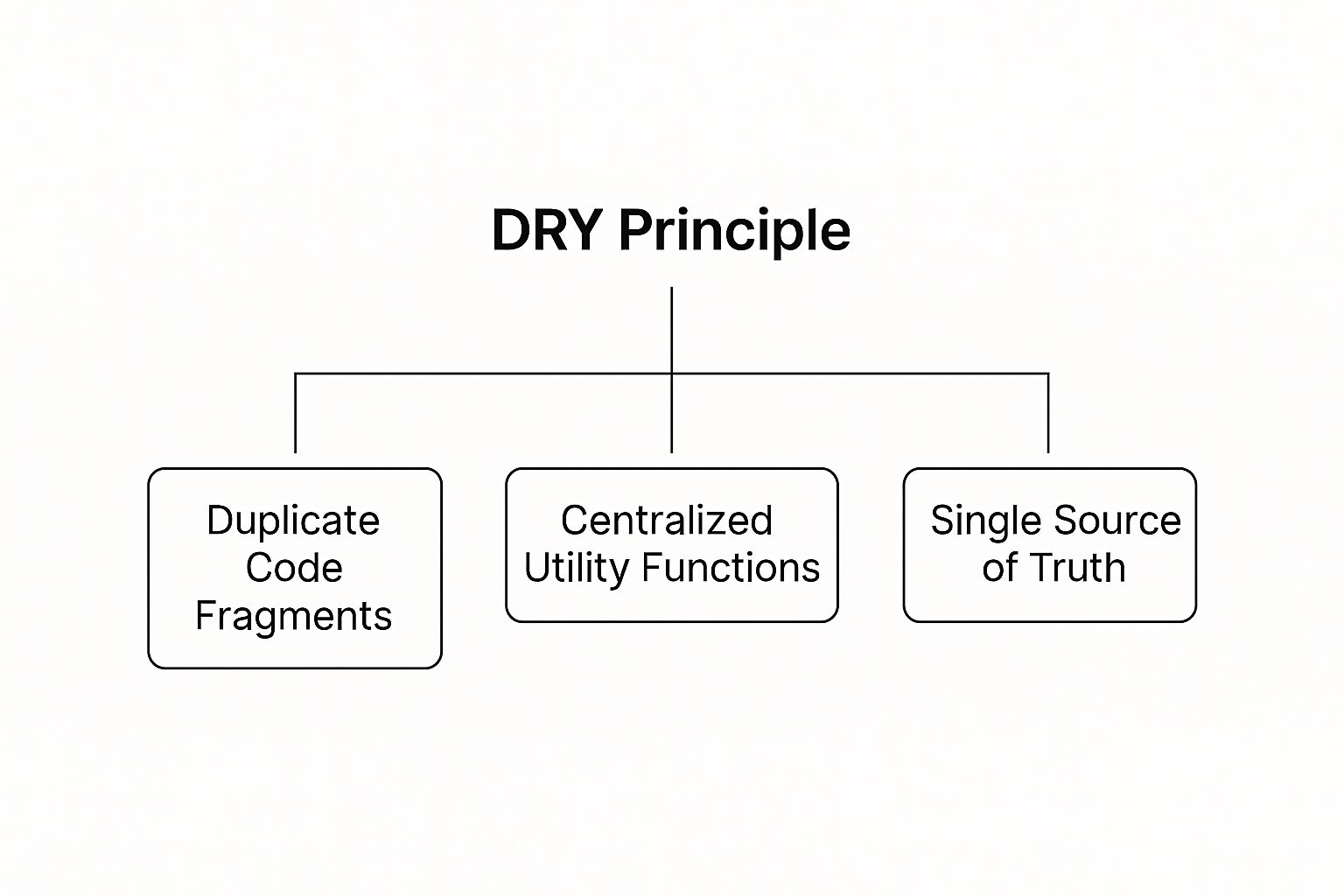 As the image shows, when you stop duplicating code, you're forced to centralize your logic, which reinforces these clean code goals.
This kind of thinking is a cornerstone of clean code, and its value isn't just anecdotal. Even in scientific software, where reproducibility is everything, researchers found that clean code is essential. A 2021 study emphasized that practices like modularity significantly cut down on cognitive load and make unit testing easier—which is critical for catching bugs early. You can read the full research about these foundational rules in scientific code.
To help keep these straight, here's a quick cheat sheet.
SOLID Principles At a Glance
| Principle | Mnemonic | Core Concept |
|---|---|---|
| Single Responsibility | SRP | A class should have only one reason to change. |
| Open/Closed | OCP | Open for extension, but closed for modification. |
| Liskov Substitution | LSP | Subclasses should be substitutable for their base classes. |
| Interface Segregation | ISP | Don't force clients to implement interfaces they don't use. |
| Dependency Inversion | DIP | Depend on abstractions, not on concrete implementations. |
These five principles work together to create software that's not just functional, but also robust, maintainable, and a pleasure to work with.
Practical Habits for Writing Cleaner Code

Knowing principles like SOLID and DRY is one thing, but the real magic happens when you start living them every day. Applying clean coding principles isn’t about some massive, one-time refactor. It's about the small, consistent choices you make every single time you sit down to write code.
Think of it like getting in shape. You don’t get fit by hitting the gym once for a marathon session. You get fit by showing up consistently. The same goes for writing clean code—little habits, repeated day after day, compound into a robust, maintainable codebase that you can build without even thinking about it.
These habits are what turn abstract concepts into concrete actions, making clean code less of a far-off goal and more of a practical, everyday reality.
Choose Names That Reveal Intent
One of the most powerful habits you can build is taking the time to name things thoughtfully. Vague names like d or data force the next developer—which is often your future self—to waste time and mental energy just trying to figure out what’s going on.
Good code is like a good joke—it needs no explanation. Meaningful names are the foundation of self-documenting code, making your logic clear without requiring a single comment.
Instead of a variable named elapsed, call it elapsedTimeInDays. Rather than a function named processData(), get specific with something like calculateUserPermissions(). This kind of clarity is a gift you give to your entire team.
Write Small, Focused Functions
Long, sprawling functions that try to do everything at once are a classic code smell. A core tenet of clean code is making sure every function does one thing and does it well. This lines up perfectly with the Single Responsibility Principle.
Breaking your logic into smaller functions brings a ton of benefits:
- Easier to Test: Small, focused functions can be unit-tested in isolation, leading to a much more reliable test suite.
- Simpler to Understand: A function with a clear, singular purpose is way faster for anyone to read and grasp.
- Highly Reusable: A function like
isValidEmail()can be used all over your application, which keeps you from repeating yourself (DRY).
This simple practice also helps you sidestep many of the issues we covered in our guide on the most common code smells in pull requests, where giant functions are a frequent offender.
Write Comments That Explain Why, Not What
Your code itself should explain what it's doing. Clear naming and a logical structure should make that obvious. Comments are for the things your code can’t say—the "why" behind your decisions. A good comment clarifies the business reason for a weird-looking piece of logic or a choice that might seem counterintuitive at first glance.
Just as readable code is crucial, so is the documentation that goes with it. Following solid technical writing best practices is what makes a project truly maintainable in the long run. Skip the redundant comments that just rephrase the code and instead focus on giving another developer the context they'd need to understand your intent.
Navigating Real-World Coding Challenges
While clean code principles are a fantastic ideal, the real world of software development is… well, messy. We’re all up against tight deadlines, requirements that seem to change by the hour, and legacy codebases that feel more like an archaeological dig than a planned city.
Applying clean coding principles in this chaos isn’t about chasing perfection. It's about being pragmatic.
The real game is finding the sweet spot between writing flawless code and actually shipping a product on time. Sometimes, a "good enough" solution is the right call to hit a deadline. This creates what we call intentional technical debt. The trick is to make it a conscious choice, not a sloppy habit, and to circle back to refactor it later.
Thinking this way helps you sidestep some common traps that can derail even the best developers.
Avoiding Common Implementation Traps
One of the biggest traps is over-engineering. It's so easy to get carried away and apply a super-complex design pattern to a simple problem, completely ignoring the YAGNI principle. Always, always start with the simplest thing that could possibly work. You can add complexity later if—and only if—you actually need it.
Another pitfall is putting too much faith in automated tools. Sure, linters and static analyzers are great allies, but they aren't foolproof. They often enforce rigid, one-size-fits-all rules that just don't make sense for your project's specific context.
A landmark 2025 study found that developers often struggle with inflexible clean code policies and the misapplication of automated tools, which can sometimes undermine clean code goals. However, it also revealed that over 70% of developers are eager to adopt these principles for their long-term benefits. You can discover more insights about these clean code findings.
Introducing Clean Code to Existing Projects
Trying to bring clean code into a massive legacy project can feel like trying to boil the ocean. A total rewrite is almost never practical, so your best bet is to improve things bit by bit.
Here are a few practical steps to get started:
- Apply the Boy Scout Rule: This is simple: always leave the code a little cleaner than you found it. When you’re in a file to fix a bug or add a feature, take a few extra minutes. Improve a variable name, remove a small bit of duplication, or clarify a confusing comment.
- Focus on High-Traffic Areas: Start by refactoring the parts of the codebase that get changed the most. Cleaning up these modules gives you the biggest bang for your buck.
- Get Team Buy-In: Clean code is a team sport. Introduce the principles gradually. Maybe start by agreeing on one or two simple standards, like better function naming. Celebrate the small wins and show everyone how these little changes make their lives easier.
Common Questions About Clean Coding
When developers first dive into clean coding, a few questions pop up almost every time. It’s a real mindset shift—moving from just getting code to work to writing code that will last. Naturally, that brings a few practical hurdles to light.
Let's walk through some of the most common challenges developers run into. Getting these sorted out can make the whole transition a lot smoother for you and your team.
Applying Principles to a Massive Legacy Codebase
Okay, so where do you even begin with a huge, messy project that's been around for years? The trick is to start small and be patient. Trying to refactor the entire thing at once is a surefire way to create chaos.
Instead, live by the "Boy Scout Rule": always leave the code a little cleaner than you found it. When you're in a module fixing a bug or adding a feature, just take five extra minutes to improve a variable name or break down a monster function. Focus your major refactoring efforts on the parts of the codebase you touch most often, and make sure any new code is up to your clean standards. It’s a marathon, not a sprint.
This incremental approach also happens to be one of the core pull request best practices. It keeps your changes small, focused, and way easier for others to review.
Adapting Principles for Non-Object-Oriented Languages
Do these principles even make sense for languages that aren't object-oriented, like C or functional languages like Elixir? Absolutely. While SOLID is definitely geared toward object-oriented design, the heart of clean code is universal.
The core goal of clean code is always to improve readability and maintainability, regardless of the programming paradigm. The philosophy transcends specific language features or styles.
Principles like DRY (Don't Repeat Yourself), KISS (Keep It Simple, Stupid), meaningful naming, and writing small, single-purpose functions are invaluable everywhere. They're all about creating clarity and taming complexity, which helps any developer working in any language. The implementation might look different, but the goal is the same.
Knowing When Code Is Too Clean or Over-Engineered
Is it possible to take things too far? Oh, yes. And it happens more than you'd think. Code becomes "too clean" when developers fall into the trap of over-engineering—applying complex design patterns to solve what are actually pretty simple problems.
This is where the YAGNI (You Ain't Gonna Need It) principle becomes your best friend. Always, always prioritize the simplest, most direct solution that gets the job done. Clean code is about clarity and simplicity, not showing off how many advanced patterns you know. If your "clean" solution is harder for someone else to understand than the straightforward one, you’ve gone too far.
Tired of noisy GitHub notifications and slow code reviews? PullNotifier integrates with Slack to deliver concise, real-time pull request updates, cutting through the clutter so your team can focus. Streamline your workflow and accelerate your development cycle by visiting us at https://pullnotifier.com.