- Published on
How to Improve Team Communication and Boost Performance
- Authors

- Name
- Gabriel
- @gabriel__xyz
When you're trying to improve how your team communicates, it really boils down to three things: setting up clear channels, building a transparent culture, and using smart technology. If you get these right, you create a system where information actually flows the way it should, saving everyone from the frustration and rework that comes with disorganized teams.
Why Better Team Communication Drives Real Results

We can all agree that "communication is key," but let's talk about the real cost of getting it wrong. Poor communication isn't just a small annoyance; it's a direct threat to your team's output and morale. It kicks off a domino effect of missed deadlines, expensive rework, and disengaged employees who feel like they're shouting into the void.
Think about it. When information gets siloed or updates are all over the place, projects will suffer. It's inevitable. We've all seen a developer push code based on outdated requirements because a critical update was buried in a massive email thread. The result? Wasted hours and a final product that completely misses the mark. This isn't some hypothetical scenario—it’s a daily reality for teams operating without a clear game plan.
The Tangible Business Impact
Effective communication is so much more than a soft skill; it’s a core business strategy with a real, measurable return. The link between clear dialogue and team output is undeniable. In fact, teams that communicate well can see their productivity jump by as much as 25%.
Even so, a lot of teams are fighting their own toolset. Roughly one-third of communicators are unhappy with the tools they have to use for work. You can dig into more workplace communication statistics and their impact to see the full picture.
This is exactly why figuring out how to improve team communication is so important. It's not about adding more meetings or tools. It’s about building a framework that actually supports your team's workflow instead of getting in the way.
To get you started, here's a quick summary of the core pillars we're about to dive into. Think of this as your roadmap to building a more connected and efficient team.
Your Quick Guide to Better Communication
| Pillar | Key Action | Expected Outcome |
|---|---|---|
| Clear Channels | Define where specific conversations happen (e.g., Slack for quick questions, email for formal updates). | Less confusion, faster decision-making, and fewer messages lost in the wrong place. |
| Transparent Culture | Foster an environment where people feel safe to ask questions, give feedback, and admit mistakes. | Higher psychological safety, more innovation, and stronger team trust. |
| Smart Technology | Adopt tools that simplify workflows and cut through the noise, not add to it. | Increased focus, reduced context-switching, and more time for deep work. |
Each of these pillars works together to create a system that just works. Getting them right is what separates the high-performing teams from the ones that are always struggling.
By intentionally designing how your team interacts, you shift from a reactive state of constant fire-fighting to a proactive one where everyone is aligned and focused on the same goals.
Ultimately, putting effort into better communication is what turns a group of individuals into a true team. It builds the trust and psychological safety needed for real collaboration, completely changing how your team solves problems, comes up with new ideas, and hits its targets together.
Architecting Your Communication Ecosystem

Great team communication doesn't just happen by accident—it’s carefully designed. To really level up how your team talks, you need a blueprint. It’s an intentional plan that cuts out the guesswork and kills information overload. This is about moving beyond just having tools and actually defining the purpose behind each one.
Without a plan, you end up with digital chaos. Questions get lost in crowded email inboxes, urgent updates are buried in general chat channels, and nobody knows where to find critical information. That kind of disorganization is a huge reason projects fail.
In fact, 86% of employees and executives point to a lack of effective communication as a primary cause of workplace failures. That stat alone should tell you how critical it is to build clear, reliable channels for collaboration. You can read more about the impact of these communication gaps if you're curious.
Create Your Communication Charter
The single most effective way to architect your communication ecosystem is by creating a Communication Charter. Think of it as a simple, shared document that outlines the rules of engagement for your team. It's your playbook for who, what, when, and where communication happens.
The goal isn't to create rigid, bureaucratic policies. It’s all about providing clarity. A charter answers common questions before they’re even asked, saving everyone a ton of time and mental energy.
A good charter should define things like:
- Channel Purpose: What is each tool actually for? For example, Slack is for quick, informal questions, while email is reserved for formal client communication.
- Response Expectations: How quickly should people expect a reply on each channel? Maybe Slack messages get a response within three hours, but emails can wait up to 24 hours.
- Urgency Protocols: What really constitutes an emergency, and what’s the right escalation path? This stops every minor issue from being treated like a five-alarm fire.
Your Communication Charter acts as guardrails, not a cage. It guides behavior and sets clear expectations, which frees your team to focus on their actual work instead of navigating a confusing web of pings and notifications.
Putting Your Charter into Practice
I once worked with a remote development team that was absolutely drowning in email. By creating a charter, they designated a specific #dev-urgent Slack channel for critical, blocking issues. That one simple change cut their internal email clutter by over 50% and sped up problem resolution dramatically.
Here's another real-world scenario: a hybrid team was struggling with brainstorming. The folks in the office dominated every conversation, leaving remote participants feeling like they couldn't get a word in. Their charter introduced a shared digital whiteboard (like Miro) as the official tool for brainstorming. Suddenly, every idea was captured and considered equally, no matter where the person was sitting.
These examples show how being intentional about your communication structure pays off. By clearly defining how information should flow, you can solve specific pain points and improve team communication for good.
Choosing the Right Tools for Seamless Collaboration
Technology should make your work easier, not add another layer of complexity. The right tools can act as powerful bridges in your communication workflow, but only if you choose and implement them with real intention. Just piling more apps onto your stack is a surefire way to create noise and confusion.
The trick is to make your tools work for you. This means automating routine updates so your team can finally stop chasing each other for status reports. For instance, connecting a project management tool like Asana to a chat platform like Slack can automatically post task completions or project milestones. Everyone stays in the loop without any manual effort.
Automate Workflows to Reduce Noise
Automation is your best defense against the dreaded notification fatigue. Instead of relying on manual check-ins, you can build systems that deliver the right information to the right people at exactly the right time. This is especially critical for technical teams where deep focus is everything.
For software development teams, this means moving beyond the constant, noisy pings from default integrations. This is where specialized tools really shine—they're designed to solve this exact problem.
Here’s a perfect example of how PullNotifier delivers clear, actionable updates directly in Slack.
This screenshot shows how the tool consolidates all pull request activity into a single, easy-to-read thread. It completely eliminates the chaotic stream of notifications that typically clutters a channel. By grouping updates, developers and stakeholders can see the status of code reviews at a glance without having to piece together information from a dozen different messages. You can find more ideas in our guide to the best GitHub Slack integrations to try.
The goal of any tool should be to increase signal and decrease noise. If an app creates more work than it saves, it's not the right fit for your team.
Effective tooling isn't just about saving time; it's about creating an environment where your team can concentrate on deep, meaningful work instead of being pulled in ten different directions by constant interruptions. This approach makes team communication more focused, relevant, and ultimately, more effective.
The Rise of AI in Team Communication
Artificial intelligence is quickly becoming a valuable ally in making our communication clearer and more effective. Modern AI-powered tools can do a lot more than just check your grammar; they're fundamentally changing how we interact in a digital workspace.
These tools can give your team a serious boost by:
- Summarizing long conversations: Instantly get the key takeaways from a lengthy chat thread or document without having to read every single word.
- Drafting clearer messages: Help team members articulate their thoughts more concisely and professionally, which cuts down on misinterpretations.
- Analyzing tone: Some tools can even detect the emotional tone of a message, helping you head off misunderstandings before they even happen.
The impact is already huge. With 73% of knowledge workers reporting that generative AI tools help them avoid miscommunications, it’s clear these technologies are becoming essential for modern teams. You can find more details in this report on emerging communication trends. This isn't just about convenience; it's about building a more empathetic and precise communication culture.
Building a Culture of Trust and Psychological Safety
Let's be real—the slickest tools and perfectly written communication plans don't mean much if your team is walking on eggshells. The human element is what makes or breaks great collaboration. If you want effective team communication, you have to build an environment where people feel safe enough to speak up, challenge ideas, and even admit they messed up.
This feeling of security has a name: psychological safety. It's the shared belief that it's okay to take interpersonal risks. In a psychologically safe team, nobody is afraid of being shut down, ignored, or embarrassed for sharing a different opinion. Instead, that kind of input is seen for what it is: a valuable contribution.
Model Vulnerability from the Top
Trust isn't built from mission statements hanging on a wall. It's forged through consistent, observable actions, especially from leaders. When leaders are open about their own mistakes and learning curves, it gives everyone else permission to do the same.
A surprisingly powerful way to do this is to kick off a weekly team meeting with a "what I learned from a mistake this week" segment. When a manager openly shares a small failure and the lesson it taught them, it completely reframes mistakes. They become opportunities for growth, not something to hide. It’s a simple act that normalizes vulnerability and opens the door for real, honest dialogue.
A culture of trust shifts the focus from blaming people for errors to collectively fixing the process that allowed the error to happen. That’s where the real innovation kicks in.
You can also use simple, structured activities to help build rapport. If you're looking for ideas that go beyond the usual team-building fluff, check out these engaging ice breakers for meetings that can help create a more open atmosphere.
Disagree Productively Without Making It Personal
Healthy conflict is actually a sign of a high-performing team. When people feel safe enough to challenge ideas, they push the entire group toward better solutions. The trick is to establish clear ground rules for disagreeing in a way that’s productive, not personal.
Here are a few simple norms you can introduce for debates:
- Challenge the idea, not the person: Frame feedback with phrases like, "I see that point, but have we considered this alternative?" instead of "That's a bad idea."
- Assume positive intent: Go into disagreements with the belief that everyone is working toward the same goal, just from a different angle.
- Seek to understand, not just to win: Encourage active listening. Ask clarifying questions before jumping in with a counterargument.
When leaders are transparent about organizational changes and actively cultivate this kind of environment, employees are over four times more likely to trust them. It's not just a feel-good metric, either. Teams with strong communication practices see 50% lower turnover than others in their industry. You can dive deeper into the data and see the full impact of communication on retention.
Adopting Practical Habits for Daily Communication
Big, sweeping strategic shifts are impressive, but they aren't what truly improves team communication. The real magic happens in the small, consistent actions you and your team take every single day. These daily habits are what build momentum and create lasting change, turning abstract goals into concrete behaviors that make collaboration feel effortless.
These habits don't need to be complicated. Think about the last time you saw a critical project update buried in a long, rambling message. It probably got skimmed or, even worse, completely ignored. Just by adopting a simple habit of formatting important messages for scannability—using bold text for key dates and bullet points for action items—you can dramatically boost comprehension and make sure nothing important gets missed.
Run Meetings That Actually Accomplish Something
We've all been trapped in those meetings that could have been an email. A simple yet powerful habit is to start using an Effective Meeting Framework for every single synchronous call. This isn't about adding red tape; it's about respecting everyone's time and making sure meetings produce tangible outcomes, not just more conversation.
Here’s what that framework looks like in practice:
- A Clear Agenda: Send out a brief agenda at least a few hours before the meeting. It should have specific topics and, most importantly, the desired outcomes. This gives everyone a chance to come prepared.
- An Assigned Note-Taker: Pick one person to capture the key decisions and action items. This role should rotate among team members to share the responsibility.
- Concrete Action Items: Never end a meeting without summarizing the next steps. Every action item needs a clear owner and a firm deadline to create real accountability.
An approach like this can transform meetings from painful time-sinks into genuinely productive working sessions.
Master the Art of Digital Messaging
In a world where most of our communication is digital, how you write is just as important as what you write. A poorly structured message breeds confusion, while a well-crafted one drives immediate action. The goal is always clarity and brevity, especially when giving feedback or sending out updates. For instance, learning how to write clear PR feedback can massively speed up development cycles just by eliminating ambiguity for your engineers.
The next time you’re about to send a project update, try this simple structure:
- Start with the headline: What’s the single most important takeaway? (e.g., "Project Phoenix: Launch Date Confirmed for Oct 25")
- Add a brief summary: Just one or two sentences explaining the current status.
- List action items or blockers: Use bullet points for anything you need from the team.
This format ensures your message gets read and understood, even by busy stakeholders who are just skimming their notifications.
The goal of any message isn't just to transmit information, but to ensure that information is received and understood with minimal effort from the recipient.
Knowing when to switch mediums is another key skill. A long, convoluted email chain with endless replies is often a signal that a quick five-minute video call is needed. Recognizing those moments and acting on them can prevent hours of back-and-forth confusion.
The infographic below shows a simple three-step process for improving awareness in non-verbal communication, which is just as crucial in video calls as it is in person.
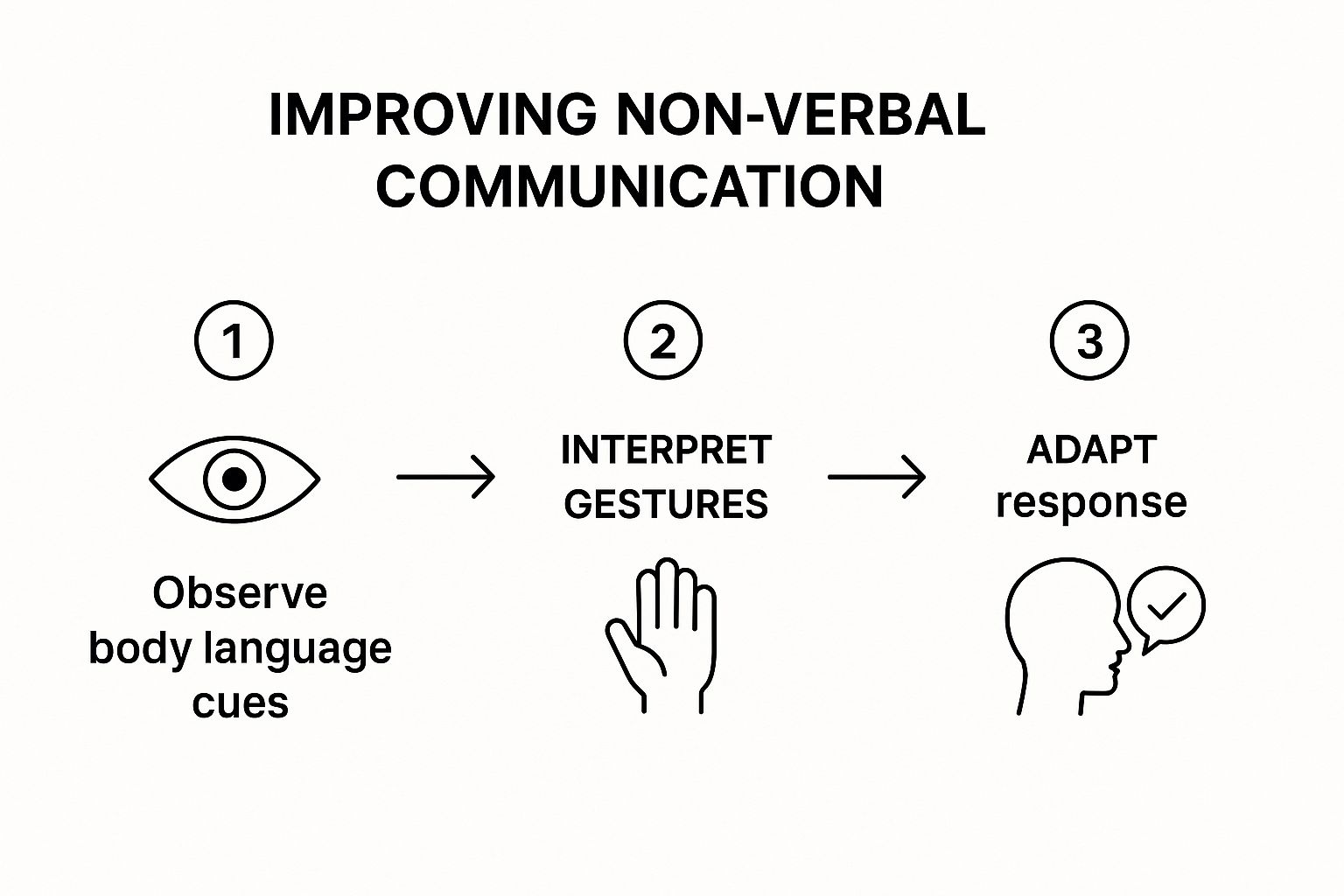
This flow highlights a critical point: effective communication is a constant loop of observing cues, interpreting them correctly, and then adapting your own response.
Choosing the Best Communication Method
Knowing which tool to use for a given situation is just as important as knowing how to use it. A request that's urgent for you might just be another notification for someone else if you send it through the wrong channel.
Here's a quick guide to help you pick the right method for the right message.
| Method | Best For | Potential Pitfall |
|---|---|---|
| Instant Messaging (e.g., Slack) | Quick questions, informal updates, and urgent but low-complexity issues. | Can become a major distraction and lead to important information getting lost in the scroll. |
| Formal announcements, detailed project updates, and communications that need a paper trail. | Slow response times and long, confusing threads that are hard to follow. | |
| Video Call (e.g., Zoom) | Complex problem-solving, team brainstorming, and sensitive conversations where tone is important. | "Meeting fatigue" and the tendency for them to run long without a clear agenda or facilitator. |
| Project Management Tool (e.g., Jira) | Assigning specific tasks, tracking progress, and documenting decisions related to work items. | Can feel bureaucratic if overused for simple communication that could happen in chat. |
| In-Person | Team-building, strategic planning sessions, and resolving interpersonal conflicts. | Not always possible for remote or distributed teams, requires scheduling and travel. |
Ultimately, the goal is to be intentional. Before you hit "send" or schedule that meeting, take a second to ask yourself if it’s truly the most effective way to get your message across. This small habit alone can save your team countless hours.
Measuring Progress and Fostering Continuous Improvement
Improving how your team communicates isn't a project you can just check off a list. It’s an ongoing commitment to getting better, together. To know if your efforts are actually paying off, you need to move past gut feelings and start measuring what’s happening. This creates a powerful feedback loop: you see what’s working, ditch what isn’t, and keep refining your approach.
Without this cycle of feedback and adjustment, even the best-laid plans can slowly unravel as old habits creep back in. The goal is to build a culture where improving communication is just part of how you operate.
Gathering Actionable Feedback
First things first, you need simple, low-friction ways for your team to share their honest thoughts. Anonymous surveys are fantastic for this because they create a safe space for candor without fear of judgment. You don’t need a massive, 50-question survey—a short, quarterly pulse check can give you incredible insights.
Try asking pointed questions that get straight to common communication pain points:
- On a scale of 1-10, how effective and well-run are our team meetings?
- Do you feel psychologically safe to voice a dissenting opinion or ask a "silly" question?
- Do you feel you have the right information at the right time to do your job effectively?
These simple metrics give you a baseline to track over time. If your meeting effectiveness score is consistently tanking, that’s a clear signal that something needs to change. This is how you spot real problems instead of just guessing.
Creating a culture of feedback empowers your team to own their communication practices. It shifts the responsibility from a top-down mandate to a shared, collaborative effort to improve everyone's daily work experience.
From Feedback to Experimentation
Once you've identified a recurring bottleneck, you can turn that feedback into action through small, controlled experiments. This approach makes change feel less intimidating and much more collaborative. For instance, if project retrospectives constantly reveal that critical updates get lost in a sea of chat messages, you can test a new process.
Maybe you decide that for the next two sprints, all major project updates must be posted in a dedicated thread within your project management tool. After the experiment, you measure the impact. Did the number of "I didn't know about that" comments decrease in the next retro? Did the team feel more aligned?
This experimental mindset is what fosters continuous improvement. It shows your team their feedback is heard and valued, which in turn encourages them to be even more open. This transparency is crucial, as it leads to 12 times higher job satisfaction among employees. Given that replacing an employee can be incredibly costly, investing in communication delivers real economic benefits by boosting morale and lowering turnover. You can find more details about the connection between transparency and job satisfaction.
Frequently Asked Questions About Team Communication
Even with the best game plan, questions always pop up when you're trying to fix team communication. Here are some quick, real-world answers to the common hurdles I see teams facing all the time.
What Is the Fastest Way to Improve Communication on a Struggling Team?
The single quickest win is to create a Communication Charter. Don't let the name intimidate you; it's just a simple document that sets clear rules of engagement for your tools.
For example, you might decide Slack is for urgent, same-day questions, while email is for formal updates that can wait 24 hours. This one change immediately cuts down on confusion and the constant "which channel should I use?" problem. It sets clear expectations for response times and helps everyone know exactly where to look for information.
How Do You Encourage Quiet Team Members to Speak Up?
The key is to create structured, low-pressure moments for them to contribute. Instead of ending a meeting with a vague, "Any questions?", try a round-robin format where each person gets a designated turn to share their thoughts. It takes the pressure off.
Another powerful technique is leaning into asynchronous tools. Brainstorming on a shared digital whiteboard or collaborating in a Google Doc lets quieter folks add brilliant ideas without the anxiety of speaking up in a live meeting. The most important part? Publicly acknowledge and validate their input. That’s how you build confidence.
Fostering an inclusive environment isn't about forcing people to talk. It's about giving them different ways to contribute their valuable insights—in a way that feels comfortable and safe for them.
What Metrics Can You Use to Track Communication Improvement?
You'll want a mix of qualitative and quantitative data to get the full picture. Hard numbers are great, but the story behind them is just as important.
- Quantitative Data: Send out brief, anonymous quarterly surveys. Ask your team to rate things like meeting effectiveness and psychological safety on a 1-5 scale.
- Qualitative Data: Dig into the notes from your project retrospectives. Look for recurring themes related to communication breakdowns or, even better, communication wins.
Seeing a steady drop in projects delayed by miscommunication or a noticeable jump in those survey scores are solid, measurable signs that your efforts are actually working.
Ready to cut through the noise and get your development team's workflow firing on all cylinders? PullNotifier delivers clean, consolidated pull request updates directly to Slack, killing notification spam and speeding up your code review process. Start your free trial today and see the difference.