- Published on
Software Productivity Definition: software productivity definition for teams
- Authors

- Name
- Gabriel
- @gabriel__xyz
For years, engineering leaders chased the wrong thing. We tried to measure productivity by counting lines of code or features shipped per week. It felt tangible, but it was like judging a world-class kitchen by how fast the chefs chop vegetables. It completely misses the point.
The real magic of a great kitchen isn't just speed; it's the quality of the final dish, the seamless collaboration of the entire staff, and the delight of the diners.
Defining Modern Software Productivity

This is exactly how we should think about the modern software productivity definition. It’s not about how much code an individual writes, but about a team's ability to deliver high-quality, valuable software in a way that’s both efficient and sustainable.
The conversation has shifted from individual output to collective outcomes. We’ve come to realize that software development is a creative, collaborative sport. The goal isn't just to build something; it's to build the right thing—reliably, efficiently, and without burning out your team in the process.
From Individual Output to Team Outcomes
This shift in thinking gets to the heart of what actually makes engineering teams effective. An engineer who writes 100 lines of code to fix a critical bug is infinitely more productive than one who churns out 1,000 lines for a feature nobody will ever use.
This new paradigm is built on a few core ideas:
*   **Focus on Value:** Is the work directly helping customers or the business?
*   **Team-Centric View:** We measure the performance of the whole system (the team), not just its individual parts (the developers).
*   **Sustainability is Key:** Can the team keep this pace without accumulating technical debt or burning out?
*   **Continuous Improvement:** Metrics are for finding bottlenecks and improving the workflow, not for pointing fingers.
Developers are on board with this change. A recent survey found that 62% of developers now see things like clear communication and collaboration as more critical to their performance than purely technical metrics. If you want to dive deeper, the latest software development statistics show just how much the industry is evolving.
Old Vs. New Software Productivity Paradigms
The difference between the old and new ways of thinking is night and day. One treats software development like a factory assembly line, while the other recognizes it as a complex, problem-solving discipline. Grasping this distinction is the first step toward building a truly high-performing engineering culture.
"True productivity is not about being busy, but about achieving meaningful results. In software, this means delivering stable, valuable features that solve real problems for users, not just closing tickets."
To make this crystal clear, let's look at a side-by-side comparison. The table below shows how our definition of productivity has matured from a narrow focus on code output to a much more holistic view of the entire delivery process.
Old vs New Software Productivity Paradigms
| Aspect | Outdated View (Output-Focused) | Modern View (Outcome-Focused) |
|---|---|---|
| Primary Metric | Lines of Code (LoC), Commits | Throughput, Cycle Time, Business Impact |
| Unit of Focus | The Individual Developer | The Entire Engineering Team |
| Core Goal | Write more code, faster | Deliver valuable software, sustainably |
| View of Quality | A separate QA phase | Built into the entire process |
| Cultural Impact | Fosters competition, burnout | Promotes collaboration, psychological safety |
As you can see, the modern approach is about fostering a collaborative environment where teams are empowered to deliver real value, not just ship code. It’s a healthier, more effective, and ultimately more rewarding way to build software.
Why Effective Measurement Drives Success
Talking about software productivity can feel a bit like trying to nail jello to a wall. But getting a real handle on it is more than just a thought exercise—it’s a strategic must. We’ve all heard the old saying, "what gets measured gets managed," and it’s especially true in software engineering. Without clear metrics, teams are just flying blind, relying on gut feelings and guesswork. That makes it impossible to spot real problems, celebrate genuine wins, or connect all that hard work to what the business actually cares about.
When you start measuring effectively, productivity stops being a vague buzzword and becomes a powerful tool for getting better. For engineering managers and tech leads, this is how you unlock your team's true potential. It gives you the hard data you need to find those sneaky bottlenecks, make a solid case for new tools or more people, and prove the engineering department’s value to the rest of the company.
From Bottlenecks to Breakthroughs
Picture a team that's constantly blowing past its deadlines. Morale is taking a nosedive, and the pressure is on. The easy assumption is that the developers aren't working hard enough, or maybe the estimates are just way off. But without data, that’s all just speculation.
Now, imagine that same team starts tracking a couple of key metrics. Right away, they notice their Cycle Time—the time it takes from starting a piece of work to getting it shipped—is alarmingly high. Digging in a bit more, they discover that pull requests are just sitting there for days, waiting for a review. The problem isn't how fast they're coding; it's a sluggish code review process that's gumming up the works.
This is where having a clear software productivity definition tied to real measurement sparks actual change.
Armed with this data, the team can take targeted action. They could set up a new process for faster reviews or bring in a tool that gets the right eyes on a PR immediately. Suddenly, the problem isn’t some fuzzy feeling of "slowness" anymore. It's a specific, solvable issue.
This kind of data-first mindset is what fuels continuous improvement. For a wider look at how data can shape your strategy, this article on data-driven decision making offers some great perspective.
Connecting Engineering Efforts to Business Goals
Ultimately, measuring productivity isn't just for internal navel-gazing; it elevates the conversation all the way up to the C-suite. When you can draw a straight line from improving a metric like Deployment Frequency to a faster time-to-market for a new feature, you're speaking the language of business leaders. Productivity stops being just an "engineering thing" and becomes a core driver of the company's success.
This has a huge impact on team morale, too. When developers see how their work directly leads to positive results and they're given the tools to crush frustrating roadblocks, their engagement and job satisfaction skyrocket. They feel empowered, not micromanaged. A fantastic starting point is this practical guide to engineering productivity measurement, which can help set your team on the right path.
By building a thoughtful measurement strategy, teams can:
*   **Pinpoint Inefficiencies:** Find and fix the systemic issues in the development lifecycle that are holding you back.
*   **Improve Predictability:** Get much better at forecasting project timelines and figuring out where to put your resources.
*   **Boost Team Morale:** Empower developers by focusing on making the system better, not pointing fingers at individuals.
*   **Align with Strategy:** Clearly connect what engineers are building day-to-day with the company's biggest goals.
In the end, measuring software productivity isn't about watching over everyone's shoulder. It's about gaining the clarity needed to build better software, faster, and without burning everyone out. It’s the compass that guides high-performing teams toward their destination.
Key Metrics for Real Productivity Insights
To really get a handle on software productivity, we need to move beyond fuzzy ideas and start measuring things. It's a classic saying for a reason: you can't improve what you don't measure. The right metrics act as a compass, pointing your team away from hidden bottlenecks and toward a smoother, more predictable way of delivering value.
It's all about turning measurement into actual success.
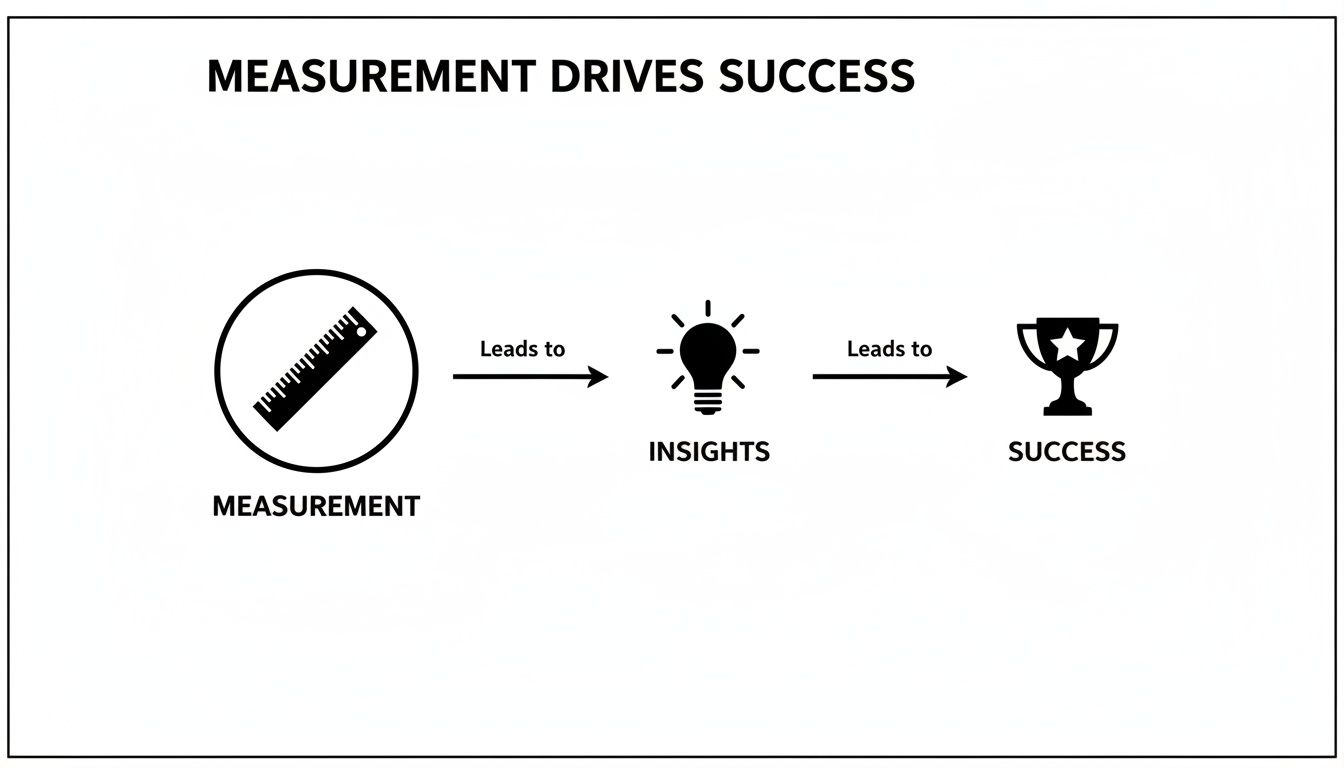
This simple flow drives home the point. The goal isn't just to collect data; it's to find actionable insights that lead to better performance and real wins.
The Gold Standard DORA Metrics
The DevOps Research and Assessment (DORA) metrics are pretty much the industry gold standard for measuring how a software team is performing. They give you a balanced view by looking at both speed (throughput) and stability (quality), making sure teams aren't just shipping fast and breaking things.
These four metrics work together to paint a holistic picture of a team's health and effectiveness.
- Deployment Frequency: This is all about how often your team successfully ships code to production. High-performing teams deploy on-demand, often multiple times a day. It's a great sign of a healthy, automated pipeline.
- Lead Time for Changes: This tracks how long it takes for a commit to go from a developer's machine all the way to production. Shorter lead times mean you can react faster to customer needs and market shifts.
- Change Failure Rate: This is the percentage of your deployments that blow up in production and require a hotfix or rollback. A low failure rate points to high quality and a reliable delivery process.
- Mean Time to Recovery (MTTR): When something inevitably does go wrong, this metric measures how long it takes to fix it. Elite teams can bounce back from incidents in under an hour, which shows just how resilient they are.
A team that deploys daily (high Deployment Frequency) but has a 30% Change Failure Rate isn't truly productive. They're just creating chaos. DORA metrics force you to connect speed directly to the stability of your system.
Understanding the Flow of Work
While DORA metrics are fantastic for an overall health check, flow metrics help you diagnose what’s happening inside the system. They give you a ground-level view of your development process, making it much easier to spot and fix inefficiencies.
Think of it this way: if DORA metrics are the speedometer and engine warning lights on your car's dashboard, flow metrics are the detailed diagnostics a mechanic runs to see what's actually going on under the hood. For a deep dive into specific metrics that can reveal bottlenecks, you can learn more about key metrics for faster code reviews in GitHub.
Here are a few essential flow metrics:
*   **Cycle Time:** This is the clock time from when work starts on a task until it's delivered. A simple analogy is ordering a pizza: Cycle Time is how long it takes from the moment you place your order until it's at your door. Shorter cycle times signal a more efficient workflow.
*   **Work in Progress (WIP):** This metric just counts how many tasks the team is actively working on. High WIP is a classic cause of longer cycle times and often means the team is juggling too many things at once. Limiting WIP is a proven way to improve focus and flow.
*   **Throughput:** This is the total number of work items your team finishes in a set period, like a week or a sprint. It’s a straightforward measure of your team's output rate.
A Practical Summary of Key Metrics
Getting started with these metrics can feel a little overwhelming, but each one tells a unique and valuable story about your team's performance. The first step toward data-driven improvement is simply understanding what they measure and why they're important.
To help with that, this table breaks down the essential software productivity metrics into a clear summary.
Essential Software Productivity Metrics Explained
| Metric | What It Measures | Why It Matters |
|---|---|---|
| Deployment Frequency | The rate of successful releases to production. | Indicates the team's ability to deliver value quickly and consistently. |
| Lead Time for Changes | The time from code commit to production deployment. | Reveals the overall efficiency of the development pipeline. |
| Change Failure Rate | The percentage of deployments causing a production failure. | Highlights the quality and reliability of the release process. |
| Mean Time to Recovery | The average time it takes to restore service after a failure. | Shows the team's resilience and ability to respond to incidents. |
| Cycle Time | The time from starting work on an item to its completion. | Pinpoints bottlenecks and inefficiencies within the workflow. |
| Work in Progress (WIP) | The number of tasks being actively worked on at one time. | Helps manage team capacity and reduce context-switching. |
By tracking a combination of DORA and flow metrics, engineering leaders can move beyond gut feelings and build a true, quantitative understanding of their team's productivity. This data-backed approach gives you the insights needed to make targeted improvements, foster a culture of continuous learning, and ultimately, ship better software faster.
Common Measurement Pitfalls to Avoid
While the right metrics can light up the path to better performance, the wrong ones will lead your team straight into a swamp. A flawed approach to measuring productivity doesn't just give you bad data; it actively poisons your culture, crushes morale, and tanks the quality of your software.
Knowing what not to do is just as important as knowing what to track.
These pitfalls usually start from a good place: a desire for a simple, single number to capture a developer's value. But software development is a complex team sport. Boiling it down to individual stats is a recipe for disaster, creating bizarre incentives where people start optimizing for the metric instead of for creating real value.
The Dangers of Individual Performance Metrics
One of the most common—and destructive—mistakes is tracking and comparing individual developer outputs. Whether it's lines of code, commit frequency, or story points completed, these metrics create a competitive, zero-sum game where collaboration goes to die.
Imagine a manager starts posting a weekly leaderboard of commit counts. Pretty soon, developers are breaking single, logical changes into a dozen tiny, meaningless commits just to climb the ranks. The codebase becomes a mess, and the focus shifts from thoughtful problem-solving to just gaming the system.
This kind of measurement completely misses the high-value work that doesn't generate a neat data point:
*   **Mentoring a junior developer:** This is absolutely critical for the long-term health of the team but won't show up on any dashboard.
*   **Deep-diving a complex bug:** The most important fixes might actually involve *deleting* code, not adding it.
*   **Improving documentation:** This makes the *entire team* faster, but it's not tied to a flashy new feature.
When measurement turns into surveillance, psychological safety is the first casualty. Developers become afraid to ask for help or admit they're stuck, fearing it will ding their personal stats and hurt their career.
Vanity Metrics That Tell the Wrong Story
Beyond individual comparisons, some metrics just plain lie to you. They look great on a chart but have zero connection to business outcomes or team health. We call them vanity metrics.
Lines of Code (LoC) is the classic example. A developer could write 5,000 lines of bloated, inefficient code to solve a problem that a senior engineer nails in 50 elegant lines. Who was more productive? Measuring LoC incentivizes quantity over quality, which is a fast track to crippling technical debt.
Another tempting but flawed metric is Story Points per Sprint. As soon as a team feels pressure to pump up their "velocity," they just start inflating their estimates. A task that was a three-pointer last month is suddenly a five-pointer this month. The number on the chart goes up, but the actual value being delivered stays flat—or even drops as planning meetings get bogged down in arguments over arbitrary numbers.
At the end of the day, these anti-patterns all stem from a fundamental misunderstanding of what software productivity really is.
*   It’s not about being busy; **it’s about creating impact.**
*   It's not about individual heroics; **it’s about effective teamwork.**
*   It’s not about hitting arbitrary targets; **it’s about continuous improvement.**
By sidestepping these traps, you can build a measurement system that's actually constructive and motivating. The goal is to focus on team-level flow and quality metrics that show you the health of the whole system, not just the output of its individual parts. That’s how you build trust and empower your team to solve problems together.
Practical Strategies to Boost Productivity

Knowing what to measure is a great start, but it's only half the battle. The real trick is turning those insights into action. Boosting software productivity isn't about getting developers to work harder or longer; it's about building a smarter, smoother system where valuable work flows with less friction.
This calls for a multi-front approach that tackles the entire development ecosystem. We can break down these practical strategies into three core pillars: refining your processes, nurturing your culture, and picking the right tools.
Optimizing Your Development Process
Think of your development process as the roadmap your team follows to get from a rough idea to a released feature. Even tiny optimizations here can compound over time, dramatically impacting your team's ability to deliver.
It's like the plumbing in a house. If you've got clogs or leaks, the whole system grinds to a halt. The goal is to create a clear, fast-flowing pipeline for work.
Here are a few high-impact process improvements:
*   **Reduce Work in Progress (WIP) Limits:** When a team is juggling too many things at once, context-switching absolutely kills focus and balloons cycle times. Strict WIP limits force the team to finish what they start, which does wonders for flow.
*   **Automate CI/CD Pipelines:** Manual testing and deployments are slow, error-prone, and a huge source of developer frustration. A fully automated continuous integration and delivery (CI/CD) pipeline lets teams ship small, high-quality changes with confidence and speed.
*   **Adopt Trunk-Based Development:** This practice has developers merge small, frequent changes into a central "trunk." It all but eliminates nasty merge conflicts and keeps the codebase in a constantly deployable state, which is a key ingredient for a higher deployment frequency.
Fostering a Culture of Improvement
Process changes will only stick if they're supported by a healthy, collaborative culture. Culture is the invisible force that dictates how your team communicates, tackles challenges, and learns together. It’s the soil where good processes take root and grow.
A culture that values productivity is built on trust, transparency, and a shared drive to get better.
Psychological safety is the bedrock of a high-performing team. When engineers feel safe to ask questions, admit mistakes, and challenge the status quo without fear of blame, they are more likely to identify and solve the deep-rooted problems that hinder productivity.
Key cultural practices that drive productivity include:
*   **Promote Continuous Improvement:** Run regular, blameless retrospectives where the team can openly discuss what went well and what didn't. This creates a feedback loop that turns every project into a learning opportunity.
*   **Foster Psychological Safety:** Leaders need to actively create an environment where vulnerability is seen as a strength. This is what unlocks open communication and proactive problem-solving.
*   **Celebrate Team Outcomes:** Shift the spotlight from individual "heroes" to team achievements. This reinforces the idea that software development is a team sport—everyone succeeds together.
For a deeper dive, check out these expert tips on how to improve developer productivity.
Implementing the Right Tools
The right tools are force multipliers. They automate the tedious, repetitive work that eats up developers' time and energy, freeing them up to focus on what they do best: creative problem-solving and building great software.
Automation is a massive part of any modern software productivity definition. We’re seeing a big shift in how developers work, especially with the rise of AI. Among developers who have adopted AI, 90% save at least one hour per week, and a solid 20% get back a full eight-hour workday through AI-assisted coding and automation.
But often, the most effective tools are the ones that solve a specific, painful bottleneck in your workflow. One of the most common productivity killers is a slow code review process, where pull requests (PRs) just sit there, waiting for someone to notice them.
This is exactly where a tool like PullNotifier shines. Instead of developers drowning in email notifications or constantly checking GitHub, PullNotifier sends clean, actionable PR updates right into the relevant Slack channel. It cuts through the noise and makes sure reviews happen fast. By directly tackling review delays, it helps teams shrink their Cycle Time—a critical productivity metric. For even more strategies, check out our guide on boosting productivity in engineering.
Frequently Asked Questions
Let's be honest, wading into software productivity metrics can feel like opening a can of worms. It's easy to get tangled up in questions about what to track, how to start, and whether you're accidentally creating a Big Brother culture. Here are some straight answers to the most common questions teams have.
How Do We Start Measuring Productivity Without Overwhelming The Team?
The trick is to start small. Don't roll out a massive, intimidating dashboard on day one. Instead, pick one, maybe two, team-level flow metrics that will give you the most bang for your buck. A fantastic starting point is Cycle Time.
Why Cycle Time? Because it’s a powerful diagnostic tool. A long cycle time instantly shines a light on bottlenecks, whether they're in your review process, your testing pipeline, or somewhere else. It tells a story about your entire system's health with just one number.
Before you track anything, though, you need to talk to your team. Explain that this isn't about creating performance leaderboards or micromanaging their every move. The goal is to make their work life easier by fixing the things that slow them down. Use tools that automate data collection from systems you already use, like GitHub, so no one gets stuck doing manual tracking. Once everyone sees the value during retros, you can slowly introduce other metrics like Deployment Frequency.
Can Software Productivity Be Measured For Individual Developers?
Technically, yes, you can track individual stats. But you absolutely shouldn't. It's a well-known anti-pattern that almost always backfires, creating a toxic culture of competition where you need collaboration. Software development is a team sport, period.
Measuring individual output is like judging a soccer player solely on how many times they kick the ball. It completely misses the strategic passes, defensive plays, and teamwork that actually win the game.
When you measure individual output, developers start optimizing for the metric, not for building great software. You get more lines of code, but not necessarily better code. Instead, keep all metrics at the team level. Use your one-on-one meetings for what they’re for: talking about personal growth, challenges, and contributions that no metric can ever capture—like mentoring a junior dev or refactoring a gnarly piece of legacy code.
What Is The Role of AI in The Future of Software Productivity?
AI is a powerful accelerant, not a magic bullet. Tools like GitHub Copilot are fantastic at speeding up repetitive tasks like writing boilerplate code or generating unit tests. This can definitely shorten parts of the Cycle Time and reduce the cognitive load on your engineers.
But AI won't fix a broken process. It can't clear up fuzzy product requirements, untangle a messy code review culture, or create psychological safety. The future is a partnership: let AI handle the predictable, grunt work so your developers can focus on what they do best—complex problem-solving, creative architecture, and collaborating with each other.
It's also worth remembering that AI's impact isn't always straightforward. Some studies have shown that for senior developers working in a familiar codebase, AI tools can actually slow them down as they spend time verifying and debugging the generated code. Think of AI as a specialized tool in your toolbox, not a replacement for the whole thing.
How Does Remote or Hybrid Work Affect Productivity Measurement?
For remote and hybrid teams, focusing on outcomes isn't just a good idea—it's essential. When you can't see people at their desks, you have to shift your focus from "time spent" to "work completed." The great news is that modern productivity metrics are built for this.
DORA metrics and flow metrics couldn't care less where your team is located. They measure the flow of value, not hours logged in.
*   **Deployment Frequency** doesn't matter if you're in the office or a coffee shop.
*   **Lead Time for Changes** tracks process efficiency, regardless of time zones.
*   **Cycle Time** shows you how fast work gets done, no matter where it happens.
One thing to pay closer attention to in a remote setup is communication health. Metrics like Pull Request Review Time become even more critical when you rely on asynchronous communication. Long review delays can kill momentum, so having visibility here is key to keeping the engine running smoothly.
PullNotifier helps remote and hybrid teams crush code review delays by sending clean, actionable GitHub pull request updates directly to Slack. Cut through the noise and keep your team in sync, no matter where they are. Get started for free at PullNotifier.com