- Published on
what is peer review process: A concise guide
- Authors

- Name
- Gabriel
- @gabriel__xyz
The peer review process is the gatekeeper of academic and scientific research. Before a research paper sees the light of day, it’s handed over to a group of independent experts in the same field. These experts act as impartial judges, meticulously checking the work for accuracy, sound methodology, and originality.
Understanding the Foundation of Scholarly Publishing

Think of it like this: if you invent a groundbreaking new gadget, you can’t just start selling it. It needs to go through rigorous safety and quality testing first. The peer review process serves the same function for new ideas, ensuring that what you read in a scholarly journal is credible and trustworthy.
It’s the bedrock procedure that filters out flawed research, strengthens good ideas, and ultimately improves the quality of papers that get published. This system is designed to uphold the integrity of the entire scholarly community by subjecting new work to the scrutiny of a "jury of its peers."
Without it, the scientific record could quickly become a minefield of unsubstantiated claims, weak data, and incorrect conclusions. That would make it nearly impossible for future researchers to build upon previous knowledge with any confidence.
The Core Goals of Peer Review
While it might sound like it’s just about finding faults, peer review is actually a collaborative effort to strengthen research. At its core, the process is driven by a few key objectives.
Here’s a quick breakdown of what peer review aims to accomplish:
Core Goals of the Peer Review Process
| Objective | What It Means in Practice |
|---|---|
| Validate Accuracy | Reviewers check if the methods, data, and conclusions presented are sound and logically derived. Are the experiments repeatable? Do the results actually support the claims? |
| Assess Originality | The process determines if the work contributes genuinely new and meaningful knowledge to the field. Is this a fresh perspective, or just rehashing old ideas? |
| Improve Quality | Experts provide constructive feedback that authors can use to clarify their arguments, correct errors, and strengthen their paper before publication. |
Ultimately, these goals work together to ensure that published research is reliable and makes a real contribution.
Across the globe, this process acts as the cornerstone of quality assurance in scientific publishing. The journey typically begins when journal editors do an initial screening for relevance and basic quality. From there, they select two or more expert reviewers to evaluate the manuscript's novelty, ethical soundness, and scientific validity. To get a visual sense of this, you can explore a detailed infographic of the process.
At its heart, the peer review process is a community-driven effort. It relies on the voluntary contributions of experts who dedicate their time to maintaining high standards within their disciplines, ensuring that scientific progress is built on a foundation of trust.
How Peer Review Became the Global Standard
The peer review process we know today wasn’t invented overnight. It slowly took shape over centuries, evolving right alongside science and academia. Its earliest roots go back to the 17th century, when scientific societies were more like exclusive clubs where scholars shared and debated new ideas among a handful of trusted colleagues.
In those early days, a manuscript's future was often in the hands of a single editor. This person was the ultimate gatekeeper, deciding what got published based on their own judgment. This worked just fine when research was a slow trickle and the scientific community was small enough for everyone to know each other.
From One Editor to a World of Experts
Things changed dramatically after World War II. Research activity exploded across the globe, and journals were suddenly flooded with a torrent of new manuscripts. It didn't take long to realize that a single editor couldn't possibly be the sole judge of quality across a rapidly expanding universe of specialized fields.
This surge in submissions created a massive bottleneck. To keep up, journals started formalizing a system of sending manuscripts out to external experts for their opinion. This was the birth of modern peer review. Eventually, influential publications like Nature made this a mandatory step, cementing its role as the gold standard for scholarly publishing.
The core idea was simple but powerful: the best people to judge new work are other experts in that exact same field. This decentralized model not only helped manage the sheer volume of research but also made the evaluation process far more rigorous.
Of course, the system's early days were painfully analog and slow. Physical manuscripts were mailed to reviewers, who would scribble their feedback by hand and mail it all back. The whole cycle could stretch on for months, creating huge delays between a discovery and its publication.
Speeding Things Up in the Digital Age
Today, the entire process has been remade by digital platforms. Online submission systems, automated reviewer matching, and instant communication have massively accelerated the workflow. What once took stamps and a lot of patience now happens with a few clicks and an upload, connecting authors, editors, and reviewers across the globe in real time.
This journey—from casual chats in a London coffee house to a structured, global system—really gets to the heart of what the peer review process is for. It started small and local but scaled up to become a worldwide mechanism for validating knowledge. The informal assessments of the past have evolved into the structured, often anonymous, review systems we count on today. You can read more about this journey and the history of peer review on Scholarly Kitchen. It's a story of a continuous push to build a trustworthy and scalable system for ensuring the quality of human knowledge.
So, what really happens after a researcher hits the “submit” button? For many, the journey a manuscript takes can feel like a total black box. Let's pull back the curtain and follow a research paper through its typical lifecycle, from submission all the way to the final verdict.
This process wasn't born overnight. The journey has evolved from informal letters back in the 17th century to the global, digital systems we use today.
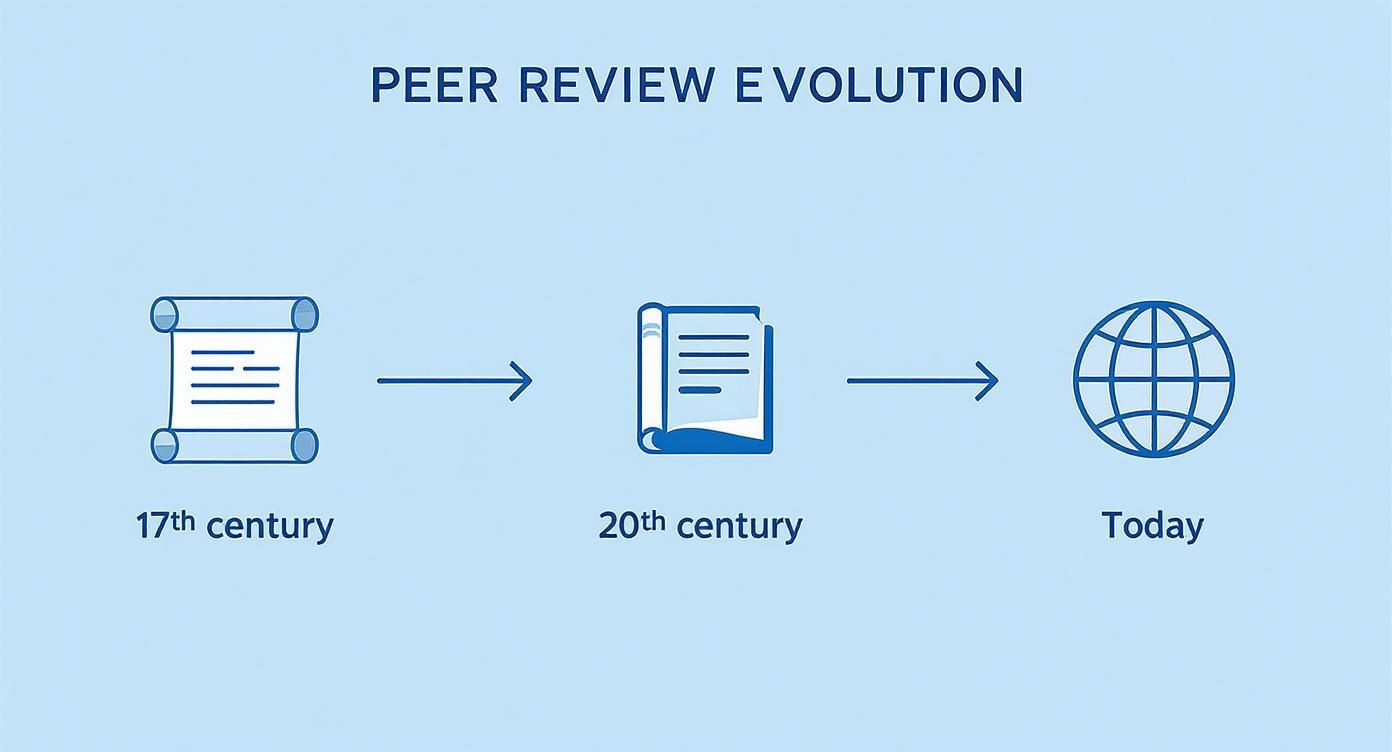
As you can see, what started as a localized, manual effort has become a highly structured, tech-driven global standard.
Stage 1: The Initial Editorial Screening
The manuscript's first stop isn't an expert reviewer—it's the journal's editorial team. This initial checkpoint, often called a desk review or editorial triage, acts as a crucial first filter.
The editor runs a quick assessment against a basic checklist. Does the paper actually fit the journal's scope? Is the research question interesting to their readers? Does it meet fundamental standards for formatting, language, and ethics?
It might surprise you to learn that a huge number of submissions, sometimes up to 30-50%, are rejected right here. This is known as a "desk reject," and it saves everyone a ton of time by preventing papers that are a poor fit from clogging up the full review pipeline.
A desk reject isn't always a comment on the quality of the research. More often than not, it just means the manuscript wasn't the right match for that specific journal's focus.
Stage 2: Finding the Right Reviewers
If a manuscript makes it past that first screening, the editor’s next job is to play matchmaker. They need to find and invite a handful of qualified experts—usually two or three—to conduct the formal peer review.
This is honestly one of the toughest parts of the job. It involves finding people with the perfect subject matter expertise who are also available and willing to volunteer their time.
Editors use a few common tactics to track down reviewers:
*   **Databases:** They'll search the journal's internal database of past reviewers and authors.
*   **References:** A clever trick is to scan the manuscript’s bibliography to find authors of cited works.
*   **Author Suggestions:** Some journals ask authors to suggest potential reviewers (and sometimes who to avoid).
Stage 3: The In-Depth Review and Decision
Once the reviewers accept the invitation, they get the manuscript and a deadline to submit their feedback. Their job is to evaluate the paper’s originality, methodological soundness, clarity, and overall contribution to the field.
This process is a lot like how a development team assesses new code. If you're curious about that world, you can check out our guide on pull request best practices.
After digging into the manuscript, reviewers submit confidential comments to the editor along with a recommendation. It usually falls into one of four buckets:
- Accept: The manuscript is good to go, maybe with a few tiny copyedits. This is the unicorn—it rarely happens on the first try.
- Minor Revisions: The paper is solid but needs some small clarifications or corrections before it can be accepted.
- Major Revisions: The paper has potential, but it needs substantial changes, like re-running data analysis or rewriting entire sections.
- Reject: The manuscript is found to have fundamental flaws or is just not suitable for publication in that journal.
Finally, the editor takes all the reviewer feedback, weighs the different opinions, and makes the final call. They then communicate that decision back to the author, along with the (usually anonymized) reviewer comments.
When it comes to peer review, it’s not a one-size-fits-all deal. Journals and conferences actually use a few different models, each with its own take on anonymity and transparency. If you've ever had two totally different review experiences, this is probably why.
Think of it like an audition. Does the judging panel see the performer? Does the performer know who the judges are? Or can everyone see each other? Each setup creates a different dynamic, and the same goes for scholarly review.
Let's break down the three most common approaches.
Single-Blind Review: The One-Way Mirror
In a single-blind review, the reviewers' identities are hidden from the author. The reviewers, however, know exactly who the author is. This has long been the traditional model and is still incredibly common, especially in many of the sciences.
The name of the game here is protecting the reviewer. The idea is that anonymity allows them to give truly frank, honest feedback without worrying about professional backlash. This is especially true if they're critiquing the work of a big name in their field.
But there's a pretty obvious downside: the potential for bias. A reviewer's judgment—whether they realize it or not—can be swayed by the author's reputation, where they work, their gender, or even their country of origin.
Double-Blind Review: The Closed-Door Audition
Double-blind review cranks up the anonymity by hiding everyone's identity. The author doesn't know who the reviewers are, and the reviewers don't know who the author is. Before a manuscript even goes out, all identifying information—names, affiliations, even funding sources—is scrubbed from the document.
This is the equivalent of a true "blind" audition, where the judges can only evaluate the performance itself. The goal is to put 100% of the focus on the quality of the research, not the person behind it.
This method is widely seen as the gold standard for cutting down on potential bias. By stripping away personal identifiers, the review is forced to stand on the scientific merit of the work alone.
Open Review: Putting Everything on the Table
The newest and most transparent model is open peer review. In its purest form, everybody knows who everybody is. Both the authors and the reviewers are identified, and it’s common for the review reports, author responses, and even earlier drafts to be published right alongside the final article.
This approach flips the script, turning the review from a private back-and-forth into a public, accountable conversation. It encourages reviewers to be more constructive and civil since their name is attached to their comments. For readers, it offers a fascinating peek behind the curtain at how the paper evolved.
Of course, understanding where peer review fits into the bigger picture of publishing is key. The nuances of traditional vs. self-publishing models show how these gatekeeping processes are deeply tied to specific industry frameworks.
Navigating the Challenges and Criticisms
While peer review is the bedrock of scholarly publishing, let's be honest—it's far from perfect. It's a system built on human judgment and volunteer effort, so it’s no surprise it’s facing some serious strain. The academic world is constantly trying to shore it up.
One of the biggest headaches is the sheer volume of research getting pumped out. The global output of scholarly articles has just exploded, putting a massive amount of pressure on a pretty small pool of qualified experts.
This leads directly to a problem everyone in the field knows all too well: reviewer fatigue.
It's getting harder and harder to find the right experts who have the time—and the willingness—to do a thorough review. The result? Frustratingly long waits that can delay important findings from being published for months, or even years.
The Problem of Bias and Gatekeeping
Beyond the simple logistics, peer review has to contend with the messy reality of human bias. Whether it’s conscious or not, a reviewer's personal opinions, where they work, or their preferred theories can color how they look at a manuscript.
This can create a "gatekeeping" effect. Reviewers might give a thumbs-up to research that fits neatly into what's already known, but get overly critical when something novel or disruptive comes along. This kind of conservatism can accidentally stifle innovation, making it tough for groundbreaking work to see the light of day.
This is a huge concern. A process designed to ensure quality shouldn't become a barrier to progress. Striking the right balance is a constant source of debate and reform.
The core challenge is balancing rigorous evaluation with an openness to new ideas. A peer review that only confirms what we already know is not serving its ultimate purpose of advancing knowledge.
The Strain of Interdisciplinary Work
Modern research just keeps getting more complicated, too. International collaborations are on the rise, and with them, the complexity of the research itself. Between 2015 and 2019, these kinds of partnerships grew from 22% to 24% of all published work, a clear trend toward studies that cross traditional academic lines. You can dig into this by exploring the findings on global research trends.
This creates a tricky situation for peer review. How do you find a single person with the right expertise to evaluate a paper that blends, say, computer science with sociology, or biology with engineering? These papers need reviewers with deep knowledge in one area and a broad understanding of others. It’s a similar challenge in other fields, too—a good code review checklist in software development, for example, has to cover multiple quality aspects at once.
These aren't just minor glitches in the system. Reviewer fatigue, bias, and the difficulty of evaluating interdisciplinary work are significant pressures. The academic and scientific communities are actively looking for solutions, exploring new models, better training, and even tech to help out. The conversation around improving the what is peer review process is far from over—and it's one we all need to be a part of.
Best Practices for Authors and Reviewers

Navigating the peer review process is a skill in itself, one that strengthens research whether you're on the giving or receiving end of feedback. For both authors and reviewers, a few key practices can make the whole experience more productive and professional.
If you’re the author, your job is to make your manuscript as easy to evaluate as possible. This isn't just about good science; it’s about clear presentation. A well-organized paper with easy-to-read figures lets reviewers focus on the substance of your work, not get bogged down by its structure.
Responding to feedback is just as important. It’s crucial to approach reviewer comments with an open mind, even if some of the criticism stings a little.
The best strategy is to address every single comment, one by one. You can either make the suggested change or write a polite, evidence-backed rebuttal explaining why you disagree. This shows you're thorough and respect the reviewer's time.
For the Author Preparing a Manuscript
To set your work up for a smooth review, focus on these key areas before you even think about hitting "submit":
*   **Follow Journal Guidelines Meticulously:** Pay close attention to formatting, word counts, and reference styles. Ignoring the rules is the fastest way to get a desk rejection before anyone even reads your work.
*   **Write a Compelling Cover Letter:** This is your elevator pitch to the editor. Briefly explain what your work adds to the field and why it's a great fit for the journal's audience.
*   **Self-Critique Your Work:** Put on your reviewer hat and read your own paper. Are your arguments clear? Is the methodology solid? Do the conclusions logically follow from the data?
For the Reviewer Providing Feedback
A great review is constructive, specific, and unbiased. Your role isn't just to find flaws—it's to help improve the paper. To provide genuinely helpful feedback, you need to be clear and offer actionable advice. While it's about code, the principles in our article on how to write clear PR feedback apply just as well here.
Remember to separate major conceptual issues from minor typos. Instead of just saying "the analysis is weak," explain why it's weak and suggest a better approach. This transforms criticism from a roadblock into a tool for growth, reinforcing the collaborative spirit that makes peer review work.
A Few Quick Questions About Peer Review
Even with a clear roadmap of the peer review process, some practical questions always pop up, especially for authors. Here are some quick answers to the most common ones.
How Long Does Peer Review Actually Take?
The timeline can be all over the map, ranging from a few weeks to well over a year. The biggest things that affect the timing are the journal you've submitted to, how easy it is to find qualified reviewers, and how many rounds of revisions your manuscript needs.
While some publications offer fast-track options for urgent research, you should generally expect a standard review cycle to last several months.
Can I Suggest My Own Reviewers?
Yes, and many journals actually encourage it. Suggesting your own reviewers is especially helpful if your research is in a niche or highly specialized field.
However, the editor always has the final say and isn't required to use your suggestions. It's critical that you only recommend experts who have no conflicts of interest—that means no recent collaborators or colleagues from your own institution.
What Happens if Reviewers Disagree?
Conflicting reviews are incredibly common, so don't be alarmed if it happens. When reviewers give opposing recommendations, the editor steps in as a moderator. They'll weigh the arguments from each side and use their own expertise to make a judgment call.
The editor's job is to synthesize all the feedback. They might even bring in a third or fourth reviewer to act as a tie-breaker before making a final decision on your manuscript.
Is It Possible to Appeal a Rejection?
Sometimes, but not always. Some journals have a formal appeals process, while many others don't.
An appeal is usually only considered if you can prove there was a major misunderstanding of your work or a serious procedural error by the journal. Simply disagreeing with the reviewers’ opinions isn't enough to warrant an appeal.
Streamline your team's code review workflow with PullNotifier. Stop chasing updates and get concise, real-time pull request notifications directly in Slack. Try PullNotifier for free.