- Published on
A Guide to Building Slack Apps That Work
- Authors

- Name
- Gabriel
- @gabriel__xyz
Building Slack apps is a fantastic way to automate tasks and bring your team's workflows directly into the place where they communicate every day. Instead of juggling a dozen different tools, you can create custom integrations that solve your specific problems, whether that's simplifying approvals or pulling real-time data from other services. The end goal? Keep work flowing inside Slack and boost your team's productivity.
Why Building Custom Slack Apps Is a Smart Move
Before we jump into the code, let's talk about why building a custom Slack app is such a powerful move. This isn't just about adding another shiny object to your tech stack; it’s about fundamentally changing how your team collaborates and gets things done.
Off-the-shelf solutions can be great, but they often make you bend your processes to fit their limitations. A custom app flips that script—it’s built to mold perfectly to your unique workflow.
Imagine your dev team needs to stay on top of pull requests from GitHub. Sure, there are existing integrations, but a custom app could filter notifications to show only what’s relevant, automatically tag the right reviewers based on who owns the code, and even post a daily summary of pending reviews. That level of precision cuts through the noise and keeps everyone focused.
For a good baseline, you can see how a polished, pre-built integration works in our guide on how to use the official GitHub Slack app.
Tailoring Solutions to Your Team's Pain Points
The real magic happens when you use a custom Slack app to tackle those specific, nagging bottlenecks that slow everyone down. Just think about the repetitive, manual chores your team deals with every single day.
*   **Automating Tedious Approvals:** An HR team drowning in expense reports could use a custom app. Employees could submit reports with a simple slash command, the app could automatically route them to the right manager, and then post a confirmation once it's approved—all without anyone leaving Slack.
*   **Centralizing Project Updates:** A project management team constantly bouncing between Slack, Jira, and Asana could have an app that fetches key ticket updates or project milestones and delivers them to a dedicated channel. Suddenly, everyone has a single source of truth.
Building a custom app means you stop forcing square pegs into round holes. Instead, you design a solution that perfectly fits the shape of your team's problems, reducing friction and saving countless hours.
The Strategic Business Advantage
This kind of customization gives you a serious strategic edge. Before getting into the nuts and bolts of building an app, it's worth understanding the broader advantages of custom software development compared to off-the-shelf products. It gives you a great perspective on why this approach is so effective.
Custom apps slash context switching—that mental tax of jumping between different applications—which is a well-known productivity killer.
This is especially powerful when you consider Slack's massive reach. The platform has over 42 million daily active users globally and is trusted by giants like IBM and Amazon. When you build for this ecosystem, you're creating a tool that lives where your team already spends its time, which naturally leads to higher adoption and engagement.
By first establishing a clear 'why,' the 'how'—which we’ll get into next—becomes a much more compelling journey.
Here's a quick look at the benefits you can expect when you decide to build a custom Slack app.
Key Benefits of Custom Slack App Development
| Benefit | Impact on Your Team | Example Use Case |
|---|---|---|
| Perfect Workflow Fit | No more workarounds. The app is built exactly for your processes. | An app that mirrors your unique multi-stage content approval process. |
| Reduced Context Switching | Keeps team members focused by bringing tasks and data into Slack. | Pulling sales analytics from Salesforce directly into a #sales-updates channel. |
| Increased Automation | Eliminates repetitive, manual tasks that drain time and energy. | A slash command to provision a new testing environment for a developer. |
| Higher Adoption Rates | Teams are more likely to use a tool that lives where they already work. | Rolling out a new feedback tool as a Slack app instead of a separate web portal. |
Ultimately, investing in a custom Slack app is about creating a more efficient, focused, and integrated work environment for your team.
Setting Up Your Development Environment
Before you write a single line of code, you need a solid development environment. Getting this right from the start is crucial because it ensures your app can talk to Slack’s servers, handle permissions correctly, and scale later without a complete overhaul.
Your first stop is the Slack API dashboard. This is your command center for registering the app and telling Slack what it is and what it needs to do. Just click "Create New App," give it a descriptive name that users will see, and you're off to the races.
Here’s a quick look at the dashboard where your journey begins.
This is where you'll manage everything—from permissions and event subscriptions to eventually distributing your app in the App Directory.
Understanding Scopes and Permissions
One of the most common hurdles for newcomers is getting a handle on OAuth scopes. Think of scopes as permissions you request from a user's workspace. Your app can't do anything—not even post a message—without the right scope.
The golden rule here is the principle of least privilege. Only ask for what your app absolutely needs. If your app just posts daily standup reminders, it only needs the chat:write scope. Requesting unnecessary permissions like channels:read or users:read will make users think twice before installing it.
Here are a few essential scopes you'll probably run into:
*   `commands`: Lets your app register and respond to slash commands (like `/kudos`).
*   `chat:write`: Grants permission to post messages in channels where the app has been added.
*   `im:write`: Needed for sending direct messages to users.
*   `app_mentions:read`: Allows your app to listen for when it's mentioned in a channel.
You can always add more scopes later as you add features. It's much better to start small and add permissions as you need them.
Bot Tokens vs. User Tokens
Once your scopes are configured, you'll be working with tokens, which are basically passwords for your app. There are two main types, and knowing the difference is critical.
*   **Bot Tokens (`xoxb-`)**: These are tied to the app itself, letting it act as a distinct bot user. They're the most common and are perfect for automated tasks like sending notifications because they don’t depend on a specific user's account.
*   **User Tokens (`xoxp-`)**: These tokens act on behalf of the user who installed the app. You’d use these when your app needs to perform actions with that user's permissions, like creating a channel or accessing their private files.
For most custom apps focused on automation, the Bot Token is what you'll use 95% of the time. It ensures your app keeps running consistently, even if the person who installed it leaves the company.
Setting Up a Local Node.js Server with Bolt
Alright, time to get your local coding environment ready. You can use any language, but we'll stick with Node.js and Slack's Bolt framework. Bolt is a lifesaver—it handles the tricky parts of the Slack API, like request verification and event routing, so you can focus on building your app's logic.
First, create a new project directory, initialize a Node.js project, and install the Bolt package.
npm install @slack/bolt
This single package gives you everything you need to listen for events, respond to commands, and interact with the Slack API. Starting your project with Bolt will make it much easier to expand later on.
Exposing Your Local Server with Ngrok
So, your app is running on your local machine, but Slack's servers are out on the internet. How do they talk to each other? The answer is a tunneling service like ngrok.
Ngrok creates a secure, public URL that forwards requests from the internet directly to your local development server. This is absolutely essential for live testing. Without it, you wouldn't be able to receive slash command requests or event notifications from Slack.
After installing ngrok, you run one simple command to expose the port your app is running on (usually 3000 for Node.js apps).
ngrok http 3000
Ngrok will spit out a public HTTPS URL. You’ll copy this and paste it into the "Request URL" fields in your app's settings on the Slack API dashboard. Now, when something happens in Slack, its servers can send the data straight to your local machine, bringing your development environment to life.
Coding Your First Interactive App with Bolt
Alright, you've got your dev environment set up. Now for the fun part: writing the code that actually makes your app do something. We're going to build a "Daily Kudos Bot" from scratch, which is a perfect way to get your hands dirty with the core concepts of building for Slack.
The idea is simple but powerful. A user will type a slash command, /kudos, which pops open a window (what Slack calls a modal). From there, they can pick a teammate, write a quick note of appreciation, and hit submit. Our app will then take that info, format it into a nice-looking message, and post it in a public channel for everyone to see.
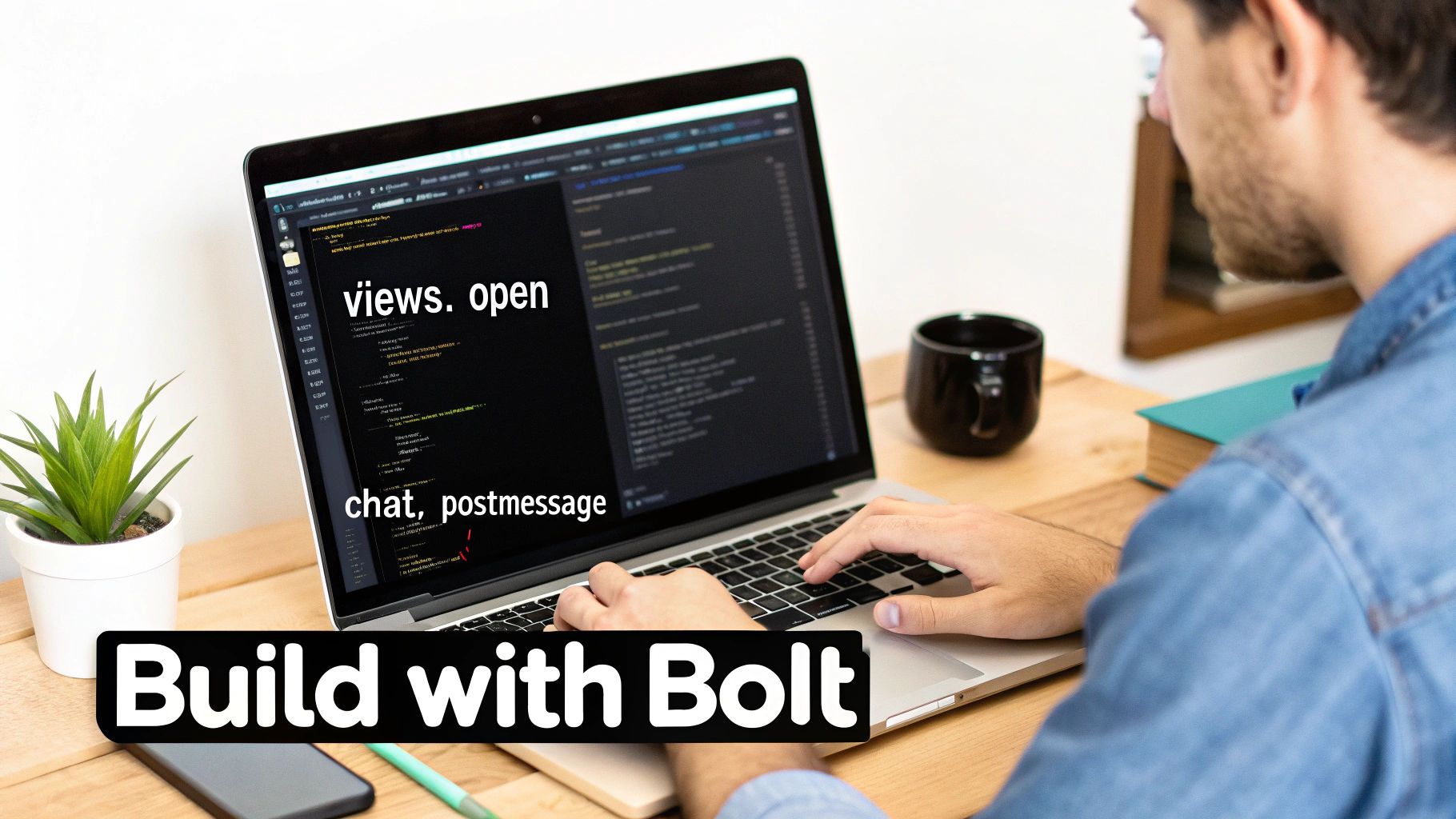
This single workflow touches on three fundamental pieces of almost any interactive Slack app:
*   Listening for user actions (like a slash command).
*   Displaying dynamic interfaces (the modal).
*   Posting messages back into a channel.
Get these down, and you can build almost anything.
Listening for Slash Commands
Our Kudos Bot's journey starts with a slash command. In a Bolt app, you just need to set up a listener that waits for the /kudos command. Bolt's syntax makes this surprisingly clean.
When someone types /kudos and hits enter, Slack fires off a data payload to your app's request URL. Tucked inside that payload is a unique trigger_id, which is basically a temporary ticket you need to open a modal for that specific user.
Here’s what the code for that listener looks like:
// Listen for the /kudos slash command
app.command('/kudos', async ({ ack, body, client }) => {
  // Acknowledge the command request from Slack
  await ack();

  // Use the trigger_id from the payload to open a modal
  try {
    const result = await client.views.open({
      trigger_id: body.trigger_id,
      // The modal's view definition goes here
    });
  } catch (error) {
    console.error(error);
  }
});
That ack() function is non-negotiable. You have to acknowledge Slack's request within 3,000 milliseconds, otherwise the user gets a timeout error. Bolt handles all the complexity here, just call the function and you're good.
Opening an Interactive Modal with Block Kit
Once you've grabbed the trigger_id, you can pop open a modal using the views.open API method. The entire layout and content of this modal is defined using Block Kit, Slack's own UI framework. It gives you a bunch of components like text inputs, dropdowns, and date pickers to build rich interfaces.
For our Kudos Bot, the modal needs just two things:
- A user-select dropdown so you can pick who gets the kudos.
- A multi-line text box for writing the actual message.
Think of Block Kit as a set of LEGO bricks for building interfaces inside Slack. You combine different blocks—like inputs, dividers, and text sections—to create a clean, native-looking experience for the user. It’s way more engaging than a bot that just spits back plain text.
It's important to give each input block a unique block_id and action_id. This is how you'll identify and grab their values after the user submits the form.
Handling Modal Submissions
When the user fills out the modal and clicks "Submit," Slack sends another payload to your app. This time, it's a view_submission event, and we need a listener to catch it.
The payload from a view_submission helpfully contains all the form values, neatly organized by the block_id and action_id you set earlier. This makes it a breeze to pull out the selected user and the kudos message.
A listener for the submission would look something like this:
// Listen for the submission of our kudos modal
app.view('kudos_modal', async ({ ack, body, client }) => {
  // Acknowledge the submission
  await ack();

  // Extract values from the form
  const user = body.user.id;
  const targetUser = body.view.state.values.user_block.user_action.selected_user;
  const message = body.view.state.values.message_block.message_action.value;

  // Now, post the kudos message to a channel
});
See how you can drill down into the body.view.state.values object? It lets you grab exactly what you need with no fuss.
Posting a Message to a Channel
The final piece of the puzzle is taking the data from the modal and sharing it with the team. For this, we'll use the chat.postMessage API method to send a formatted message to a channel like #general or a dedicated #kudos channel.
This is another chance to use Block Kit to make the message pop. Instead of just plain text, you can design a custom "card" that clearly lays out who sent the praise, who received it, and the message itself.
The logic here involves a few final steps:
*   Constructing the Block Kit JSON for the message you want to post.
*   Grabbing the ID of the channel you want to post in.
*   Calling `chat.postMessage` with your bot token and the message payload.
This creates a public record of positive feedback and helps build a great team culture. It's these kinds of mission-critical apps, handling potentially sensitive internal comms, that explain why 77 of the Fortune 100 companies use Slack. The platform's security and enterprise-ready infrastructure make it a place businesses trust. You can find more stats on Slack's enterprise adoption on businessdasher.com.
And that’s it! By building this little Kudos Bot, you've just walked through the entire interactive loop for a Slack app. You now know how to listen for triggers, show users a dynamic interface, and respond with rich, useful messages. This foundational pattern is the key to unlocking countless other powerful apps you can build.
Alright, let's move beyond a bot that just talks at you. A static message is fine, but a message users can actually interact with? That’s where the magic happens. We're going to upgrade our Kudos Bot by adding a simple "Like" button to each message, letting teammates pile on the praise.
This might seem like a small tweak, but it unlocks a fundamental concept in Slack app development: handling real-time user interactions that modify existing content. This post, interact, and update loop is the backbone of tons of powerful workflows, from quick polls to formal approval systems.
Responding to User Actions with Block Actions
Whenever someone clicks a button or messes with any interactive element in your app's messages, Slack fires off a block_actions event your way. Our job is to catch this specific event, figure out which button was clicked, and then do something about it.
The Bolt framework makes this incredibly simple. You just set up a listener that hones in on the action_id you gave your "Like" button. This ensures your code only kicks into gear for that specific button, not every single interactive bit you might add later.
Let's say you added a button with an action_id of like_button. Your listener in Bolt would look something like this:
app.action('like_button', async ({ body, ack, client }) => {
  // Acknowledge the action right away
  await ack();

  // Logic to update the message goes here...
});
Don't forget to call ack() immediately. It's a non-negotiable step to tell Slack, "Yep, got it!" This prevents the user from seeing a nasty timeout error on their end.
Updating Messages in Real Time
Once you've caught that button click, the next move is to update the original kudos message to show the new "like." This is where the chat.update API method shines. It lets your app modify a message that's already been posted, which is a much cleaner experience than spamming the channel with new messages.
To make chat.update work, you'll need three key pieces of info from the block_actions payload Slack sends you:
*   The `channel.id` where the message is located.
*   The `message.ts` (timestamp), which is the message's unique ID.
*   The original `blocks` from the message, which you're about to change.
Your code will need to dig into the original message blocks, find the part that shows the like count, bump it up by one, and then call chat.update with the newly modified blocks. This creates a really fluid experience where users see the count tick up instantly.
This pattern of updating a message based on an interaction is a total game-changer. It transforms your app from a simple notification machine into a dynamic, stateful application that truly lives inside a Slack channel.
This same idea can be applied to more technical integrations. For teams managing development workflows, a similar button could trigger a build or kick off a deployment. We explore this concept further in our guide to GitLab Slack integration, which shows how to bring CI/CD updates directly and interactively into your channels.
Building a Persistent App Home
Channel messages are awesome for public shout-outs, but sometimes users need a private space to interact with your app. That's exactly what the App Home is for. It's a personal, dedicated tab that shows up when a user clicks on your app in their Slack sidebar.
We can leverage the App Home to give each user a personalized dashboard of all the kudos they've ever received. This adds a ton of value and keeps people coming back to your app.
To get this working, you'll need to listen for the app_home_opened event, which, as you might guess, fires every time a user clicks into your app's home tab.
Publishing a Dynamic App Home View
When that app_home_opened event comes in, your app's mission is to grab the right data for that user—in our case, all their kudos—and use the views.publish API method to display it.
Here’s the breakdown of how it works:
- Listen for
app_home_opened: This is your trigger. It tells you who is looking. - Fetch User-Specific Data: You’ll need a way to store and look up kudos. A simple database or even an in-memory store will do the trick for this example.
- Construct a Block Kit View: Design the App Home layout using Block Kit. You can dynamically create blocks for each piece of kudos a user has received.
- Call
views.publish: This method takes theuser_idand your freshly built Block Kit view and pushes it to that user's App Home.
This approach makes sure every user gets a view that’s tailored just for them. It’s a powerful way to offer personalized value that goes way beyond public channel messages, making your app an essential part of their Slack experience. Features like these are what separate a simple bot from a truly integrated Slack application.
Deploying Your App for Production
An app running on your local machine with ngrok is perfect for development, but it’s not a real solution. To make your app reliable and available 24/7, you need to ship it to a production environment. This is the step that turns your project from a cool experiment into a dependable tool your team can actually count on.
Going to production means picking a hosting provider, tightening up security, and getting your app ready for the realities of live traffic. It's the final—and most critical—phase in building a Slack app that delivers real value.
Choosing Your Hosting Environment
When it comes to hosting, you’ve got a few paths you can take. But for a typical Slack app, serverless platforms often provide the best balance of cost, scalability, and ease of management.
Serverless computing is a natural fit for the event-driven nature of Slack apps. Instead of paying for a server to idle around waiting for something to happen, you only pay when your code actually runs in response to an event, like a slash command or a button click.
Let's look at a few of the most popular choices:
*   **AWS Lambda**: A leading serverless platform where you upload your code as "functions" that get triggered by events. It's incredibly scalable and cost-effective for apps with unpredictable traffic.
*   **Google Cloud Functions**: A direct competitor to Lambda, it offers a similar pay-as-you-go model and plugs right into other Google Cloud services.
*   **Heroku or Render**: These are Platform-as-a-Service (PaaS) providers that make deployment dead simple. You just push your code, and they handle the servers, scaling, and infrastructure. They're a bit pricier but offer a fantastic developer experience.
For most Slack apps, starting with a serverless option like AWS Lambda is the smartest move. The cost is often negligible for low-traffic apps, and the platform automatically scales to handle sudden bursts of activity without you lifting a finger.
Securing Your Slack Tokens and Secrets
This part is non-negotiable. Never, ever commit your Slack tokens, signing secrets, or any other credentials directly into your code or a version control system like Git. Exposing these secrets is like leaving the keys to your house on the front door.
The industry-standard practice is to use environment variables. These variables live outside your application code and are supplied by your hosting environment when the app starts.
Every hosting provider has a way to manage them:
- You'll find a section in your hosting dashboard (like AWS Lambda's configuration settings or Heroku's "Config Vars").
- Define your key-value pairs, such as
SLACK_BOT_TOKENand its correspondingxoxb-...value. - Your code then reads these values using
process.env.SLACK_BOT_TOKENin Node.js.
This simple practice keeps your sensitive credentials completely separate from your codebase, dramatically improving your app's security. For even more robust security, you can look into dedicated secret management services like AWS Secrets Manager or HashiCorp Vault.
Maintaining a Healthy Production App
Getting your app live is just the beginning. A production app needs care and attention to run smoothly over the long haul. You need to anticipate problems and handle them gracefully to provide a good user experience.
Robust error handling is crucial. Wrap your API calls and event handlers in try...catch blocks to prevent your entire app from crashing if a single request fails. Log these errors to a monitoring service so you can diagnose and fix issues without digging through server logs.
Another key aspect is managing API rate limits. Slack enforces limits on how many API calls you can make in a given period. If your app gets popular, you could hit these limits, causing requests to fail. The Bolt framework has some built-in logic to handle this, but you should always be mindful of making API calls efficiently.
Finally, think about automation. Setting up a CI/CD pipeline is a great way to streamline updates. For example, you can learn about using GitHub Actions to send Slack notifications to your team when a new deployment is successful, keeping everyone in the loop.
If you plan to share your app publicly, you'll need to submit it to the Slack App Directory. This involves a review process where Slack checks your app for security, user experience, and functionality. Make sure your app has a clear privacy policy, support information, and follows all of Slack’s guidelines before you submit.
Got Questions About Building Slack Apps?
Building your first few Slack apps always brings up some questions. It's just part of the process. I've pulled together some of the most common ones I hear to help you sidestep a few hurdles and make smarter choices from the start.
Bolt vs. The Slack Web API: What's The Difference?
Think of the Slack Web API as the raw engine. It’s a straight-up collection of HTTP endpoints you can hit to do things like send a message with chat.postMessage or pop open a modal using views.open. When you use it directly, you're in charge of everything—authentication, request verification, the works.
Bolt, on the other hand, is the slick, fully-equipped car built around that engine. It's Slack's official framework that handles all the tedious boilerplate for you. Things like verifying requests and routing events are just done. Using Bolt means you can jump straight into writing the fun logic for your app instead of wrestling with raw HTTP calls. It massively speeds up development and cuts down on silly mistakes.
The Web API gives you raw power and total control, but Bolt gives you a faster, more efficient path to building a solid app. For almost everyone, starting with Bolt is the way to go.
How Should I Handle Scopes and Permissions?
This one's simple: stick to the principle of least privilege. Only ask for the permissions your app absolutely needs to do its job. If all your app does is post messages to a channel, just ask for chat:write. That's it.
You set these permissions, which Slack calls scopes, in your app's "OAuth & Permissions" dashboard. It's tempting to ask for a bunch upfront "just in case," but that's a huge red flag for users and can scare them away from installing your app. It's far better to start lean and only add new scopes when you build a feature that genuinely requires them.
Can I Test My App Without Pushing it to a Server?
You bet. The standard way to develop Slack apps is to run them on your local machine and use a tunneling service like ngrok. What ngrok does is create a secure, public URL that points directly to your local development environment.
This setup is a lifesaver for real-time testing. You can trigger slash commands, click buttons, and respond to events in your actual Slack workspace, and the requests will hit the code running on your laptop. This lets you build and debug in a super-fast, iterative loop without having to deploy every single tiny change.
What Are The Most Common Mistakes I Should Avoid?
A few classic mistakes trip up almost every new Slack app developer. Steer clear of these, and you'll save yourself a world of pain.
*   **Asking for too many permissions upfront:** It kills user trust before you even get started. Start small.
*   **Ignoring API rate limits:** Your app might work fine with one user, but it can easily crash and burn under heavy use if you're not mindful of how many API calls you're making.
*   **Hardcoding your secret tokens:** Never, ever put tokens directly in your code. Use environment variables to keep them safe and sound.
*   **Giving users the silent treatment:** Always let the user know if their command worked or if it failed. A silent failure is just a terrible user experience.
Stop letting noisy pull request notifications disrupt your team's workflow. PullNotifier integrates seamlessly with GitHub and Slack to deliver clear, consolidated updates that accelerate your code review process. Learn more and start your free trial at PullNotifier.