- Published on
10 release management steps for flawless deployments
- Authors

- Name
- Gabriel
- @gabriel__xyz
Shipping software can feel like navigating a minefield. One wrong move can trigger downtime, introduce critical bugs, or derail a product launch, leaving engineering teams scrambling and users frustrated. The difference between a smooth, successful deployment and a chaotic, stressful "fire drill" is a structured, repeatable release process. A well-defined blueprint for shipping code is no longer a luxury for large enterprises; it's a fundamental requirement for any team aiming for high-velocity, reliable software delivery.
This guide provides a comprehensive breakdown of the essential release management steps that transform deployments from risky ventures into predictable, routine events. We will move beyond high-level theory and dive deep into a practical, ordered checklist designed for modern software teams. You will learn how to meticulously plan releases, implement robust testing and validation, orchestrate deployments with precision, and establish effective post-release monitoring and feedback loops.
We will cover ten critical stages, from initial strategy and planning to post-deployment retrospectives. Each step includes actionable insights and real-world examples to help you implement these practices within your own workflows. We’ll also highlight key opportunities for automation, including integrating tools like PullNotifier into your CI/CD pipeline to streamline communication and approvals. By the end of this article, you will have a clear, actionable framework for building a world-class release machine that ships quality software faster, safer, and with greater confidence. Let's get started.
1. Release Planning and Strategy: Your Blueprint for Success
Effective release management begins long before any code is deployed. The release planning and strategy phase is the foundational blueprint that guides the entire process, ensuring every action aligns with business objectives and stakeholder expectations. This initial step among all release management steps involves defining the release's scope, objectives, timeline, and required resources. It’s where you decide what features will be delivered, when they will arrive, and how you will measure a successful outcome.
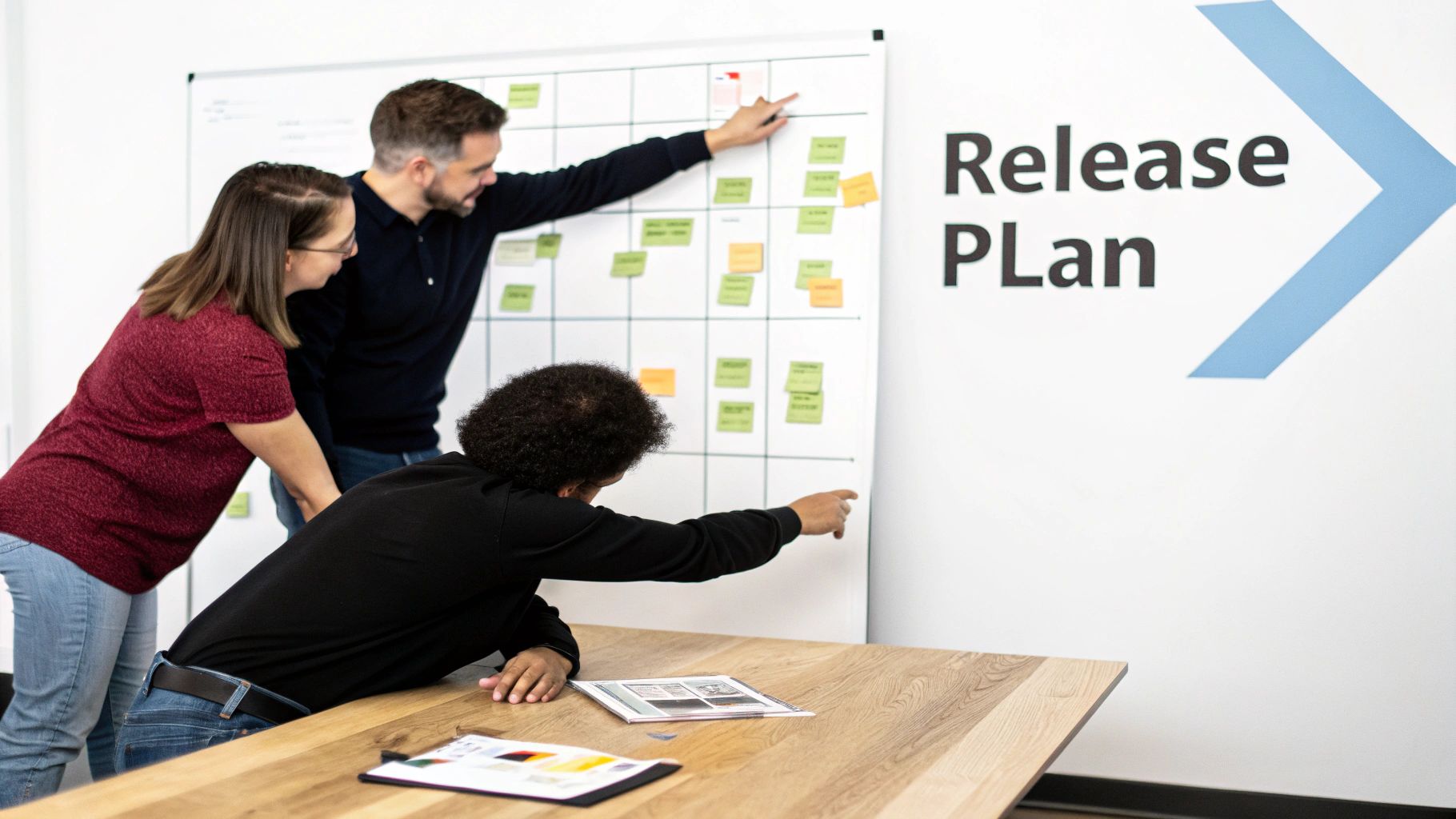
This process isn’t just about creating a schedule; it's a strategic alignment exercise. It brings together product, engineering, and operations teams to prioritize features based on user value and technical feasibility. A well-documented plan, popularized by frameworks like ITIL and agile methodologies, prevents scope creep and ensures everyone shares a common vision.
Key Activities in Release Planning
*   **Stakeholder Alignment:** Conduct workshops to gather requirements and secure buy-in from all key stakeholders, including business leaders, product managers, and customer support teams.
*   **Risk Assessment:** Proactively identify potential risks, such as technical dependencies, resource constraints, or market changes. For extensive releases involving system changes, consulting a detailed [digital platform migration checklist](https://www.kogifi.com/articles/digital-platform-migration-checklist-12-critical-steps) can significantly enhance your release planning and strategy.
*   **Resource Allocation:** Confirm the availability of developers, QA testers, and infrastructure needed to execute the plan successfully.
*   **Success Metrics:** Define clear Key Performance Indicators (KPIs), such as adoption rate, system performance improvements, or reduction in support tickets, to measure the release's impact.
Think of how industry leaders manage their releases. Salesforce announces its quarterly release cycles with specific feature sets, giving customers a clear roadmap. Similarly, Google Chrome’s frequent, predictable releases are built on a transparent planning process that manages user expectations and delivers incremental value. This strategic foresight transforms a release from a technical task into a powerful business driver.
2. Build and Compilation: Forging Code into Deployable Artifacts
Once your release plan is set, the next critical step is transforming source code into a functional, deployable product. The build and compilation phase is the assembly line of your software factory. This process involves automatically compiling source code, running initial checks, and packaging everything into consistent, executable artifacts like binaries, JAR files, or Docker containers. It’s where theoretical code becomes a tangible asset, ready for testing and deployment.
This stage, heavily influenced by Continuous Integration (CI) pioneers like ThoughtWorks and Martin Fowler, is no longer a manual task. Automated build systems ensure that every commit triggers a consistent, reproducible build, eliminating "it works on my machine" issues. This automation is foundational to modern release management steps, providing the rapid feedback necessary for agile development and ensuring every artifact is created under the same controlled conditions.
Key Activities in Build and Compilation
*   **Automated Build Triggers:** Configure your CI server (like Jenkins, GitLab CI, or GitHub Actions) to automatically start a build process upon every code commit to the main development branch.
*   **Dependency Management:** Implement dependency caching to drastically reduce build times by storing and reusing previously downloaded libraries and packages.
*   **Artifact Versioning:** Automatically version and tag every build artifact with unique identifiers and metadata, such as the commit hash and build timestamp, for clear traceability.
*   **Containerization:** Use tools like Docker to package the application and its dependencies into a standardized container, ensuring environmental consistency from development to production. For a deeper dive into optimizing this process, see this guide on [how to create reusable GitHub Actions](https://blog.pullnotifier.com/blog/how-to-create-reusable-github-actions-in-2025).
A prime example is Netflix's sophisticated build pipeline, which handles thousands of builds daily, ensuring reliability at scale. Similarly, GitLab CI leverages containerized build environments to isolate dependencies and produce clean, predictable artifacts for its own platform. By automating this crucial step, teams guarantee that the assets moving to the testing phase are stable, consistent, and ready for validation.
3. Testing and Quality Assurance: The Guardian of Quality
A release plan is only as good as the quality of the product it delivers. The testing and quality assurance (QA) phase is the critical checkpoint that validates the release against rigorous standards, ensuring it is stable, secure, and meets user expectations. This step in the release management steps is a comprehensive process involving various types of tests, from granular unit tests on individual code components to broad user acceptance testing (UAT) with end-users. It is the final gate before deployment, designed to catch defects and prevent them from impacting customers.
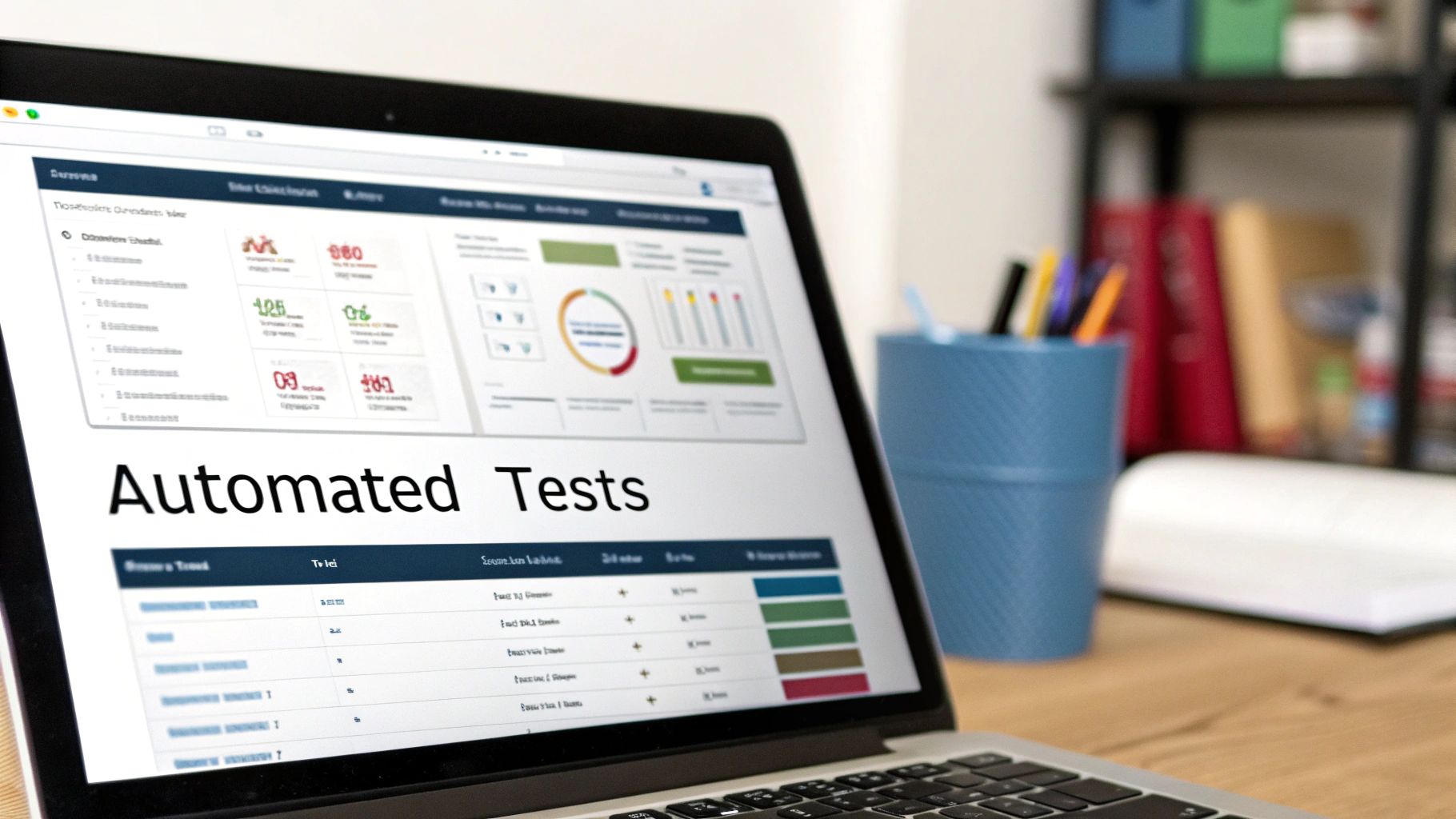
Modern QA is not a siloed, end-of-cycle activity but an integrated part of development. Practices like Test-Driven Development (TDD), pioneered by Kent Beck, and the "shift-left" principle advocate for testing early and often. This approach embeds quality into the entire software development lifecycle, reducing the cost and complexity of fixing bugs discovered late in the process.
Key Activities in Testing and QA
*   **Automated Test Execution:** Run automated test suites covering unit, integration, and end-to-end scenarios to get fast feedback. These tests should be a core part of your CI/CD pipeline.
*   **Manual and Exploratory Testing:** Conduct manual testing for complex user workflows, usability, and areas not easily covered by automation. This human-centric approach uncovers edge cases that scripts might miss.
*   **Performance and Security Audits:** Stress-test the application to ensure it can handle expected load and perform security scans to identify vulnerabilities before they reach production. To learn more about the specifics, check out this [guide to the quality assurance testing process](https://blog.pullnotifier.com/blog/a-guide-to-the-quality-assurance-testing-process).
*   **User Acceptance Testing (UAT):** Involve key stakeholders or end-users to validate that the new features meet business requirements and provide the intended value in a real-world context.
Think of how Adobe ensures the reliability of its Creative Cloud suite. Its comprehensive QA pipeline includes millions of automated tests that run continuously, providing immediate feedback on every code change. Similarly, Amazon's distributed microservices architecture relies heavily on automated testing to ensure that changes to one service do not adversely affect the entire ecosystem. This rigorous commitment to quality is what makes a successful release possible.
4. Staging and Pre-Production Validation: Your Final Dress Rehearsal
After development and initial testing, the release candidate moves to a crucial phase: staging and pre-production validation. This step involves deploying the release to an environment that mirrors the live production system as closely as possible, from infrastructure and configurations to data volumes. It serves as the final dress rehearsal, allowing teams to validate performance, functionality, and stability under realistic conditions before impacting actual users. This is one of the most critical release management steps for mitigating deployment risk.
This environment is not just for catching bugs; it’s for uncovering hidden issues related to configuration drift, data migrations, or performance bottlenecks that only appear at scale. Popularized by DevOps practitioners and the Infrastructure-as-Code (IaC) movement, a robust pre-production environment ensures that what works on a developer's machine will also work for millions of users in production.
Key Activities in Staging and Validation
*   **Environment Parity:** Use IaC tools like Terraform or CloudFormation to maintain a staging environment that is an exact replica of production, including network rules, hardware specs, and software versions.
*   **Production Data Simulation:** Load the staging environment with anonymized production data to test database migrations, queries, and performance with realistic data volumes and patterns.
*   **Full-Scale Testing:** Conduct a comprehensive suite of tests, including integration, performance, load, and security testing, to validate the release against production-level expectations.
*   **Monitoring and Baselining:** Implement the same monitoring and alerting tools used in production to establish performance baselines and ensure observability is working correctly before the go-live.
Consider how major tech companies rely on this step. Netflix simulates real-world traffic patterns in its complex staging environment to ensure a new feature can handle its massive global user base. Similarly, banking systems utilize extensive pre-production environments to validate releases against strict regulatory and security compliance requirements before any financial data is touched. This rigorous validation transforms the final deployment from a leap of faith into a confident, controlled process.
5. Release Notes and Documentation: Communicating What's New
A release isn't truly complete until its changes are clearly communicated. The creation of comprehensive release notes and documentation is a critical step that bridges the gap between the technical teams who built the product and the end-users who will interact with it. This phase is about crafting clear, accessible communication artifacts that detail what's new, what has changed, and what users need to know. It’s where you translate complex development work into tangible value for customers, support staff, and internal teams.
This process is far more than an afterthought; it’s a core component of a successful release. Well-crafted documentation prevents confusion, reduces the load on support teams, and drives adoption of new features. By clearly outlining changes, known issues, and upgrade instructions, you empower users and ensure a smooth transition, solidifying trust and transparency.
Key Activities in Documentation
*   **Audience-Centric Content:** Tailor documentation for different personas. Create high-level, benefit-focused release notes for end-users and detailed technical guides with API changes for developers.
*   **Drafting During Development:** Avoid the last-minute scramble by writing release notes and documentation iteratively as features are completed. This "documentation-driven development" approach ensures accuracy and reduces pre-release stress.
*   **Clear Impact Highlighting:** Explicitly call out breaking changes, deprecations, or critical security updates. Use clear visual cues like bold text or callout boxes to draw attention to essential information.
*   **Versioning and Accessibility:** Ensure all documentation is versioned and stored alongside the release artifacts. Make it easily accessible through your product, website, or developer portal.
Consider the meticulous release notes for Apple's iOS updates, which clearly articulate new features for a massive, non-technical audience. On the other end of the spectrum, the Linux kernel release notes offer exhaustive technical detail for developers. Similarly, AWS provides extensive documentation and migration guides with every service update. These examples show how effective communication is a non-negotiable part of modern release management steps, turning a deployment into a well-understood and valuable event.
6. Deployment and Release Execution
This is the moment of truth in the release management process: deploying the new build into the live production environment. The deployment and release execution phase involves moving the approved code from staging to production, which includes infrastructure provisioning, running database migrations, applying configuration changes, and initializing services. It is the culmination of all prior release management steps, transitioning a thoroughly tested release package into a live service for end-users.

This step can range from a fully automated, single-click action to a highly coordinated manual effort, depending on the system's complexity and the organization's maturity. The core goal is to perform this transition smoothly, predictably, and with minimal disruption to users. A well-executed deployment minimizes risk and ensures the value planned in the initial stages is successfully delivered.
Key Activities in Deployment and Execution
*   **Infrastructure Provisioning:** Use Infrastructure as Code (IaC) tools like Terraform or CloudFormation to ensure production environments are consistent, repeatable, and version-controlled.
*   **Progressive Deployment Strategy:** Implement techniques like blue-green deployments, canary releases, or feature flagging to gradually expose the new version to users, limiting the blast radius of any potential issues.
*   **Automated Deployment Pipelines:** Leverage CI/CD tools to automate the entire deployment workflow, from building the artifact to running final health checks, reducing the chance of human error.
*   **Incident Response Readiness:** Ensure that monitoring dashboards are active and the incident response team is on standby to immediately address any anomalies detected during or after the deployment.
Tech giants exemplify mastery in this area. Amazon's highly sophisticated internal deployment systems enable thousands of deployments per day with minimal impact, while Etsy is renowned for its pioneering use of continuous deployment and robust monitoring. These practices, popularized by the DevOps community and leaders at companies like Netflix, demonstrate that a disciplined, automated approach to deployment transforms it from a high-stakes event into a routine, low-risk business operation.
7. Monitoring and Observability: Your Eyes on Production
Deployment isn't the finish line; it’s the starting line for observing how your release performs in the real world. This step in the release management steps focuses on monitoring system health and performance while observability provides the deeper context needed to understand why the system behaves the way it does. Monitoring tells you when something is wrong, while observability helps you ask new questions to find out why. Together, they ensure issues are detected, diagnosed, and resolved rapidly before they impact users.
This practice, heavily championed by Google's Site Reliability Engineering (SRE) teams, shifts the focus from passive "is it up?" checks to active, intelligent system analysis. It involves collecting and correlating metrics, logs, and traces to build a complete picture of your application's state. Without this visibility, teams are flying blind, relying on customer complaints to discover problems rather than proactively identifying them.
Key Activities in Monitoring and Observability
*   **Establish Baselines:** Before deploying, capture baseline performance metrics. This allows you to accurately measure the new release's impact on system health and user experience.
*   **Implement Comprehensive Tooling:** Utilize tools like Datadog, New Relic, or open-source solutions like Prometheus and Grafana to collect telemetry data across your infrastructure and application layers.
*   **Set Intelligent Alerts:** Configure alerts based on user impact (e.g., increased error rates, high latency) rather than simple resource thresholds. Integrating these alerts with your communication tools is crucial; you can [use GitHub Actions to send Slack notifications](https://blog.pullnotifier.com/blog/using-github-actions-to-send-slack-notifications) to ensure the right team is notified instantly.
*   **Create Dashboards:** Build and share dashboards that visualize key business and technical metrics, providing a single source of truth for the release's performance.
Think of how Netflix uses sophisticated monitoring to ensure a seamless streaming experience for millions globally. Their systems detect and route around issues in real-time, often before users even notice a problem. This level of insight transforms post-deployment from a period of anxiety into a data-driven opportunity for continuous improvement and validation.
8. Incident Response and Issue Resolution
Even with the most robust testing and monitoring, post-release incidents are an inevitable reality. Effective incident response and issue resolution is a critical step in the release management process that minimizes downtime, protects the user experience, and maintains business continuity. This phase is not about preventing all failures but about responding to them swiftly, efficiently, and systematically when they occur. It involves a prepared set of procedures for identifying, triaging, escalating, and resolving issues as soon as they are detected.
This process transforms chaos into a structured, coordinated effort. Rather than a frantic, ad-hoc scramble, a well-defined incident management plan provides clear roles, communication channels, and technical protocols. Popularized by Google's SRE culture and embodied by tools like PagerDuty and Incident.io, this approach turns every incident into a learning opportunity, strengthening the system against future failures.
Key Activities in Incident Response
*   **Establish Severity Levels:** Define clear, documented severity levels (e.g., SEV-1 to SEV-4) that dictate the urgency, required responders, and communication protocols for any given issue.
*   **Create Response Playbooks:** Develop step-by-step runbooks for common and high-risk failure scenarios. These guides should detail diagnostic steps, escalation paths, and resolution actions.
*   **Practice Incident Drills:** Regularly conduct "war games" or drills to simulate major incidents. This ensures that on-call engineers are prepared and that your response plans work as expected under pressure.
*   **Embrace Blameless Postmortems:** After resolving an incident, conduct a blameless postmortem to analyze the root cause. The goal, as practiced by companies like Etsy, is to understand systemic issues and improve processes, not to assign blame.
Modern incident management platforms are essential for orchestrating these activities. They automate alerting, centralize communication, and track resolution progress, ensuring all stakeholders are informed. By treating incident response as a core competency within your release management steps, you build a resilient system and foster a culture of continuous improvement and reliability.
9. User Communication and Change Management: Guiding Your Users to Success
Technical success means little if users are confused, frustrated, or unaware of the changes. The user communication and change management step is a critical part of the release management process that bridges the gap between the deployed code and the end-user experience. It’s about preparing your audience for what’s coming, guiding them through the transition, and ensuring they can successfully adopt the new features or workflows. This phase turns a technical deployment into a valuable user-centric update.
This process is more than just sending a "we've updated" email. It's a strategic effort to manage expectations, minimize disruption, and maximize adoption. By proactively communicating and providing support, you transform potential user friction into enthusiasm and engagement. This approach, heavily promoted by customer success and change management disciplines like Prosci, ensures your hard work translates into real-world value.
Key Activities in User Communication
*   **Tailored Messaging:** Develop communication plans based on user personas. A power user needs different information than a new customer, so tailor your release notes, emails, and in-app messages accordingly.
*   **Multi-Channel Communication:** Reach users where they are. Use a mix of channels, including in-app notifications, email newsletters, blog posts, social media updates, and webinars to announce and explain the release.
*   **Proactive Support and Training:** Prepare support teams with FAQs and troubleshooting guides before the release goes live. Create training materials like video tutorials, updated documentation, and knowledge base articles.
*   **Feedback Loop Establishment:** Implement clear channels for users to provide feedback, such as surveys, forums, or a dedicated support email. This not only helps you gather insights for future releases but also makes users feel heard.
Look at how Slack masterfully handles this. It uses subtle in-app notifications and a detailed, accessible changelog to inform users about new features without disrupting their workflow. Similarly, Notion's release strategy is deeply integrated with its community, often accompanied by tutorials and templates that demonstrate the value of new functionality, driving immediate adoption and fostering loyalty. This makes communication one of the most vital release management steps for user-facing products.
10. Retrospective, Learning, and Continuous Improvement
The release cycle doesn’t end with deployment. The final, and arguably most critical, of all release management steps is the post-release retrospective. This phase is dedicated to reflecting on the entire process to identify what went well, what could have been better, and what lessons were learned. It is a structured feedback loop that transforms experiences, both good and bad, into actionable insights for future releases.
This step, popularized by the Agile community and Google's SRE culture, is not about assigning blame but improving the system. A well-executed retrospective fosters a culture of psychological safety and continuous improvement, ensuring that the organization learns and adapts. By systematically analyzing the planning, execution, quality, and outcomes, teams can refine their processes, reduce future risks, and build a powerful base of organizational knowledge.
Key Activities in a Release Retrospective
*   **Data-Driven Discussion:** Gather metrics from the release, such as deployment frequency, change fail rate, MTTR, and the KPIs defined in the planning phase. Use this data to ground discussions in objective reality rather than subjective feelings.
*   **Diverse Participation:** Invite representatives from every team involved in the release, including development, QA, operations, product, and customer support, to ensure a holistic view of the process.
*   **Action Item Creation:** The primary output should be a short list of specific, measurable, achievable, relevant, and time-bound (SMART) action items. Assign owners to each item to ensure accountability.
*   **Knowledge Sharing:** Document the key findings and action items from the retrospective and share them broadly. This transparency helps scale lessons learned across the entire organization.
Tech leaders champion this practice. Etsy is famous for its blameless postmortem culture, which focuses on systemic causes rather than individual errors. Similarly, Google's post-incident reviews (PIRs) are legendary for their depth and impact on system reliability. Embracing this final step ensures that each release doesn’t just deliver new features but also makes the entire delivery mechanism stronger and more resilient.
10-Step Release Management Comparison
| Release Component | Complexity 🔄 | Resources ⚡ | Expected Outcomes 📊 | Ideal Use Cases 💡 | Key Advantages ⭐ |
|---|---|---|---|---|---|
| Release Planning and Strategy | 🔄 High — cross-team coordination, risk planning | ⚡ Moderate — stakeholder time, planning tools | 📊 Clear roadmap, prioritized scope, measurable success criteria | 💡 Major releases, multi-team projects, strategic roadmaps | ⭐ Direction and alignment; reduced scope creep; measurable goals |
| Build and Compilation | 🔄 Medium — CI setup, dependency management | ⚡ Moderate–High — build servers, caches, artifact repos | 📊 Reproducible artifacts, faster dev cycles, traceability | 💡 Frequent commits, microservices, automated CI pipelines | ⭐ Consistency and repeatability; early validation |
| Testing and Quality Assurance | 🔄 High — multi-level test design and maintenance | ⚡ High — test infra, data, tooling, automation effort | 📊 Fewer defects, higher reliability, quality metrics | 💡 Safety-critical systems, large user bases, complex integrations | ⭐ Defect detection; improved customer trust; measurable coverage |
| Staging and Pre-Production Validation | 🔄 High — mirror production infra and configs | ⚡ High — duplicate infra, anonymized data, storage | 📊 Reduced deployment surprises; validated migrations & performance | 💡 Regulated systems, large-scale performance testing, complex deployments | ⭐ Environment parity; realistic validation of changes |
| Release Notes and Documentation | 🔄 Low–Medium — coordination across teams | ⚡ Low — technical writers, time, possible translations | 📊 Better adoption, fewer support tickets, compliance record | 💡 User-facing features, enterprise releases, regulatory needs | ⭐ Clear communication; reduced support load; historical record |
| Deployment and Release Execution | 🔄 High — orchestration, deployment strategies, rollback | ⚡ High — automation, ops support, orchestration tools | 📊 Fast, repeatable deployments; minimized downtime; audit trails | 💡 Continuous delivery, large-scale services, high-availability apps | ⭐ Reduced human error; rapid rollouts; rollback capabilities |
| Monitoring and Observability | 🔄 Medium–High — instrumentation and correlation | ⚡ Medium–High — monitoring tools, storage, SRE expertise | 📊 Real-time detection, root-cause insights, performance trends | 💡 Production services, distributed systems, customer-facing apps | ⭐ Faster MTTR; performance optimization; data-driven ops |
| Incident Response and Issue Resolution | 🔄 Medium — on-call processes, escalation paths | ⚡ Medium–High — staffing, incident tooling, runbooks | 📊 Rapid mitigation, documented postmortems, reduced impact | 💡 High-availability systems, regulated businesses, critical services | ⭐ Rapid response; organizational learning; improved coordination |
| User Communication and Change Management | 🔄 Medium — messaging, training, feedback loops | ⚡ Medium — content creation, support readiness, campaigns | 📊 Higher adoption, fewer support issues, better user experience | 💡 Major UX changes, enterprise rollouts, public launches | ⭐ Smoother transitions; increased adoption; early feedback |
| Retrospective, Learning, and Continuous Improvement | 🔄 Low–Medium — facilitated reviews and analysis | ⚡ Low — meeting time, metrics collection tools | 📊 Process improvements, tracked action items, knowledge capture | 💡 Agile teams, organizations aiming to reduce repeat issues | ⭐ Institutional learning; measurable process gains; team cohesion |
Build Your Release Flywheel
The journey through the ten essential release management steps, from initial planning to the final post-release retrospective, reveals a powerful truth: effective release management is not a static checklist. It is a dynamic, evolving system, a flywheel that gains momentum with each rotation. When you meticulously execute these steps, you're not just pushing code; you're investing in a process that makes every subsequent release smoother, faster, and more reliable.
Viewing your release process as a flywheel shifts the focus from a series of disjointed tasks to a holistic, self-reinforcing cycle. Each step feeds into the next, creating a loop of continuous improvement. A well-executed planning phase prevents downstream chaos, robust CI/CD automation accelerates testing, and diligent monitoring provides the critical data needed for a more insightful retrospective. This, in turn, refines your next release plan, spinning the flywheel faster and with greater stability.
From Anxiety to Advantage
For many teams, "release day" is synonymous with high stress and unpredictability. The goal of mastering these release management steps is to methodically dismantle that anxiety and transform your deployment pipeline into a strategic asset. When releases are predictable, low-risk, and frequent, you unlock a significant competitive advantage. You can respond to market changes faster, deliver customer value more consistently, and free up your engineers from firefighting to focus on innovation.
This transformation hinges on two core principles: automation and collaboration.
*   **Embrace Intelligent Automation:** The more you automate, the less you leave to chance. Automating builds, tests, security scans, and deployment gates doesn't just increase speed; it enforces quality and consistency at every stage. This is where you move from manual, error-prone tasks to a reliable, machine-driven process.
*   **Foster a Culture of Shared Ownership:** Release management is a team sport. It requires seamless collaboration between developers, QA, DevOps, and product managers. Tools that enhance visibility and communication, like integrating GitHub pull request statuses directly into Slack channels, are not just conveniences; they are foundational to building a culture where everyone is informed and aligned.
Your Actionable Path Forward
Absorbing all ten steps at once can feel overwhelming. The key is to start small and build momentum. Don't aim for a revolutionary overhaul overnight. Instead, adopt an iterative approach to improving your release management process.
Here are your next steps:
- Conduct a Process Audit: Gather your team and candidly assess your current release process against the ten steps detailed in this article. Where are your biggest pain points? Is it in manual testing bottlenecks, poor monitoring, or a non-existent retrospective?
- Identify Your Biggest Opportunity: Pick the single area that, if improved, would have the most significant positive impact. Perhaps it's automating your deployment to the staging environment or implementing a structured rollback plan.
- Implement and Measure: Focus your energy on improving that one step. Define what success looks like, implement the necessary changes (whether a new tool, a process adjustment, or an automation script), and measure the outcome.
- Spin the Flywheel Again: Once you've seen improvement, move on to the next biggest opportunity. Each small, incremental win adds energy to your release flywheel, making the entire system more efficient.
By consistently refining your approach to these core release management steps, you build more than just a better deployment pipeline. You build a more resilient, efficient, and innovative engineering organization capable of delivering exceptional value to your users with confidence and speed.
Ready to supercharge your team's collaboration and visibility during the release cycle? PullNotifier bridges the gap between GitHub and Slack, ensuring key stakeholders are instantly updated on pull request statuses, approvals, and deployments. Stop chasing down updates and start building a smoother, more transparent workflow today. Learn more and get started at PullNotifier.