- Published on
A Practical Guide to Principles of Clean Code
- Authors

- Name
- Gabriel
- @gabriel__xyz
The idea of "clean code" isn't just a buzzword; it's a set of professional standards that guide developers in writing code that’s actually easy to read, understand, and, most importantly, maintain.
Think of it this way: clean code is like well-written prose. It’s simple, direct, and tells a clear story. For any development team aiming to build something that lasts, this isn't just a nice-to-have—it's a critical asset.
Why Clean Code Is Your Most Valuable Asset

Let’s be real for a second. Messy, convoluted code slows everyone down. It creates friction, breeds confusion, and can quietly sabotage even the most brilliant projects from the inside out.
The principles of clean code aren't just academic theories you read about in a textbook; they're a survival skill in modern software development. I like to think of a codebase as a city's infrastructure. Is it a well-planned grid, easy to navigate and build upon? Or is it a chaotic mess of dead-end streets, confusing signs, and crumbling buildings?
A messy codebase is a huge source of technical debt. That’s not just a fancy term—it has real-world consequences that directly hit the bottom line. When code is a nightmare to understand, every single task takes longer than it should. Fixing a "simple" bug turns into a multi-day forensic investigation, and adding a new feature feels like performing delicate surgery in the dark.
The Tangible Costs of Poor Code Quality
The cost of neglecting code quality doesn’t hit you all at once. It's a slow burn that gradually drags down team productivity and morale. This slow decline usually shows up in a few painful ways:
*   **Missed Deadlines:** Velocity grinds to a halt because developers are spending more time trying to figure out what the code does than actually writing new, valuable features.
*   **Persistent Bugs:** Tangled, complex code is a perfect breeding ground for defects. When you fix something in one place, two other things break somewhere else. It's a frustrating cycle.
*   **Developer Burnout:** Nothing drains the motivation of a talented engineer faster than forcing them to fight against a poorly designed system day after day. This constant struggle leads to burnout and, eventually, high turnover.
*   **Onboarding Nightmares:** Trying to get a new developer up to speed on a messy project is a slow, painful process that eats up a ton of a senior developer's time.
"The only way to go fast is to go well." - Robert C. Martin
That one sentence perfectly captures why clean code is so important. The time you invest upfront to write clean, maintainable code pays for itself over and over again throughout a project's life. So many teams get caught in the trap of trying to balance speed and quality. Understanding the key trade-offs between code quality vs delivery speed is the first step toward making smart decisions that lead to sustainable development.
This guide isn't about theory. It’s a practical roadmap. We’re going to dig into the core principles of clean code and give you actionable strategies you can start using today to build software that’s not just functional, but also resilient, adaptable, and genuinely a pleasure to work with.
The Art of Writing Code Humans Can Read

Here’s a secret about clean code: it’s not about flexing your knowledge of complex algorithms or obscure language features. It’s all about clarity. It's the art of writing code that speaks for itself, communicating its purpose so well that another developer—or even your future self—can grasp its intent almost instantly.
That whole journey kicks off with one of the simplest yet most powerful habits: intentional naming.
Making Your Code Tell a Story
Think about your variables, functions, and classes. They're the characters and actions in a story. If their names are vague or misleading, the plot falls apart. The goal is to choose names that are descriptive and unambiguous, which often eliminates the need for extra comments explaining what’s going on.
It’s a small shift with a huge impact. Consider this snippet:
Before (What does 'd' mean?):
// 'd' is the elapsed time in days
let d = 0;
After (Crystal Clear): let elapsedTimeInDays = 0; The second version requires zero mental gymnastics. It tells you exactly what it is, cutting down the cognitive load for anyone reading it. When you apply this simple change across an entire codebase, confusing scripts start to transform into self-documenting systems. Clear names also help you sidestep some of the most common code smells that often appear in pull requests.
This idea extends to functions, too. A function name should be a verb or a verb phrase that tells you exactly what it does.
*   **Avoid:** `processData()`
*   **Prefer:** `fetchAndValidateUserData()`
The second name paints a clear picture of its responsibilities, making the code's logic far easier to follow.
Code is read far more often than it is written. Therefore, the effort invested in making code readable pays off exponentially over the life of a project.
Structuring for Clarity and Focus
Beyond just naming things well, the physical layout of your code plays a massive part in its readability. Consistent formatting, sensible line lengths, and a logical file structure all work together to create a codebase that's welcoming and easy to navigate. These aren’t just nit-picky aesthetic choices; they are practical tools for wrestling with complexity.
A huge piece of this is function size. We’ve all seen them: giant, monolithic functions that try to do everything at once. They're a common source of confusion and bugs. The clean code approach is to break them down into smaller, focused functions that each do one thing well.
This isn't just folk wisdom from veteran developers. A comprehensive study that analyzed code from major projects at Apache, Google, and Microsoft found a direct link between function size and maintainability. The research revealed that keeping functions small—typically fewer than 20 lines—dramatically improves readability by reducing how much information a developer has to juggle at one time. You can explore the detailed findings of this research here.
The Power of Visual Organization
How your code looks on the screen directly affects how easily it’s understood. Imagine trying to read a novel with no paragraphs or punctuation—it would be a nightmare. The same goes for code.
To make life easier for yourself and your teammates, build these organizational habits:
*   **Consistent Indentation:** Stick to a consistent style (tabs or spaces) to clearly define code blocks and hierarchies. Tools like Prettier or linters can automate this for you.
*   **Vertical Separation:** Use blank lines to group related lines of code, creating visual separation between distinct logical chunks inside a function.
*   **Logical Grouping:** Arrange functions within a file in a way that makes sense. A good pattern is to put a public function at the top, with its private helper functions directly below it.
When you treat readability as a top priority, you build a codebase that’s not just easier to debug and maintain, but also more enjoyable to work in. These small, deliberate details are what separate a fragile, confusing system from a robust and resilient one.
Mastering Functions That Do One Thing Well

Think of great functions like specialized tools in a workshop. You wouldn't use a hammer to tighten a bolt, right? Each tool has a single, well-defined job it excels at. This exact same idea is one of the most important principles of clean code: functions should do one thing, do it well, and do it only.
This isn't some abstract theory; it's a direct application of the Single Responsibility Principle (SRP) at the function level. It’s a simple concept with a huge payoff for your codebase’s clarity, testability, and resilience.
The Swiss Army Knife Anti-Pattern
We’ve all seen a Swiss Army knife. It’s handy on a camping trip, but let's be honest—it’s not the best tool for any specific job. The screwdriver is awkward, the scissors are tiny, and the knife is small. In software, a function that tries to do everything is just like this clumsy multi-tool.
A function that validates user input, queries a database, formats the data, and then sends an email is a classic example of this anti-pattern. This "god function" quickly becomes a nightmare to work with.
*   **Hard to Understand:** You have to wade through a swamp of unrelated logic just to figure out what it's trying to accomplish.
*   **Difficult to Test:** How do you even begin to write a unit test for that monster? You’d have to mock the database, the email service, and every validation rule all at once.
*   **Impossible to Reuse:** You can't just grab the database logic without dragging the validation and email-sending code along for the ride.
A collection of small, focused tools is far more powerful and flexible than a single, complex tool that does everything poorly. The same is true for your functions.
Breaking down these massive functions is a core discipline of writing clean code. It forces your logic to be explicit and your architecture to be far more robust.
Refactoring to Single-Responsibility Functions
Learning to spot a function that’s doing too much is a skill that sharpens with practice. A great rule of thumb is to try and describe what the function does in a single, concise sentence. If you find yourself using the word "and" over and over, that’s a massive red flag.
For instance, say we have a function called processAndEmailReport. That "and" is practically screaming at us. This function is doing at least two things: processing the report and emailing it. A much cleaner approach is to break it apart.
*   `generateSalesReport(dateRange)`: This function is only responsible for fetching data and creating the report. It returns a report object. Simple.
*   `sendReportByEmail(report, recipient)`: This function’s only job is to take that report object and email it to someone. That's it.
This separation offers immediate wins. Now, generateSalesReport can be used to display the report on a dashboard without sending an email. The sendReportByEmail function can be used to send other kinds of documents, not just sales reports. Each function is now testable in isolation, making debugging a whole lot easier.
The Litmus Test for a Clean Function
So, how can you be sure your function is following the one-thing rule? Just ask yourself these three questions:
- Can I describe it simply? If you can't explain what it does without using "and" or "or," it’s probably doing too much.
- Is it at a single level of abstraction? The code inside a function should stick to one conceptual level. A high-level function might call several other functions, but it shouldn't get bogged down in low-level implementation details itself.
- Can I extract another function from it with a clear purpose? If you can look inside and see a group of lines that could be pulled out into their own well-named function, you probably should.
Adopting this principle is a game-changer. It leads to a codebase built from small, understandable, and composable building blocks—which is the heart of what the principles of clean code aim to achieve. Your future self, and your teammates, will definitely thank you for it.
Building a Solid Architectural Foundation
While small, focused functions are the tactical, on-the-ground rules of clean code, a truly resilient system needs a strategic blueprint. This is where the SOLID principles come in. They are five foundational design principles that guide you in building software that’s flexible, maintainable, and easy to extend without shattering everything that already works.
Think of it like building a house. You wouldn’t just start nailing boards together at random. You'd follow an architectural plan to make sure the foundation is strong, the walls are load-bearing, and the plumbing and electrical systems are laid out logically. The SOLID principles provide that exact same level of structural integrity for your codebase.
Introduced by Robert C. Martin, these principles have become a cornerstone of modern object-oriented design. And their impact isn't just theoretical. Teams that actually apply SOLID principles report massive improvements. In fact, some studies show that sticking to these guidelines can lead to a 25% reduction in software defects and a 30% boost in code maintainability scores.
The Single Responsibility Principle (SRP)
We’ve already touched on this at the function level, but SRP is just as critical for classes and modules. A class should only have one reason to change. That means it needs a single, well-defined responsibility within the application.
When a class tries to do too many unrelated things—like handling user authentication, data validation, and database logging—it becomes incredibly fragile. A tiny change to the database schema could accidentally break the authentication logic.
Analogy: Imagine a chef who also tries to be the waiter and the dishwasher. The moment the restaurant gets busy, all three jobs suffer. A clean design gives each role to a different person, letting them focus and excel at their one specific task.
The Open/Closed Principle (OCP)
This principle states that software entities (like classes, modules, and functions) should be open for extension, but closed for modification. It sounds like a contradiction at first, but it's a powerful concept for building stable systems.
What it really means is that you should be able to add new functionality without having to change existing, working code. This is usually achieved through abstractions like interfaces or abstract classes, which let you plug in new implementations without messing with the core logic.
*   **Closed for Modification**: Once a component is tested and shipped, you shouldn't need to crack it open and edit its source code just to add a feature.
*   **Open for Extension**: You should be able to build *on top of* that component, adding new behaviors that extend what it can do.
Violating this principle almost always leads to a domino effect of changes across the system whenever a new requirement comes in, which dramatically increases the risk of introducing bugs.
The Liskov Substitution Principle (LSP)
This one sounds way more academic than it actually is. In simple terms, LSP means that you should be able to replace any object of a parent class with an object of one of its subclasses without breaking the application.
Let's say you have a Bird class with a fly() method. Then you create a Penguin subclass. Houston, we have a problem. A penguin is technically a bird, but it can't fly. If your code is written to expect any Bird object to fly, swapping in a Penguin object will cause a crash.
Violation Example: A function like
makeBirdFly(bird: Bird)would blow up if you passed it aPenguininstance. This breaks the substitution principle because the subclass isn't a true substitute.
Following LSP ensures your class hierarchies are logically sound and that polymorphism works the way you expect it to, preventing all sorts of strange and unexpected runtime errors.
The Interface Segregation Principle (ISP)
The Interface Segregation Principle advises that it's far better to have many small, specific interfaces than one massive, general-purpose one. Clients shouldn't be forced to depend on interfaces they don’t actually use.
Imagine a giant IWorker interface with methods for work(), eat(), and sleep(). A HumanWorker class can implement all three, no problem. But what about a RobotWorker? A robot might work, but it definitely doesn't eat or sleep. Forcing the RobotWorker class to implement those irrelevant methods leads to clunky, confusing, and often empty code.
A much cleaner approach is to segregate the interface into smaller, more focused roles:
*   `IWorkable` { `work()` }
*   `IFeedable` { `eat()` }
*   `ISleepable` { `sleep()` }
Now, HumanWorker can implement all three interfaces, while RobotWorker only needs to implement IWorkable. This creates a much more flexible and decoupled system.
The Dependency Inversion Principle (DIP)
This final principle is absolutely crucial for building loosely coupled systems. It boils down to two key ideas:
- High-level modules should not depend on low-level modules. Both should depend on abstractions (like interfaces).
- Abstractions should not depend on details. Details (the concrete implementations) should depend on abstractions.
In plain English, this means your high-level business logic class shouldn't be directly creating an instance of a low-level SQLDatabase class. Instead, it should depend on an IDatabase interface. This "inverts" the traditional top-down dependency flow.
This approach allows you to easily swap out the SQLDatabase for a MongoDatabase or even a mock database for testing, all without changing a single line of code in the high-level module. This decoupling is the secret sauce for building adaptable and testable software. To truly build resilient systems, it’s also key to understand various proven enterprise application architecture patterns.
By embracing these five principles, you'll move from just writing code that works to architecting robust, scalable, and elegant software solutions. They are the bedrock of what it means to write clean code.
Embracing Simplicity with DRY and KISS
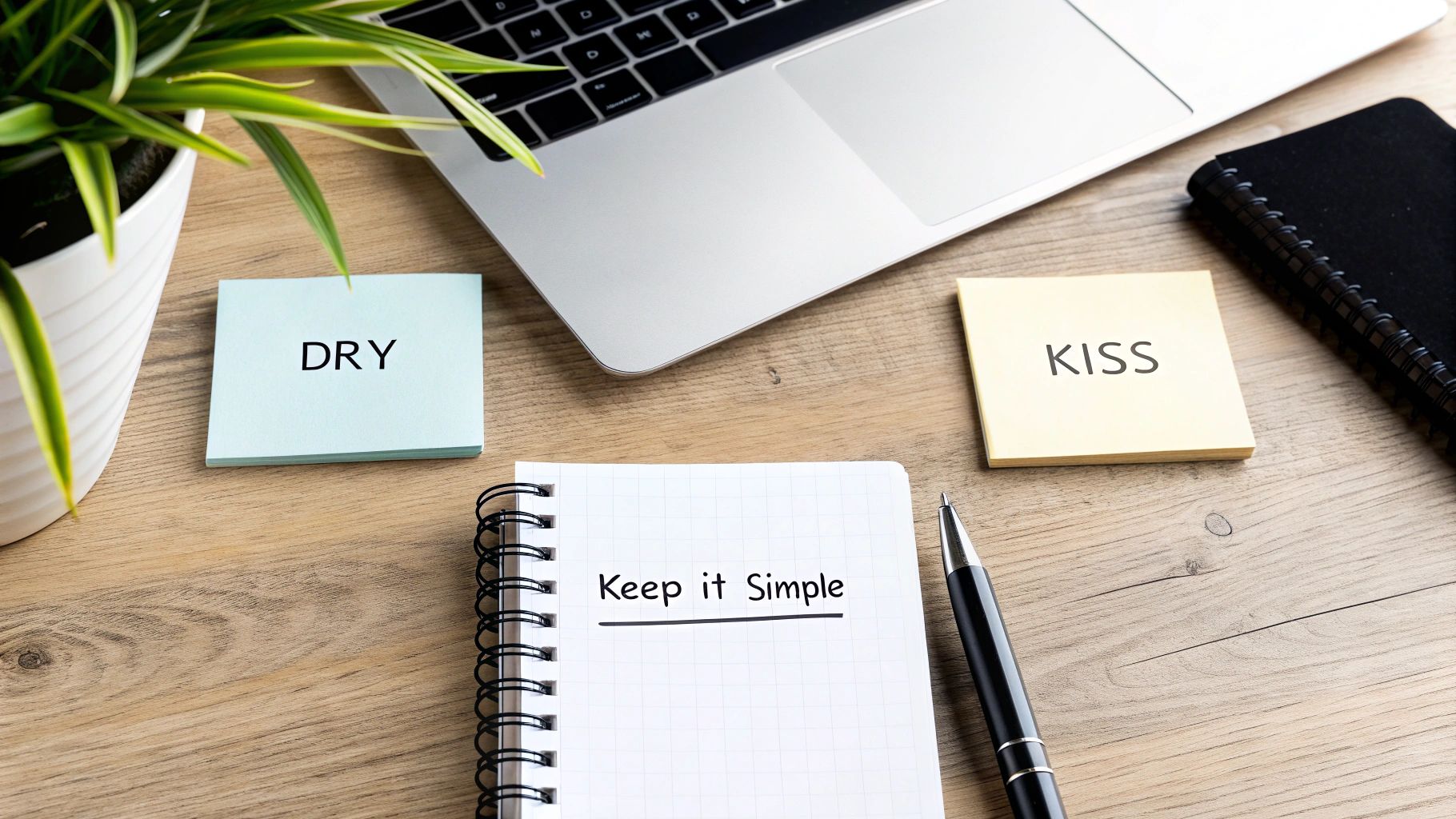
As we build more and more complex systems, the biggest enemy we face isn't a specific bug or a tricky feature—it's complexity itself. Two of the most powerful, down-to-earth principles in clean code are designed to fight this enemy head-on: Don't Repeat Yourself (DRY) and Keep It Simple, Stupid (KISS).
Think of these two ideas as your guiding philosophies. They help you make disciplined choices that lead to software that’s actually maintainable. They are your first line of defense against creating a codebase that’s a nightmare to understand, let alone change.
The Power of Not Repeating Yourself
The DRY principle is beautifully simple: every piece of knowledge must have a single, unambiguous, authoritative representation within a system. In the real world, this just means avoiding duplicate code. When you find yourself copying and pasting a block of logic, it's a huge red flag that you've missed an opportunity to abstract.
Imagine you have a specific calculation for sales tax that pops up in three different parts of your e-commerce app. If the tax rate changes, you now have to hunt down and update all three spots. It's almost guaranteed one will be missed, leading to inconsistent data and subtle, infuriating bugs.
"Every time you see duplication in the code, it represents a missed opportunity for abstraction." - Robert C. Martin
By pulling that logic into a single function, like calculateSalesTax(), you create one source of truth. Now, if the tax rules change, you update it in one place, and the change propagates everywhere instantly. That’s the core win of DRY: it makes your system far more predictable and easier to modify with confidence.
Keeping It Simple Is a Superpower
While DRY helps manage duplication, the KISS principle tackles a different but equally dangerous problem: over-engineering. We’ve all been there—falling into the trap of building overly "clever" or complex solutions for simple problems, trying to anticipate future needs that might never even happen.
KISS is a reminder to always go for the simplest, most direct solution that actually works. It's about fighting the urge to add unnecessary layers of abstraction or premature optimizations. A simple, straightforward approach is almost always easier to read, debug, and maintain than some convoluted masterpiece.
Think of it this way: you could build an elaborate, Rube Goldberg-style machine to make your morning coffee, complete with pulleys, levers, and a trained squirrel. Or, you could just use a simple coffee maker. The coffee maker is the KISS solution—it's reliable, easy to use, and gets the job done without the drama.
Finding the Right Balance
Applying DRY and KISS takes good judgment, because they can sometimes feel like they're at odds with each other. Being overzealous with DRY can lead to creating complex abstractions that actually violate KISS, making the code even harder to follow. The key is to find a practical balance.
*   **Rule of Three:** A good rule of thumb is to wait until you see the same code repeated **three** times before you refactor it into an abstraction. Sometimes, a little duplication is better than a bad abstraction.
*   **Prioritize Clarity:** Always ask yourself, "Will this change make the code easier or harder for the next person to understand?" Simplicity and clarity should always be your main goals.
*   **Avoid Premature Abstraction:** Don't build abstractions for problems you *think* you might have in the future. Solve the problem you have today with the simplest solution possible.
Mastering these two principles is a huge step toward becoming a more effective developer. They are foundational to the principles of clean code because they force you to think critically about complexity and make deliberate choices that benefit the long-term health of your project.
Clean Code as a Professional Discipline
Let's get one thing straight: writing clean code isn't just about personal style or making things look neat. It's about being a professional. Think of it as the shared language of your team, the foundation that makes genuine collaboration possible. When everyone on the team agrees on what quality looks like, code reviews stop being a battleground and onboarding new developers becomes a whole lot smoother.
This isn't just a "tech company" thing, either. The world of scientific research, where a staggering 90% of the work relies on software, is grappling with a reproducibility crisis. A huge part of the problem comes from messy, inconsistent coding. To fix this, scientific communities are now pushing for clean code standards so that findings can actually be verified and built upon. It all comes down to fostering transparency and trust.
Fostering Collective Ownership
When you commit to clean code, something interesting happens: your team starts to feel a sense of collective ownership. Instead of developers guarding their own little corners of the codebase, a shared standard of quality empowers anyone to jump in and make improvements anywhere. This mindset is absolutely critical for the long-term health of any project.
A professional developer understands that writing code is a communal activity. The primary goal is to create something that is not just functional but also understandable and maintainable for the entire team.
This professional discipline starts long before the first line of code is written. A disciplined software development discovery phase is where you set the stage for success, heading off the messy code problems that teams often spend months trying to untangle later.
By establishing clear expectations for code quality from day one, teams build a more predictable and far less stressful development environment. Being proactive is always better than trying to clean up a disaster later on. Using a solid code review checklist can formalize these expectations and help keep everyone on the same page.
Got Questions About Clean Code? Let's Unpack Them.
Even when you've got the basics down, taking clean code principles from theory to the real world can throw a few curveballs. It's totally normal. Getting past these common questions is how you start making clean code second nature in your day-to-day work.
Let’s dive into a few of the questions that pop up most often when developers are leveling up their craft.
I'm a Beginner. Where Should I Even Start with Clean Code?
The best starting point, hands down, is readability. Seriously, don't get bogged down trying to memorize every single SOLID principle from day one. Instead, just pour your energy into writing code that's easy to understand.
Focus on giving your variables and functions clear, descriptive names. Keep your functions short, sweet, and dedicated to doing just one thing. Nailing these fundamentals builds a solid foundation, making it much easier to pick up the more advanced stuff later on.
How Do I Get My Team on Board with Clean Code?
The most powerful tool you have is leading by example. Start applying clean code principles to your own work, and when you're in a code review, gently point out the upsides. It helps to frame the discussion around business goals—talk about how clean code cuts down on bugs, makes it faster to add new features, and gets new hires up to speed quicker.
The best way to get buy-in is to show, not just tell. Demonstrate how a quick refactor made a tangled feature simple to test, or how a clear variable name stopped a major misunderstanding in its tracks.
You could also suggest starting with just a couple of simple, agreed-upon standards, like a team-wide naming convention or a rule about maximum function length. Bringing in an automated code quality tool can also be a game-changer, as it enforces the rules without anyone having to play the bad guy.
Is It Really Worth It to Refactor Our Old, Messy Legacy Code?
Absolutely, but you have to be smart about it. Trying to rewrite everything from scratch is usually a recipe for disaster—it's risky, expensive, and takes forever. A much better approach is to follow the "Boy Scout Rule": always leave the code a little cleaner than you found it.
So, the next time you dive into that crusty old legacy code to fix a bug or tack on a new feature, carve out a little extra time to clean up that specific part of the codebase. This slow-and-steady approach gradually improves the code's health over time without grinding development to a halt. For the biggest bang for your buck, start with the modules that are most critical to the business or get the most traffic.
Tired of drowning in GitHub notification noise? Streamline your team's code review process and ship faster with PullNotifier. Get clear, actionable pull request updates right in Slack. Start your free trial today.