- Published on
Secure Code Review That Actually Works
- Authors

- Name
- Gabriel
- @gabriel__xyz
A secure code review is a methodical deep-dive into an application's source code, designed to hunt down and squash security vulnerabilities before they ever have a chance to be exploited. It’s one of the most powerful ways to stop security breaches in their tracks by catching flaws early in the development process.
Think of it less like proofreading for typos and more like checking a legal contract for critical loopholes.
Why Secure Code Review Is Non-Negotiable

In the rush to ship new features, it’s all too easy to treat security as an afterthought—something to bolt on at the end. But treating a secure code review like a simple checklist item is like an architect giving a skyscraper's blueprint a quick once-over just moments before the first steel beam is raised. It's a dangerously shortsighted move.
A proper review isn't about nitpicking minor syntax errors. It's about finding the deep, structural weaknesses that could bring the entire system crashing down. This kind of proactive analysis is your first, and arguably most effective, line of defense.
Finding Flaws Before They Become Disasters
Let's be blunt: catching a security flaw during the coding phase is exponentially cheaper and easier than fixing it after deployment. A vulnerability that makes it into a live production environment can trigger emergency patches, system downtime, and a whole lot of reputational damage you just don't need.
And the threat is only getting worse. A recent analysis clocked a historic high in software vulnerability disclosures, with over 21,500 CVEs (Common Vulnerabilities and Exposures) reported in just the first six months of the year. That's an 18% jump from the year before. Even more alarming, a staggering 38% of these were classified as High or Critical. You can explore the detailed vulnerability statistics to see just how real the risk is.
A secure code review turns security from a reactive, costly firefight into a proactive, manageable process. It’s how you build software that people can actually trust.
This shift in mindset is everything. Weaving security into the development lifecycle isn't just a "best practice" anymore; it's a fundamental requirement for building software that's resilient, trustworthy, and ultimately, successful. The goal is to create a culture where security is everyone's job, not just a final gatekeeper slowing things down.
Building Your Code Review Playbook
A great secure code review doesn't just happen by chance. It's the result of a repeatable system—a playbook that guides your team through a consistent process of security analysis.
This playbook is all about blending different methods to catch the widest possible range of vulnerabilities. At its core, you’ll need to decide on the right mix of three main approaches: manual, automated, and hybrid reviews.
Choosing isn’t about finding one “best” method. It’s about making smart trade-offs between depth, speed, and how you use your team's time. Each strategy brings something different to the table, and the trick is knowing when to use each one.
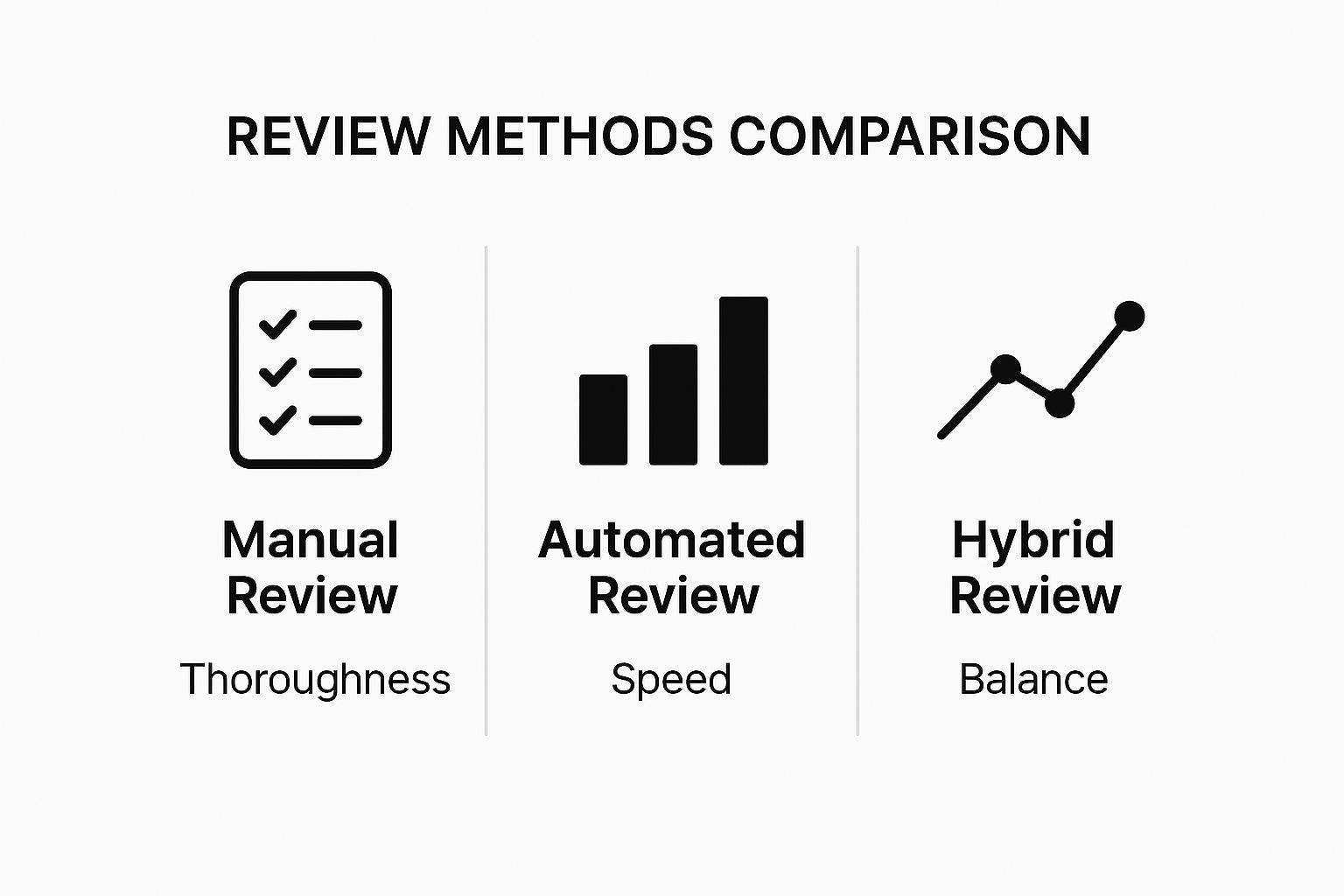
As you can see, there's no silver bullet. The most effective security strategies almost always combine the unique strengths of each approach to create a defense that’s both broad and deep.
Comparing Secure Code Review Approaches
To really get a feel for how these strategies differ, let's break them down side-by-side. The table below compares the three main approaches—manual, automated (SAST), and hybrid—across a few key attributes to help you figure out what makes the most sense for your team.
| Attribute | Manual Review | Automated Review (SAST) | Hybrid Approach |
|---|---|---|---|
| Speed | Slow, meticulous, and time-intensive. | Extremely fast; scans entire codebases in minutes. | Balances speed by using tools for initial scans. |
| Depth | Very high. Catches complex, nuanced business logic flaws. | Limited to known patterns and common vulnerabilities. | High. Directs human expertise to high-risk areas. |
| Accuracy | High, with few false positives. | Prone to false positives, requires tuning. | Improved accuracy as humans verify tool findings. |
| Cost | High due to reliance on skilled security experts. | Lower operational cost after initial setup. | Optimized cost by focusing expert time effectively. |
| Scalability | Difficult to scale across large codebases or teams. | Highly scalable; runs on every commit. | Scalable with automation, deep with manual checks. |
| Best For | Critical components, business logic, architectural flaws. | CI/CD integration, catching low-hanging fruit early. | Comprehensive security for most modern teams. |
Ultimately, this comparison shows that the best approach depends entirely on your specific needs, risk tolerance, and the maturity of your development process.
Exploring the Three Core Approaches
A manual secure code review is like having a master architect inspect your building's blueprints. A security expert painstakingly goes through your source code line by line, looking for issues. This human-led process is fantastic at finding tricky business logic flaws, subtle design errors, and vulnerabilities that require a deep understanding of what the code is supposed to do—the kind of stuff automated tools almost always miss.
On the other end of the spectrum is automated review, which mostly relies on Static Application Security Testing (SAST) tools. Think of SAST tools as a super-fast spell-checker for common security mistakes. They can scan your entire codebase in minutes, flagging well-known vulnerability patterns like SQL injection or cross-site scripting with incredible efficiency. Their big win is speed and scale.
The hybrid approach is exactly what it sounds like: the best of both worlds. It starts with automated SAST tools to run broad, rapid scans and catch all the low-hanging fruit. Then, it uses those findings to direct human experts to focus their energy where it matters most—on high-risk areas, complex logic, and nuanced issues that demand critical thinking.
Crafting a Practical Workflow
Okay, concepts are great, but how do you turn this into a real-world system? You need a step-by-step process that plugs right into your development cycle. A solid playbook makes sure your security checks are consistent, efficient, and actually work.
Here’s a practical workflow your team can adopt:
- Start with Threat Modeling: Before you even look at a line of code, figure out what you’re trying to protect. This first step helps you map out potential threats and prioritize which parts of the application—like authentication logic or payment modules—need the most attention.
- Run Automated Scans Early: This is non-negotiable. Integrate SAST tools directly into your CI/CD pipeline. This gives developers immediate feedback on every commit or pull request, catching simple mistakes before they become ingrained.
- Triage and Prioritize Findings: Not all bugs are created equal. Automated tools can be noisy, so the next step is to triage the results. Filter out the false positives and focus on fixing the high-impact, easily exploitable flaws first.
- Conduct Targeted Manual Reviews: Now, bring in the experts. Use the insights from your automated scans and threat model to guide manual reviews. This ensures your security engineers are spending their valuable time on the most critical and complex parts of the code, not just hunting for typos.
- Verify Fixes and Document Learnings: After a developer pushes a fix, it needs to be verified. Make sure the vulnerability is truly gone and that the fix didn’t accidentally introduce a new problem. Don't forget to document common issues—it helps train the whole team and stops the same mistakes from happening again.
By establishing this repeatable playbook, you transform secure code review from a reactive, unpredictable task into a core, predictable part of your development rhythm.
Embedding Security Into Your Daily Workflow

Let's be honest: security can feel like a roadblock. For years, it was a final, frustrating step that held up releases. The goal of modern AppSec is to flip that script entirely. It's all about "shifting left"—weaving security checks directly into the tools your developers already live in.
This completely changes the game. Instead of a security team flagging a problem weeks after code is written, developers get instant feedback. This proactive approach helps them learn secure coding habits on the fly, catching and fixing vulnerabilities when they're still cheap and simple to resolve.
Making Security an Everyday Habit
To really make this work, you have to meet developers where they are. That means embedding automated security checks so seamlessly into their workflow that it feels like a natural part of the process, not a clunky interruption.
Here are a few powerful ways to pull this off:
- Pre-Commit Hooks: Think of these as the first line of defense. They're simple scripts that run checks before a developer can even commit their code. They're perfect for catching simple but critical mistakes, like accidentally leaving an API key in the code, and give instant feedback right in the terminal.
- IDE Integrations: Many security tools now offer plugins that plug straight into popular IDEs like VS Code. These work like a spell-checker for security, flagging potential vulnerabilities in real-time as the code is being written.
- CI/CD Pipeline Scans: This is where you can build an automated security gate. By weaving SAST scans into your Continuous Integration/Continuous Deployment (CI/CD) pipeline, you can automatically block any build or deployment that introduces known vulnerabilities.
Integrating security at these early stages makes it a non-negotiable part of every single pull request. It stops insecure code from ever hitting the main branch.
This continuous feedback loop is what makes all the difference. It fosters a culture where developers are empowered to ship secure code by default, turning them from a potential liability into your first line of defense. You can tighten this loop even further with tools that send automated pull request notifications, ensuring no check is ever missed. For a deeper dive, check out our guide on setting up code quality checks with GitHub Actions and Slack.
The Growing Market for Integrated Security
This move toward integrated, developer-first security isn't just a trend—it's a massive and growing market. The global secure code review software market has exploded, showing just how seriously organizations are taking software security.
The market was recently valued at around $2.5 billion and is projected to grow at a compound annual growth rate (CAGR) of 15% over the next few years. That surge is a direct response to the rising frequency and cost of software vulnerabilities. By embedding security tools directly into daily workflows, teams are tackling this challenge head-on, reducing risk and building tougher, more resilient applications from the ground up.
Spotting Real-World Vulnerabilities In Code

Theory and process are great, but a truly effective secure code review happens in the trenches. It's where you learn to spot the subtle, dangerous patterns that lead to big security holes.
Moving from abstract concepts to seeing these flaws in actual code is how reviewers build the intuition to catch high-risk issues before they blow up into security incidents. You start recognizing the common vulnerability classes that plague modern applications, building up the pattern-recognition skills that make your reviews faster and far more effective.
Unmasking SQL Injection
One of the most classic and destructive vulnerabilities out there is SQL Injection (SQLi). This happens when an attacker can manipulate an application's database queries by sneaking in their own malicious SQL. Think of it like tricking a librarian into giving you access to a restricted section by slipping a fake command into your book request slip.
The business impact can be devastating, leading to anything from unauthorized data access to complete database deletion.
What to Look For:
- String Concatenation in Queries: Be extremely wary of code that builds SQL queries by directly mashing user input into a query string.
- Lack of Parameterized Queries: Code that doesn't use prepared statements or parameterized queries is a massive red flag. This is a foundational defense.
- Trusting User Input: Any code that blindly takes input from a URL, form, or API and uses it in a query without rigorous sanitization is asking for trouble.
Unsafe Python (Flask) example
user_id = request.args.get('id') query = "SELECT * FROM users WHERE id = " + user_id # Vulnerable to SQLi
Defending Against Cross-Site Scripting (XSS)
Cross-Site Scripting (XSS) is another all-too-common threat. This attack involves injecting malicious scripts into trusted websites, which then execute in the browsers of unsuspecting users. If SQLi targets the database, XSS targets your users directly.
An attacker could use XSS to steal session cookies, deface your site, or redirect users somewhere malicious. While hunting for these issues, it's also a good time to think about sensitive information and broader data privacy considerations.
A successful XSS attack can completely undermine user trust, as it turns your own application into a weapon against its users.
What to Look For:
- Rendering Raw HTML: Look for any place where user-supplied data is rendered directly onto an HTML page without being properly sanitized or encoded.
- Using
innerHTMLin JavaScript: Functions likeinnerHTMLare notorious for executing scripts if they are passed unsanitized user input. - Missing Content Security Policy (CSP): A strong CSP header is a critical defense-in-depth measure. It can block many XSS attacks even if a flaw slips through.
Preventing Broken Access Control
Broken Access Control is what happens when an application fails to properly enforce who is allowed to do what. This flaw lets attackers access functionality or data that should be off-limits, like viewing another user's private info or hitting admin-only functions.
Often, these issues aren't just technical bugs but "code smells" that point to deeper design problems. For more on that, you can learn about 10 common code smells in pull requests that often go hand-in-hand with security weaknesses.
This vulnerability consistently ranks as one of the most critical web application security risks because it's a direct path to unauthorized data disclosure and privilege escalation. Finding these flaws requires understanding not just what the code does, but what it should be allowed to do.
Creating a Culture of Security
Tools, workflows, and automated scans can certainly level up your security posture, but they can only take you so far. A truly resilient security program isn’t built on process alone; it's built on culture. This is the human side of secure code review—turning security from a siloed chore into a shared, collective mission.
When security is treated as some other team's problem, developers naturally see it as a roadblock. The goal is to flip that script entirely. Security needs to be an inherent quality of good software, right up there with performance and reliability.
That cultural shift starts by giving developers the knowledge and tools they need to become the first line of defense.
Make Security a Shared Responsibility
For a security-first culture to actually stick, everyone on the team needs to feel a sense of ownership. This means moving away from a world where the security team is a gatekeeper and toward one where they're enablers and coaches. When a vulnerability is found, the conversation shifts from "who did this?" to "how can we learn from this together?"
Here are a few ways to get this kind of environment off the ground:
- Standardized Security Checklists: Create simple, practical checklists specific to your tech stack. These guides help developers run their own quick reviews and squash common bugs before a pull request even gets opened.
- Introduce Security Champions: Find the developers who are already passionate about security and officially empower them. These champions act as a bridge between dev teams and the security folks, offering guidance and promoting better habits from within.
- Celebrate the Wins: When a developer finds and fixes a critical vulnerability, make it a team win. This kind of positive reinforcement encourages proactive thinking and makes finding flaws feel like a constructive part of the process, not a failure.
A strong security culture reframes finding a vulnerability not as a mistake, but as a success. It's proof the system is working, with everyone pitching in to make the product safer.
Implement Training and Metrics That Actually Matter
Consistent, effective training is what keeps skills sharp. Forget about those generic, once-a-year slideshows that everyone tunes out. Modern developer training needs to be hands-on, continuous, and baked right into the daily workflow. Interactive coding challenges that mimic real-world attacks are way more effective than just passively listening to a presentation.
On top of that, to know if you're getting better, you have to measure what matters. Vanity metrics can look good on a chart but don't tell you anything useful. You need to focus on data that shows real progress and helps you make smarter decisions.
Key Metrics to Track:
- Vulnerability Remediation Time: How fast are critical bugs being fixed after they’re found? A downward trend here is a huge win.
- Recidivism Rate: What percentage of old vulnerabilities pop back up in the codebase after being "fixed"? A low rate shows developers are actually learning from past mistakes.
- Security Flaws per Thousand Lines of Code: This metric helps you normalize your data, letting you track security quality as the codebase inevitably grows.
By focusing on these cultural pillars, you start to build a self-sustaining security program where every single person is invested in the outcome. This approach doesn't just cut down on risk—it actually speeds up development by catching issues earlier and building more solid, secure software from day one.
Securing More Than Just Your Application Code
You can write the most secure application in the world, but if it's running in a leaky environment, it’s still vulnerable. A real secure code review strategy has to look past your application’s source code and scan the entire ecosystem that brings it to life. After all, a single leaked secret can make all your careful in-code security work completely worthless.
Think of your application as a high-tech bank vault. You've spent a fortune building an unbreakable door—that’s your application code. But attackers aren't going to bother with the door if they can just climb through an open window. Those "windows" are often hiding in your infrastructure, like configuration files or build pipelines, which are the first places attackers look.
This is exactly why security reviews need a wider lens. A truly comprehensive approach puts every component that touches your code under the microscope, from the first line written to the final deployment.
Uncovering Hidden Attack Surfaces
Some of the most critical risks are hiding in plain sight within your toolchain and infrastructure. You have to find these blind spots before an attacker does.
Here are the usual suspects to hunt for:
- Hardcoded Secrets: API keys, database credentials, and other secrets carelessly dropped into config files or, even worse, committed directly into your version history.
- Vulnerable Dependencies: Outdated third-party libraries pulled into your build process that sneak known vulnerabilities right into your application.
- Permissive Repository Settings: Publicly exposed repositories or overly generous access controls can leak sensitive code and infrastructure details to the entire world.
- Insecure CI/CD Pipelines: Misconfigured build servers or pipelines with exploitable flaws can be hijacked, allowing attackers to inject malicious code into your finished product.
A recent analysis found that a staggering 61% of organizations had secrets like cloud credentials and API keys exposed in public code repositories. This isn't just a small oversight; it's a massive, easily exploited security gap. You can read the full report on code security risks for more alarming details.
Keeping third-party dependencies in check is a huge part of this bigger picture. Automated tools are essential for patching vulnerabilities the moment they're discovered. For a great comparison of popular options, check out our breakdown of Dependabot vs Renovate for dependency updates. By extending your security focus to these areas, you’re not just securing your code—you’re locking down your entire development lifecycle.
Common Questions About Secure Code Review
When you're rolling out a secure code review process, a few key questions always pop up. Getting these answers straight helps lock in your strategy and gets the whole team on the same page. Let's tackle the ones we hear most often.
How Often Should a Secure Code Review Be Performed?
The simple answer? All the time. Ideally, secure code review isn't an event—it's a continuous part of your workflow. Automated scans should kick off with every single commit or pull request, giving developers instant feedback right where they work.
But automation can't catch everything. You still need in-depth manual reviews for the high-stakes stuff: major new features, anything that touches sensitive user data, and core components like authentication or payment gateways. It's also a great practice to schedule a full-scope review of your entire codebase periodically to catch anything that might have slipped through the cracks.
What Is the Difference Between SAST and DAST?
Think of SAST (Static Application Security Testing) as inspecting a building's blueprints. It analyzes your source code from the inside, without ever running the application, to find structural flaws early in the building process.
DAST (Dynamic Application Security Testing), on the other hand, is like hiring a professional security tester to try and break into the finished building. It probes your running application from the outside, mimicking an attacker to find vulnerabilities that only appear at runtime. They aren't competing tools; they're complementary. You get the best results when you use them together.
Security is a shared responsibility. The most successful programs foster a collaborative culture where developers and security experts work together to build secure software from the ground up.
Stop letting pull requests become bottlenecks. PullNotifier integrates with GitHub and Slack to deliver real-time, consolidated PR updates, cutting review delays and keeping your team in sync. Streamline your workflow and ship code faster at https://pullnotifier.com.