- Published on
A Guide to Reviewing Pull Requests
- Authors

- Name
- Gabriel
- @gabriel__xyz
Let's be real—for a lot of developers, reviewing pull requests feels like a chore. It gets a bad rap as a gatekeeping process that just slows everyone down. But it doesn't have to be that way. When you start treating reviews as a collaborative practice, you can actually speed up your team, seriously improve code quality, and spread knowledge across the entire organization.
Moving Beyond Gatekeeping in Code Reviews
One of the biggest frustrations I hear from engineering teams is that code review has become a bottleneck. You’ve probably seen it: massive pull requests (PRs) sitting stale for days, feedback that feels vague or nitpicky, and a process that adds more friction than value. This guide is all about moving past those pain points with practical, battle-tested strategies to make your reviews faster, more constructive, and a true cornerstone of building better software.

The goal here is to shift your team’s mindset from finding flaws to one of collective ownership. A great review isn't just about catching bugs. It’s a prime opportunity for mentorship, a chance to share knowledge, and a way to ensure the long-term health of your codebase. When you get it right, the whole process becomes a powerful tool for leveling up every single person on the team.
What to Expect from This Guide
We’re going to cover everything you need to completely transform your team's approach to reviewing pull requests. Instead of just rattling off a list of rules, we'll give you actionable workflows and insights to help you build a culture where efficient, supportive review is just how things are done.
You will learn how to:
*   **Establish a clear process** that balances speed with thoroughness.
*   **Provide impactful feedback** that actually helps your teammates grow.
*   **Use automation and tooling** to eliminate tedious manual checks.
*   **Structure PRs for easy review**, which is a critical (and often overlooked) first step.
The secret to better reviews isn't just becoming a better reviewer—it's creating an environment where high-quality feedback is the norm. It’s a shared responsibility between the author and the reviewer to make the process smooth and effective.
Ultimately, mastering the art of the pull request review is about much more than just shipping features faster. It's about building a more connected, knowledgeable, and resilient engineering team. And if you're looking to really refine your communication, our ultimate guide to constructive feedback in code reviews offers deeper insights into crafting comments that build your team up.
A great pull request review isn't just a quick scan for typos. It's a structured analysis, kind of like looking at the same code from three different angles. If you approach a review in distinct passes, you can give much better, higher-impact feedback without getting overwhelmed.
This method is all about wearing different hats—the architect, the engineer, and the person who has to maintain this thing six months from now. Thinking in layers keeps you from getting bogged down in implementation details before you even understand why the change is being made. Each "lens" helps you focus, making the whole process more efficient for everyone.
The Architectural Lens
Before you even look at a single line of code, start with the big picture. Your first pass should be through the architectural lens, focusing on the "what" and "why" of the change. The goal is to make sure the whole idea is sound from a system design perspective.
Ask yourself these high-level questions:
*   Does this PR actually solve the right problem?
*   Does this new solution fit logically with how our system is already designed?
*   Are there any weird side effects or new dependencies that might mess with other parts of the app?
Imagine someone submits a PR to add a new caching layer. An architectural review isn't about the specific cache implementation they chose. It’s about asking, "Do we even need caching here? Will this create data consistency problems with our other services?" Nailing this down first saves a ton of time that might otherwise be wasted on a flawed approach.
The Implementation Lens
Okay, once you're good with the overall direction, it's time to switch to the implementation lens. This is what most people think of as a classic code review—getting into the nitty-gritty. Here, you’re focused on correctness, logic, and performance.
You're hunting for logic flaws, missed edge cases, potential security holes, and inefficient code. This is where you might spot an off-by-one error in a loop or realize a database query is going to be painfully slow. The key is to be specific and helpful. Don't just say, "This is inefficient." Offer a real alternative: "This query could cause performance issues under heavy load. Have you considered adding an index to the user_id column or using a batch operation instead?"
The Readability and Maintainability Lens
Last but not least, put on your readability lens. This final pass is all about long-term code health. You’re thinking about the next developer who will have to touch this code—which, let's be honest, might be you in the future. Code is read way more often than it's written, so clarity is everything.
Here’s what you’re looking for:
*   Clear variable and function names that actually describe what they do.
*   Making sure the code follows the team's style guide and conventions.
*   Enough comments to explain any complex or weird-looking logic.
*   Good, comprehensive tests that also serve as a form of documentation.
A comment like "This is confusing" doesn't help anyone. A better way to phrase it is, "I had to read this function a few times to get it. What if we renamed
process_datato something more specific, likegenerateUserReportFromLogs?" That turns a critique into a collaboration.
This three-lens approach helps you systematically catch different kinds of issues. It also cuts down on the endless back-and-forth that happens when feedback is all over the place. When you see a PR with a ton of revisions, it often points to a complex or controversial change that would have benefited from more structured feedback. In fact, a 2022 study on heavily revised PRs showed just how costly those iterative feedback loops can be, which really drives home the need for better review practices. You can check out the full research on pull request revisions to see the data for yourself.
Building a Modern PR Review Workflow
Having a team of skilled reviewers is great, but what really moves the needle is a repeatable, scalable process. A modern pull request workflow isn’t about piling on more rules; it's about cutting out the friction so engineers can focus on what they do best: building great software.
The foundation of any good review process is surprisingly simple: keep pull requests small. Seriously. A PR should be a single, logical chunk of work. This makes it faster to review, easier to grasp, and less intimidating for everyone involved.
Once your PRs are bite-sized, you can set real expectations for how quickly they get reviewed. A common and effective team agreement is to guarantee a first pass within 24 hours. This simple rule prevents PRs from getting stale and avoids the soul-crushing merge conflicts that come from leaving branches open for days. A clear service-level objective (SLO) here builds momentum and a culture of responsiveness.
Let Automation Handle the Grunt Work
Next up, offload as much of the tedious work as you can to your tools. Human brainpower is your most expensive resource—don't waste it on checking for style violations or missing semicolons. Let machines handle the routine checks so your team can focus on the tricky stuff like logic, architecture, and user impact.
This is where your CI/CD pipeline, powered by tools like GitHub Actions, becomes your best friend. Set it up to run these checks automatically on every PR:
*   **Linting:** Enforces a consistent code style across the entire project. No more debates about tabs versus spaces.
*   **Unit Tests:** Confirms that new code works as intended and, just as importantly, that it didn’t break anything else.
*   **Static Analysis:** Scans for common bugs, anti-patterns, and potential security holes before a human ever lays eyes on the code.
By the time a PR lands in a reviewer's queue, these basic quality gates should already be green. If you want to go deeper on setting this up, there are some great resources on Automating Builds and Tests on Pull Requests that cover advanced CI/CD techniques.
From Notification Chaos to Focused Alerts
One of the biggest killers of a smooth workflow? Notification fatigue. The constant stream of emails and default pings from GitHub quickly turns into background noise that everyone tunes out. For a review process to actually work, you need communication that cuts through the clutter.
This is where tools like PullNotifier come in. Instead of a firehose of every single update, PullNotifier integrates with your team’s chat platform (like Slack) to deliver concise, actionable alerts right when a PR needs attention. This keeps the review cycle moving without drowning your team in notifications.
This structured approach lets reviewers focus their energy where it matters most: on the higher-level aspects of the change. You can think of it as a three-stage process, moving from the big picture down to the details.
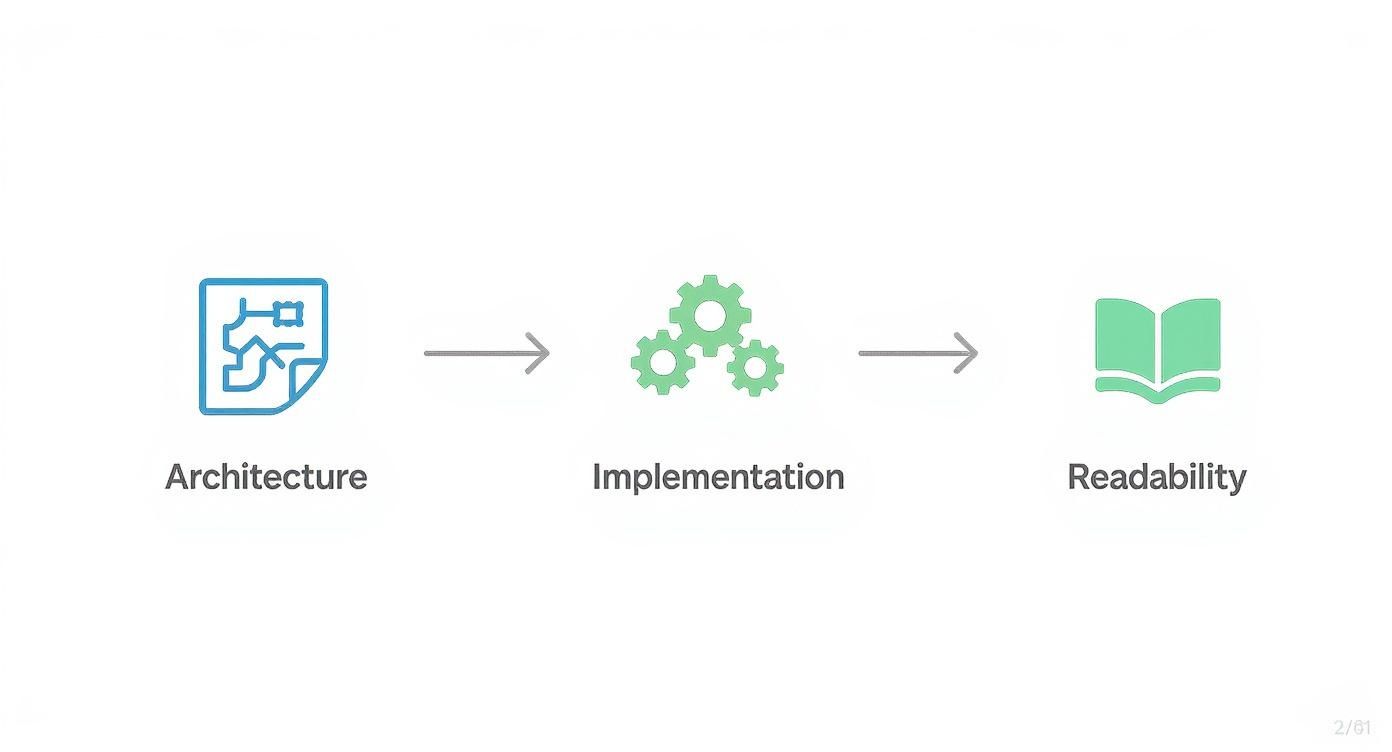
By automating the initial checks and streamlining communication, you free up your reviewers to concentrate on these more strategic layers of analysis.
The goal is to make the right way of working the easiest way. By combining small PRs, clear turnaround times, and smart automation, you create a workflow that is both fast and thorough.
Ultimately, a well-designed review process transforms PRs from a chore into a collaborative, value-add part of your development cycle. It creates a powerful feedback loop: faster reviews encourage smaller PRs, and smaller PRs lead to even faster reviews. Everyone wins.
Why Small Pull Requests Are Non-Negotiable
If there’s one habit that can single-handedly rescue a broken review process, it’s this: keep your pull requests small. Large, monolithic PRs are the number one cause of bottlenecks, reviewer fatigue, and sluggish team velocity. They kick off a ripple effect of delays that can grind a team’s momentum to a halt.
When a reviewer gets hit with a PR containing thousands of lines of code, the cognitive load is just overwhelming. It's practically impossible to give that code the deep, thoughtful attention it needs. This usually results in superficial reviews where only the most obvious issues get caught, while subtle architectural flaws or logic bugs sail right through.
This isn’t just a gut feeling; the data backs it up. An extensive analysis of over 6.1 million pull requests found a direct link between PR size and engineering velocity. Smaller, more focused PRs get reviewed and merged way faster, which lowers risk and keeps the development cycle moving. The same report found that massive PRs often get trapped in a negative feedback loop where authors add even more changes while waiting for a review, just making the problem worse. You can discover more insights in the full Engineering Benchmarks Report.
Strategies for Breaking Down Large Features
Switching to smaller PRs is more about changing habits than just making a new rule. Instead of building out an entire feature in one massive, long-running branch, your team needs to adopt techniques that allow for tiny, safe, incremental merges.
Here are two powerful strategies to get you started:
*   **Feature Flags:** Think of these as on/off switches for new code. They let you merge incomplete or experimental work directly into your main branch without ever exposing it to users. This effectively decouples deployment from release, empowering your team to ship small, atomic changes continuously.
*   **Stacked PRs:** When one change depends on another, you can "stack" them. The first PR introduces the foundational change, and the second PR is branched off the first one, containing the next logical piece. This approach breaks a huge feature into a sequence of dependent, yet individually reviewable, chunks.
The real win with small pull requests is the feedback loop. Quick reviews mean quick merges, which means developers get their code integrated faster and can move on to the next task without context switching.
Resisting Scope Creep
Another hidden danger of large PRs is scope creep. While an author is stuck waiting for a review, it’s all too tempting to add "just one more thing." A small bug fix or a minor refactor gets tacked on, blurring the PR's original purpose and making the reviewer's job even harder.
Enforcing a one-change-per-PR policy is critical. If a reviewer spots an unrelated issue, the best move is to approve the current PR and open a new ticket or a separate PR to address it later. This discipline ensures every pull request remains a focused, manageable unit of work—the absolute cornerstone of an efficient process for reviewing pull requests.
How AI Is Supercharging Code Reviews
The next big shift in how we review pull requests is already happening, and it’s being driven by artificial intelligence. Tools like GitHub Copilot are completely changing the PR lifecycle for both the person writing the code and the person reviewing it. Think of it less like a passive spell-checker and more like an active collaborator. This isn't about replacing developers; it's about giving them a serious upgrade to ship better code, faster.

For authors, AI basically acts as a pair programmer from the moment they start coding. It helps write cleaner, more consistent code from the get-go by suggesting completions, spotting common patterns, and even writing entire functions. The result? Far fewer simple mistakes and style issues ever make it into a pull request, which means less back-and-forth during the review.
For reviewers, the payoff is just as huge. AI assistants can take over many of the tedious, low-level checks that drain time and mental energy.
AI's Role in Modern Reviews
Instead of manually hunting for common errors or style guide violations, reviewers can let an AI handle that first pass. This frees up their brainpower to focus on what really matters—the high-level architectural decisions and tricky business logic that machines just can't tackle yet.
Here’s how AI tools can give reviewers a hand:
*   **Summarizing complex changes:** They can automatically generate a plain-English summary of what a massive PR actually does.
*   **Suggesting improvements:** AI can offer alternative ways to write a function for better performance or readability.
*   **Identifying potential bugs:** It’s getting surprisingly good at flagging subtle logic errors or missed edge cases before they get merged.
This shift turns the whole review process into something more strategic and a lot less of a chore. If you're looking for more ways to streamline things, you might want to check out these tips on automating code review with smarter tools for your team. While AI is a massive boost for development, its capabilities are also making waves in security, particularly with the rise of autonomous AI agents in cybersecurity.
The Data-Backed Impact on Velocity
The effect of AI on development workflows isn't just a feeling; the data is pretty clear. The massive adoption of GitHub Copilot, now with 15 million global users, has delivered some impressive results. Controlled studies have shown an 11% higher merge rate and a wild 84% boost in successful builds.
What that really means is that AI-assisted code is just higher quality right out of the gate, leading to less rework and fewer round-trips in the review cycle. You can read the full findings on Copilot's impact to see the numbers for yourself.
By handling the rote aspects of coding and review, AI allows developers to focus on creative problem-solving and architectural integrity. It's a partnership that elevates the quality and speed of the entire software development lifecycle.
Common Questions About Pull Request Reviews
Once a team starts getting serious about their code review process, the same handful of questions always pop up. Getting these sorted out is key to building a review culture that actually helps people move faster, rather than bogging them down in bureaucracy. Let's tackle the most common ones.
How Small Should a Pull Request Actually Be?
There's no magic number, but a great rule of thumb is that a pull request should tackle one logical change. It has to be small enough for a teammate to review thoroughly in one sitting—for most of us, that's under 30 minutes. In practical terms, that usually means keeping changes under 250 lines of code.
The real litmus test, though, is cognitive load. If your reviewer has to pull out a notepad just to keep track of all the moving parts, your PR is way too big. This is where you start leaning on tools like feature flags or stacked PRs to break down monster features into smaller, more manageable chunks that are easy to review.
What if I Disagree with a Reviewer's Feedback?
It happens. Disagreements are a totally normal part of building something together. The first and most important step is to always assume good intent. Your teammate isn't trying to block you; they have the same goal you do—shipping better code.
Kick things off by asking for clarification. Make sure you're actually on the same page and understand their point. If you still see it differently, calmly explain your own reasoning. Back it up with context or evidence, like pointing to the project requirements, sharing performance data, or dropping a link to the relevant docs.
If you find yourselves going back and forth more than a couple of times, just stop typing. A five-minute call will resolve a complex disagreement far faster than an hour-long, frustrating comment thread ever could.
How Do We Actually Reduce Our Team's Review Time?
Cutting down review time is a team sport, but there are a few high-impact moves you can make. The single biggest lever you can pull is enforcing smaller PRs, like we just talked about. Once you have that handled, turn your attention here:
*   **Automation is your first line of defense.** Your CI pipeline should handle all the robotic work—linting, running tests, and static analysis—so your human reviewers don't have to waste their brainpower on it.
*   **Get smarter with your alerts.** Use tools that send instant, targeted notifications to Slack when a PR needs attention. This cuts out the dead time where a PR is just sitting around, waiting for its first look.
*   **Make reviews a team priority.** Reviewing pull requests needs to be a core part of the daily workflow, not something you get to *after* you finish your "real" work. It should carry the same weight as writing new code.
Who Should Review My Pull Request?
The best reviews come from a mix of perspectives. As a default, you should always include at least one person who has deep context on the part of the codebase you're touching. They're the ones who can really validate the logic and spot subtle implementation mistakes. A CODEOWNERS file is a great way to automate these initial assignments so they don't get missed.
But don't just stop there. It's incredibly valuable to pull in a reviewer from another team or someone with a different specialty. They bring fresh eyes to the problem and are far more likely to catch issues with clarity, documentation, or broad architectural assumptions that the primary reviewer might glance right over. If you want a more structured way to make sure all your bases are covered, a good code review checklist can be a huge help.
Ready to eliminate notification noise and cut down your review times? PullNotifier delivers concise, real-time pull request updates directly in Slack, helping your team stay focused and ship faster. Get started for free at https://pullnotifier.com.