- Published on
How to Improve Developer Experience in Your Team
- Authors

- Name
- Gabriel
- @gabriel__xyz
To truly improve the developer experience, you have to get systematic about removing friction from daily workflows. It’s not about flashy perks; it’s about giving engineers what they actually need: fast feedback loops, less cognitive load, and an environment that fiercely protects deep, focused work.
When you do that, you’re empowering them to build incredible software, efficiently.
Why Developer Experience Is Your New Competitive Edge
Let’s be real for a moment. "Developer Experience," or "DevEx," can easily sound like a fluffy buzzword. But what if it’s the single most critical business lever you aren't pulling? A superior DevEx is a direct line to your company's ability to innovate, ship faster, and—most importantly—keep your best engineers from walking out the door.
This isn't about adding a ping-pong table. It's about systematically dismantling the invisible walls that drain time, money, and morale from your engineering teams.
Every time a developer has to fight slow builds, decipher confusing documentation, or navigate a convoluted review process, they're not just getting frustrated. They're bleeding productive hours. In fact, research shows a staggering 69% of developers lose eight or more hours every week to these kinds of roadblocks. That's an entire workday gone, every single week.
The friction your developers face isn't just a morale problem; it's a direct hit to your bottom line. These small, daily frustrations compound into significant business challenges.
Connecting Developer Friction to Business Problems
| Developer Friction Point | What It Feels Like for Developers | How It Hurts the Business |
|---|---|---|
| Slow CI/CD Pipelines | "I pushed my code an hour ago and I'm still waiting to see if it passed." | Delayed feature releases, slower bug fixes, and wasted engineering hours. |
| Complex Local Setups | "It took me three days just to get the project running on my machine." | Slower onboarding for new hires and reduced productivity for the whole team. |
| Vague Documentation | "I have no idea how this API works or who to ask for help." | Increased errors, inconsistent implementations, and reliance on a few key people. |
| Constant Interruptions | "I can't get into a flow state because of endless Slack pings and meetings." | Poor code quality, lack of innovation, and increased developer burnout. |
| Unreliable Tooling | "My debugger keeps crashing, and the linter gives cryptic errors." | Frustration, wasted time on tool maintenance instead of coding, and lower morale. |
Seeing these connections makes it clear: a poor developer experience isn't just an internal issue—it’s a competitive disadvantage that impacts your ability to deliver value to customers.
The Three Pillars of Elite DevEx
When you boil it down, a world-class developer experience really stands on three core pillars. Get these right, and you create a seamless, productive environment where engineers can truly shine.
Fast Feedback: Developers need to know immediately if their code works. This isn't just about unit tests running in seconds; it’s about a CI/CD pipeline that gives a clear thumbs-up or thumbs-down in minutes, not hours.
Low Cognitive Load: This is all about minimizing the mental energy spent on anything that isn't coding. Think simple, standardized environments, crystal-clear documentation, and intuitive tools. It lets developers focus their brainpower on solving actual business problems, not fighting their setup.
Deep Work: Protecting engineers from the constant barrage of interruptions is non-negotiable. An environment that champions long, uninterrupted blocks of time is where high-quality, innovative work actually happens.
This isn’t just a theory. These principles create a powerful cycle that directly fuels innovation by eliminating friction.
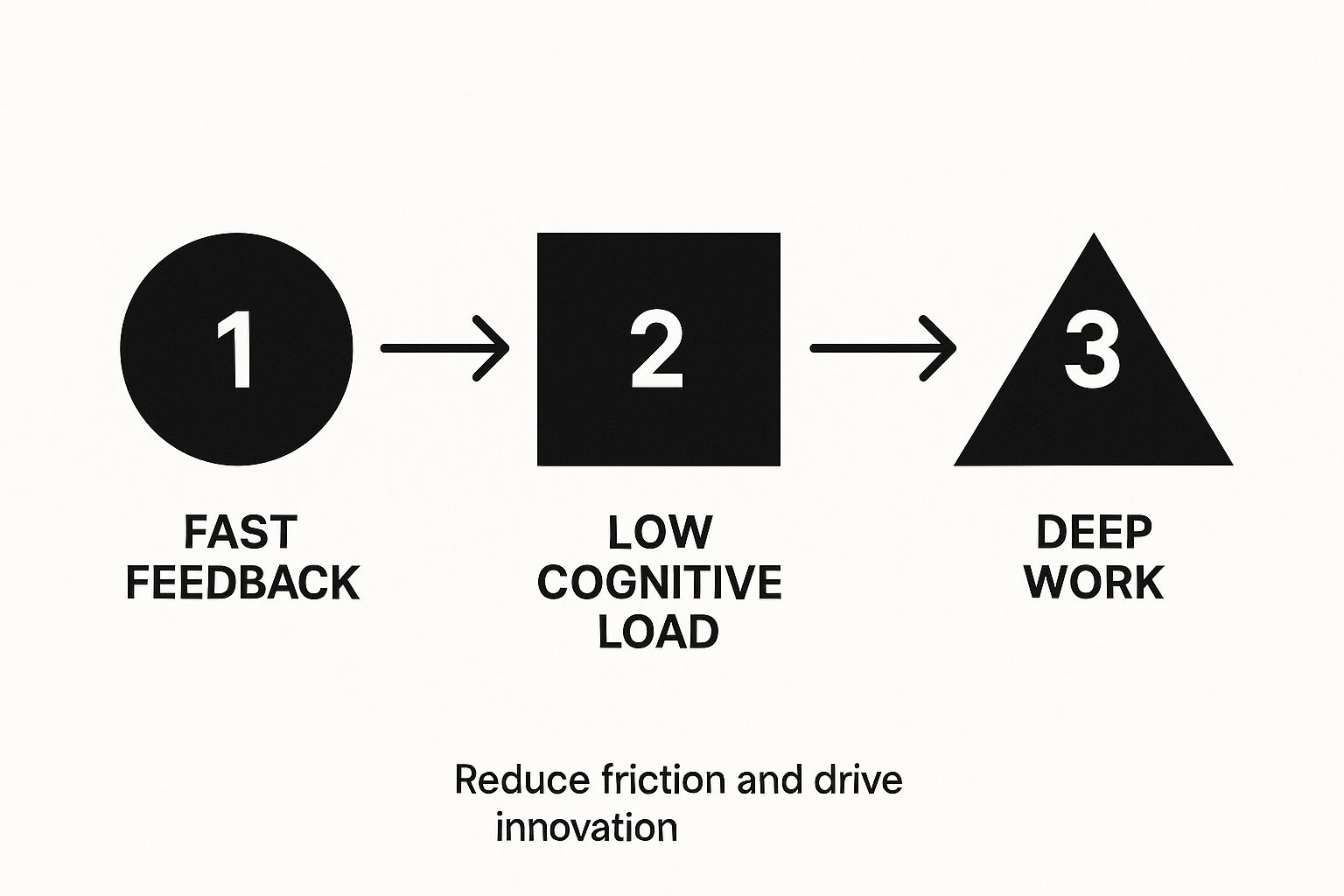
As you can see, when you prioritize immediate feedback and simple workflows, you create the space for the focused, deep work that leads to real breakthroughs. Treating DevEx as a strategic priority isn't a cost center; it's a competitive advantage that pays dividends.
Optimizing Your Core Development Workflow
 A great developer experience isn’t about grand, sweeping changes. It’s forged in the daily grind. The most impactful way to improve developer experience and reclaim lost hours is to smooth out the core workflow, from the moment a ticket is picked up to the second code hits production. It’s all about creating a "path of least resistance" where doing things the right way is also the easiest way.
This journey starts by killing the dreaded "it works on my machine" problem. Inconsistent local environments are a massive source of friction, especially when onboarding new hires. Adopting containerization with a tool like Docker ensures every developer has an identical, predictable setup. This one change can shave days off initial setup time and prevent countless hours spent debugging environment-specific glitches.
Slashing Build and Test Times
Once everyone's local setup is consistent, the next big bottleneck is usually the feedback loop. When developers have to wait 15, 30, or even 60 minutes for a build to complete, they aren't just sitting idle—they're context-switching. That disruption kills momentum and opens the door for distractions.
To get that time back, you need to attack your build and test processes:
- Parallelize Your Tests: Don't run your test suite in a single, long sequence. Split it up to run concurrently across multiple agents to dramatically cut down execution time.
- Implement Caching: Cache dependencies and build artifacts. There’s absolutely no reason to re-download or rebuild the same components over and over again.
- Optimize Your Test Suite: Regularly hunt down and refactor slow or flaky tests. A test that gives unreliable feedback is often worse than no test at all.
A fast, reliable CI pipeline is the bedrock of a solid DevEx. When developers trust that they'll get feedback in minutes, not hours, they stay in the zone and can iterate much faster. That leads directly to higher quality code and quicker delivery.
Simplifying Your Git Strategy
A convoluted branching strategy can bury your team in complexity and constant merge conflicts. For most teams, a simple model like trunk-based development or GitHub Flow works wonders. The goal is to keep branches short-lived and merge them back to the main branch frequently.
This approach minimizes the odds of those painful, complex merges and keeps the whole team working from a recent version of main. Collaboration becomes smoother, and integration issues become a rarity. Tackling these workflow challenges is a direct path to better outcomes, and you can find more proven strategies to reduce cycle time in our detailed guide here: https://blog.pullnotifier.com/blog/7-proven-strategies-to-reduce-cycle-time-in-2025.
Beyond the code, don't forget the physical environment. Something as simple as creating an ergonomic monitor setup can significantly reduce strain and boost focus. Shaving minutes off these daily, repetitive tasks quickly adds up to hours of focused, high-impact coding time each week. It's all about removing the needless hurdles so your team can spend more time doing what they do best: solving complex problems and building great software.
How to Measure Developer Experience Without Micromanaging
You can’t fix what you can't see. But how do you measure something as squishy as "developer experience" without making your team feel like they're under a microscope?
The secret is to stop focusing on individual performance and start looking at the health of your system. A data-informed approach to DevEx isn't about subjective feelings; it's about finding objective insights that reveal process bottlenecks, not who's working the hardest.
This isn't about tracking keystrokes or time spent in an IDE. Think of it like a doctor checking your blood pressure—it’s a diagnostic tool for the health of the system, not a judgment on the patient.
Identify Systemic Friction Points
To actually improve developer experience, you have to look for metrics that expose friction in your development lifecycle. These are the numbers that tell you where the process is slowing people down or causing unnecessary headaches. The right data helps you figure out where to focus your energy for the biggest impact.
Here are a few meaningful metrics that tend to shine a light on systemic issues:
- Cycle Time: This is the big one—the total time from the first commit until that code is live in production. If your cycle time is consistently long, it's a huge red flag for delays in code review, a sluggish CI/CD pipeline, or overly complex approval gates.
- Deployment Frequency: How often does your team successfully ship code to production? Elite teams are deploying multiple times a day. A low frequency might signal a lack of automation, a fear of breaking things, or a release process that’s just too painful.
- Code Review Health: Dig into metrics like Pull Request (PR) pickup time (how long a PR sits waiting for its first review) and review depth. Long delays here are a classic sign of a workflow bottleneck that kills developer momentum.
Measuring these isn't about creating leaderboards. It’s about starting productive conversations. A high PR pickup time isn't one developer's fault; it’s a team problem that could be fixed with better notifications or a clearer on-call review rotation.
Use Data to Build Your Case
When you bring data to the table, you shift the conversation from, "I feel like our reviews are slow," to "Our average PR waits 48 hours for a first review." That specific, objective data point is impossible to ignore. It makes a powerful case for investing in better tooling or changing a broken process.
Quantitative measurement of Developer Experience (DevEx) is a proven way to improve productivity and satisfaction. Research has identified 19 key DevEx metrics that give companies real insights into workflow problems, from code review delays to communication breakdowns. Tracking these metrics directly impacts business goals like faster feature delivery, better code quality, and lower developer turnover. You can explore the research behind these developer experience metrics to see how they connect to what the business cares about.
Gathering Data Ethically
This is the most important part: be transparent. Your team needs to be crystal clear on what you're measuring and, more importantly, why.
- Communicate the "Why": Explain that the goal is to improve the process, not to evaluate individuals. Frame it as a team effort to make everyone's work life less frustrating.
- Focus on Team-Level Data: Always, always aggregate metrics at the team or organizational level. Individual data should never, ever be used for performance reviews.
- Combine with Qualitative Feedback: Data tells you what is happening, but only your team can tell you why. Use the metrics as conversation starters in retrospectives or one-on-ones.
By measuring the health of your code review process, you can pinpoint the exact friction points holding your team back. For a deeper dive into this, check out our guide on the key metrics for faster code reviews in GitHub. This approach turns measurement from a tool of surveillance into a tool for empowerment.
Integrating AI Tools That Actually Help
 AI coding assistants are everywhere now, and they all promise to make us more productive. But just throwing another tool into the mix doesn't automatically improve developer experience. In fact, a poorly implemented AI tool can create more friction, introducing subtle bugs and just adding to the cognitive load it was supposed to reduce.
The trick is to treat AI like a specialized assistant, not a replacement for your engineering judgment. The biggest trap I see teams fall into is trying to outsource complex logic to an AI. That almost always ends in code that’s a nightmare to debug, maintain, and even understand—completely defeating the purpose.
And the data actually backs this up. A recent study found something pretty surprising: AI assistance increased the average time it took experienced developers to finish tasks by 19%. While those same devs expected a 24% speed boost, the reality was the exact opposite. It's a huge disconnect between perception and reality. You can read the full study about AI's impact on developer tasks to see all the details.
Pinpoint High-Value Use Cases
To make AI a real asset, you have to focus it on tasks that are repetitive, predictable, and frankly, a bit of a drag. This is where AI really shines. It frees up developers to concentrate on the hard problems that require actual creativity.
Start by identifying specific pain points in your workflow that AI can solve:
- Generating Boilerplate Code: Instantly create file structures, config files, or the basic scaffolding for a new component.
- Writing Unit and Integration Tests: AI is surprisingly good at generating solid test cases, especially for well-defined functions.
- Summarizing Pull Requests: Some tools can auto-generate concise summaries of changes, making code reviews much faster.
- Refactoring Simple Code: Ask an AI to clean up a specific function for readability or convert it from one pattern to another.
The goal is to offload the "grunt work" of development. When AI handles the mundane tasks, it lowers cognitive load and helps engineers stay in a flow state for longer, tackling the complex challenges that require human creativity and critical thinking.
Train Your Team on Effective Prompting
Just giving your team access to an AI tool isn't enough. The quality of what you get out is directly tied to the quality of what you put in. A vague prompt will almost always give you a generic, unhelpful, or flat-out wrong answer.
You need to establish clear guidelines and offer training on how to write good prompts. This is the single most important step to making sure AI becomes a powerful assistant instead of a source of technical debt. It's a common hurdle developers face, especially when they're figuring out bigger-picture tasks like building mobile apps with AI, which requires getting the fundamentals right from the start.
An effective prompt gives context, specifies constraints, and clearly defines the output you want. For example, instead of asking, "Write a test for this function," try something much more specific: "Write three Jest unit tests for the calculateTotal function. Include one test for a positive case, one for a zero value, and one edge case using a negative number."
That level of detail turns AI from a fun novelty into a genuinely reliable collaborator. It's also critical to pair AI assistance with strong review processes. You can explore our list of the 12 best automated code review tools for 2025 to find tools that can help catch issues before they ever make it to production.
Building a Culture That Drives Improvement

Here's the hard truth: the best tools and processes in the world will fall flat in a culture of silence. A truly great developer experience is built on a foundation of psychological safety, where engineers feel they can flag problems and pitch solutions without anyone playing the blame game.
It’s all about creating an environment where feedback is treated as a gift, not a complaint.
That shift has to start at the top. When leadership actively asks for input—and more importantly, acts on it—people pay attention. If you don't take visible action, any attempt to gather feedback will feel performative, and your engineers will quickly clam up. The goal is a tight feedback loop where problems are raised, addressed, and the results are shared with the whole team.
Creating Channels for Honest Feedback
If you really want to know what’s going on, you need to open up multiple avenues for your team to share their thoughts. A mix of qualitative and quantitative methods usually works best, giving you both the hard data and the crucial "why" behind it.
Here are a few practical ways to get the ball rolling:
- Developer Roundtables: Host regular, informal chats with a small group of engineers. Keep the agenda loose. Ask open-ended questions like, "What’s the most frustrating part of your week?" or "If you could wave a magic wand and fix one thing in our workflow, what would it be?"
- Simple, Anonymous Surveys: Use lightweight tools for short, targeted surveys. Ask specific questions about tooling, meeting overload, or documentation quality. Anonymity is absolutely essential if you want brutally honest answers.
- Dedicated Slack Channel: Spin up a channel like
#devex-feedback. It gives engineers a low-friction way to flag frustrations or share ideas the moment they pop up.
The most critical part of this is closing the loop. When someone gives feedback, acknowledge it publicly. Explain what you're doing about it, and then report back on the outcome. This shows their voice actually changes their work environment.
Bridging the Gap Between Tools and Reality
It's a strange paradox. Even with all the powerful new tools at our disposal, organizational friction is still a massive barrier. A recent survey found that while AI tools can save developers around 10 hours per week, they lose that exact same amount of time to inefficiencies like hunting for documentation or navigating team bureaucracy.
The gains from new tech are being completely wiped out by systemic issues. You can dive into the details in the full Atlassian research on developer experience.
The only sustainable way to make DevEx improvements stick is to empower engineers to own and improve their own workflows. When people feel a sense of agency, they stop being passive observers of a flawed system and start becoming active participants in building a better one. That cultural foundation is what turns a good team into a great one.
Common Questions About Developer Experience
As engineering leaders start digging into DevEx, the same handful of questions always pop up. Getting straight, practical answers is the first step to building a strategy that actually works and gets people on board.
Where Should I Start with a Limited Budget?
You don't need a huge budget to make a real difference in your team's day-to-day experience. In fact, the highest-impact changes are often the cheapest.
The best place to start is by gathering feedback. Just have some informal chats or send out a simple, anonymous survey. Your goal is to find the biggest sources of daily friction that slow everyone down.
More often than not, the big wins come from fixing broken processes, not buying fancy tools.
- Standardize local development: Create a single script or container so you can finally kill the "it works on my machine" problem for good.
- Improve documentation: Don't try to document everything. Just focus on clarifying the most confusing parts of your codebase or APIs first.
- Optimize code review guidelines: Set clear expectations for how fast reviews should happen and what good feedback looks like.
These changes mostly cost you time and a bit of teamwork, but they pay for themselves almost immediately by saving countless hours of developer frustration.
How Do I Convince Management to Invest?
To get buy-in, you have to speak their language. Frame your pitch around business value, not just developer happiness.
Use the metrics we’ve already talked about—like cycle time and deployment frequency—to draw a straight line from developer friction to slower product delivery and higher costs.
Build a business case that clearly shows how investing in better tooling or process automation will lead to faster time-to-market, improved product quality, and higher developer retention. Each of these outcomes has a direct, positive impact on the bottom line.
When you can show that a small investment will make the entire engineering org more efficient, it's a much easier conversation to have.
Can a Small Team Benefit from DevEx?
Absolutely. For small teams, every minute of a developer's time is even more valuable. Improving DevEx can have a massive impact because it helps a lean team stay focused and punch above its weight.
Things like streamlining onboarding, automating repetitive deployment tasks, and keeping documentation clean are non-negotiable for small teams. These practices are what allow you to grow effectively without getting crushed by technical debt and process chaos later on.
Ready to eliminate code review bottlenecks and give your team back valuable hours? PullNotifier integrates seamlessly with GitHub and Slack to provide silent, real-time PR updates, cutting review delays by up to 90%. Start streamlining your workflow for free.