- Published on
Mastering Security Code Reviews Your Practical Guide
- Authors

- Name
- Gabriel
- @gabriel__xyz
Security code reviews aren't just about finding bugs. They're a systematic deep dive into your application's source code, specifically looking for ways it could be exploited. Think of it as a foundational pillar for building secure software, helping your team spot security flaws before they ever see the light of day in production.
Why Modern Development Demands Security Code Reviews
Treating security code reviews as just another box to check is a recipe for disaster. Let’s be real—they’ve become an absolutely indispensable part of the development lifecycle, not just a "nice-to-have."
In today's world of rapid, continuous deployment, a single vulnerable commit can be live in front of customers in minutes. That can turn a small oversight into a massive breach. This isn't just theory, either. The financial and reputational damage from a security incident can be staggering, especially since modern apps often depend on dozens of third-party libraries, creating a huge attack surface.
The Rising Tide of Cyber Threats
The threat landscape is only getting more dangerous. In 2024 alone, supply chain cyberattacks hit roughly 183,000 customers—that's a 33% jump from the year before. At the same time, encrypted cyberattacks surged by 92%, which shows just how good attackers are getting at hiding their tracks in what looks like normal traffic.
Integrating security reviews early in the development lifecycle—a concept known as "shifting left"—drastically cuts the cost of fixing vulnerabilities. A bug found in development is exponentially cheaper and faster to fix than one discovered in production after a breach.
A Competitive Advantage
But strong security code reviews aren't just about playing defense; they're a competitive advantage. This practice shows a serious commitment to quality and security, which builds trust with both users and enterprise clients. A solid security posture is how you build software people can actually rely on, making your product more resilient in a crowded market.
To really get why these reviews are so vital, you need to see them as part of a bigger picture, like the one outlined in these 10 Actionable DevOps Security Best Practices. It's a key piece of a mature security culture that favors proactive risk management over reactive firefighting. This reframes the conversation entirely, turning what some see as a costly chore into a strategic investment in product quality and customer trust.
Setting the Stage for a Successful Security Review
An effective security code review doesn't start with line one of a pull request—it kicks off with a solid plan. Diving into code without context is like navigating a city without a map. You might stumble upon something interesting, but you'll almost certainly miss the critical landmarks. Preparation is what separates a quick, superficial check from a deep, meaningful analysis.
The very first thing you need to do is establish a tangible scope. What exactly is being reviewed? Is it a single function, a brand-new microservice, or a subtle change to the authentication flow? A clearly defined scope prevents wasted effort and makes sure everyone—the author, the reviewer, and the security champion—is on the same page from the get-go.
Understand the Application Context
Before you can even think about spotting a vulnerability, you have to understand what the code is supposed to do. This means getting a firm grasp on the application's context, its data flows, and its overall threat model. Without this foundation, a piece of code might look perfectly harmless in isolation but could introduce a massive flaw within the larger system.
Start by asking these key questions:
- What's the purpose of this change? Get familiar with the business logic behind the new feature or fix.
- Where does the data come from? Trace the flow of user input and data from other services. Is it trusted? Sanitized?
- What are the trust boundaries? Pinpoint where the application interacts with untrusted external systems or users.
Doing this homework helps you put on your "attacker hat" and focus your attention on the most sensitive parts of the codebase. It also helps you spot issues that go beyond simple syntax errors, like the subtle logic flaws we discuss in our guide to common code smells in pull requests.
The infographic below breaks down these core prep steps for a successful security review.
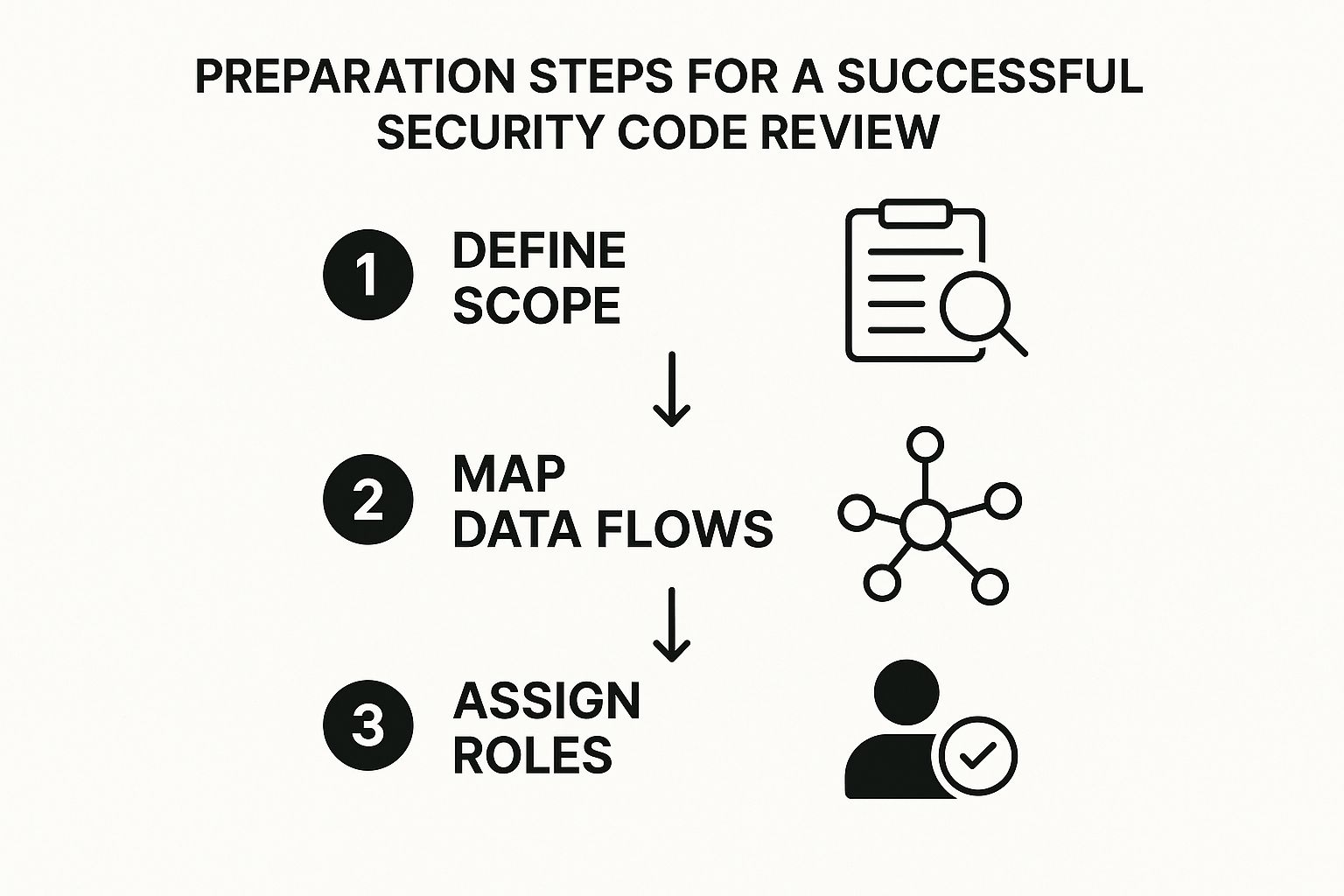
As you can see, defining the scope, mapping out data flows, and assigning clear roles are the foundational steps that make any review truly impactful.
Clarify Roles and Responsibilities
Finally, a smooth process requires everyone to know their part. The roles in a security review are distinct but collaborative, creating a balanced and efficient workflow.
Key Takeaway: A successful review isn't just one person's job. It’s a structured collaboration where the author provides context, the reviewer offers an objective analysis, and the security champion provides specialized guidance.
- The Author: Their main job is to provide context. This means explaining the "why" behind the code, pointing out any particularly complex areas, and being open to constructive feedback.
- The Reviewer: This person brings a fresh pair of eyes. They're tasked with scrutinizing the code against security best practices, the defined scope, and the application’s threat model.
- The Security Champion: Often a developer with extra security training, this person acts as a guide. They can help resolve disputes, offer deeper security insights, and ensure consistency across reviews.
By establishing this pre-flight checklist, every review becomes more focused, efficient, and impactful right from the start.
The Anatomy of an Effective Security Code Review

Alright, this is where the real work begins. An effective security code review isn’t just a one-off check; it’s a repeatable process that blends automated scanning with sharp human intuition. You have to learn to think like an attacker and question every single assumption the code makes about its inputs and environment.
Your process should always kick off with automation. Using Static Application Security Testing (SAST) tools as your first line of defense is non-negotiable. These scanners quickly comb through your code for known vulnerability patterns, catching the low-hanging fruit before a human reviewer even sees the pull request.
But here’s a critical mistake I see teams make: they stop there. SAST tools are fantastic at spotting syntax-level flaws, but they have zero understanding of your business logic. That’s where a manual review becomes absolutely essential.
Adopting an Attacker's Mindset
Once the automated scans have done their part, it’s time for the human-centric review. Your main goal here is to think beyond the code's intended function and imagine all the ways it could be abused. In short, you need to adopt an attacker's mindset.
Question everything. Every single piece of user input—from a simple form field to a URL parameter—is a potential attack vector until you can prove it’s safe.
To stay organized and make sure you don’t miss anything, a structured approach is your best friend. A comprehensive security code review checklist can guide your efforts and ensure you cover all the critical bases, from authentication flaws to insecure data handling.
Spotting What Automated Tools Miss
Automated tools are powerful, but they completely lack nuance. Your manual review needs to zero in on the vulnerabilities that require a deep understanding of context and intent.
Here are the key areas where a human reviewer provides the most value:
- Business Logic Flaws: Can a user manipulate a workflow to their advantage? For example, could they apply a discount code multiple times or somehow skip the payment step in an e-commerce checkout?
- Broken Authentication and Authorization: Does the code actually check if a user is who they claim to be (authentication) and if they have permission to perform a specific action (authorization)? It’s surprisingly easy to miss a permission check on a less-common API endpoint.
- Injection Flaws: While SAST tools are pretty good at catching basic SQL injection, they often miss more complex variants or other injection types like Log Injection or OS Command Injection, where user input gets passed to system commands without proper sanitization.
- Insecure Direct Object References (IDOR): This classic vulnerability happens when an application exposes a direct reference to an internal object, like a database ID, right in the URL. An attacker could simply change
/user/123to/user/124and potentially access someone else’s data.
Let's look at a concrete example of a logic flaw that an automated tool would almost certainly miss.
// A simple API endpoint to process a discount
app.post('/apply-discount', (req, res) => {
  const { userId, discountCode } = req.body;
  const user = database.findUser(userId);

  // The code applies the discount without checking if it was already used
  if (isValidDiscount(discountCode)) {
    user.applyDiscount(discountCode);
    database.save(user);
    return res.status(200).send({ message: 'Discount applied!' });
  }

  return res.status(400).send({ message: 'Invalid code.' });
});
In this snippet, the code correctly validates the discount code itself. What it doesn't do is check if the user has already used this code before. A savvy user could just call this endpoint over and over, applying the same discount repeatedly. This isn't a syntax error; it's a pure business logic vulnerability that requires a human to spot.
Key Insight: A successful review isn't just about finding violations of a rulebook. It's about understanding the code's purpose and identifying where its logic can be subverted to cause unintended behavior.
This human-centric approach, guided by a structured process, is what uncovers the deep-seated risks that pose the greatest threat to your application.
Common Vulnerabilities and Review Focus Areas
To help you focus your manual review, here's a quick checklist of common vulnerabilities. Think of it as a starting point to train your eyes on what to look for when you're examining a pull request.
| Vulnerability Category | What to Look For (Key Questions) | Example Code Snippet to Scrutinize |
|---|---|---|
| Injection (SQL, Command, etc.) | Is user input ever directly concatenated into database queries or system commands? Are parameterized queries used everywhere? | const query = "SELECT * FROM users WHERE id = '" + userId + "';"; |
| Broken Authentication | Are session tokens managed securely? Can session IDs be predicted? Are password policies enforced? | res.cookie('session_id', user.id); |
| Broken Access Control (IDOR) | When accessing a resource, does the code verify that the logged-in user is authorized to view or edit that specific resource? | app.get('/orders/:orderId', ...) |
| Insecure Deserialization | Does the application deserialize data from untrusted sources without validating it first? Could an attacker manipulate the object? | let obj = JSON.parse(userInput); |
| Cross-Site Scripting (XSS) | Is user-provided data rendered directly in the browser without proper output encoding? | document.getElementById('welcome').innerHTML = "Welcome, " + userName; |
| Business Logic Flaws | Can a user perform actions out of order? Can they manipulate pricing, quantities, or other critical business rules? | if (isValidDiscount(code)) { applyDiscount(); } |
This table isn't exhaustive, but it covers the heavy hitters. Focusing on these areas will dramatically increase the effectiveness of your manual review and help you catch the kinds of critical bugs that automated tools often miss.
Integrating Automated Tools into Your Workflow
Manual security code reviews are where you'll catch the really tricky, context-specific bugs, but you can't rely on them as your only line of defense. To scale security without slowing everyone down, you have to get smart about weaving automation into your development process. This creates a powerful hybrid approach.
The whole point is to let automation handle the low-hanging fruit and repetitive checks. This frees up your team's brainpower to hunt for the deeper, more nuanced vulnerabilities that tools almost always miss. It all starts by embedding automated tools right into your daily workflow, making security feel like a natural part of development, not some dreaded final gate.
Weaving SAST into Your CI/CD Pipeline
The single most impactful thing you can do is to hook a Static Application Security Testing (SAST) tool directly into your CI/CD pipeline. The moment a developer pushes code or opens a pull request, the SAST tool should automatically kick off a scan on the new changes.
This gives developers instant feedback, flagging common vulnerability patterns before they ever get merged. They get a notification right there in their pull request, letting them fix simple mistakes on the spot. This immediate feedback loop is absolutely essential for building and reinforcing secure coding habits over time.
A classic mistake is to just "set and forget" these tools. Out-of-the-box configurations are notoriously noisy, flooding your team with so many false positives that they start suffering from alert fatigue. Before long, everyone just ignores the results completely.
Fine-Tuning Tools to Slash False Positives
To get real value from automation, you must fine-tune your tools. This isn't optional. It means digging into the rule sets and tailoring them to your project's specific tech stack and risk profile. If your team knows for a fact that a certain rule doesn't apply to your architecture, turn it off. Simple as that.
You can also go a step further and create custom rules that enforce your organization’s specific coding standards. This is how you transform a generic scanner into a highly-tuned security assistant that gives your developers relevant, actionable feedback. Properly configured tools will drastically cut down on the noise, ensuring that when an alert does pop up, the team actually takes it seriously.
For a deeper look, check out our guide on the 12 best automated code review tools for 2025.
Protecting Yourself from Vulnerable Dependencies
Your own code is only half the story. Modern applications are built on a mountain of open-source libraries and frameworks. A single vulnerable dependency can create a gaping hole in your entire system. This is exactly what Software Composition Analysis (SCA) tools are designed to prevent.
SCA tools automatically scan your project's dependencies and check them against massive databases of known vulnerabilities. They'll alert you the moment a library you're using has a known security flaw, and they often suggest a safe version you can upgrade to. Integrating an SCA tool into your CI/CD pipeline is non-negotiable for protecting your software supply chain.
The market for these platforms is growing fast. The global Secure Code Review Platforms Market is projected to hit USD 1.22 billion in 2025 and is expected to reach around USD 2.44 billion by 2030, thanks in large part to the widespread adoption of DevSecOps. You can find more details about this market growth on mordorintelligence.com.
Building a Culture Where Security Thrives

Tools and processes are important, but they’ll only take you so far. The most resilient organizations are built on a foundation of shared ownership, where security isn't just one person's job—it's woven into the fabric of every team.
This shift doesn't happen by accident. It takes a deliberate effort to turn security from a dreaded gatekeeping exercise into a collaborative, educational experience.
The industry is already heading in this direction. The market for security code reviews is projected to grow at an 8.24% CAGR from 2024 to 2031, a clear sign that companies are investing more in code quality and cybersecurity. This trend highlights a broader move toward collaborative workflows. You can dig into more details about the code review market's future on futuredatastats.com.
This momentum makes it the perfect time to focus on the human side of security. To really make it stick, you need to understand the fundamentals behind strategies for cultivating a positive workplace culture.
Frame Feedback as a Learning Opportunity
How you deliver feedback during a review makes all the difference. Ditch the criticism and start framing your comments as learning opportunities. The real goal here is to educate and empower your developers, not just point out what they did wrong.
Think of it this way: a comment that just says "This is vulnerable to XSS" is a directive. It doesn't teach anything.
A much better approach explains the why and the how: "This input isn't being encoded, which could let an attacker inject malicious scripts. Let's use our standard output encoding library here to lock that down." This approach builds skills and, just as importantly, trust.
Key Insight: The tone of a security code review sets the tone for your entire security culture. Make it constructive, educational, and collaborative, and you'll see developers start proactively seeking out security guidance.
Establish a Security Champions Program
You can't have a security expert embedded in every single team—it just doesn't scale. What you can do is create a security champions program.
The idea is simple: find developers who are already passionate about security and give them extra training and resources. They become the go-to security advisors for their own teams.
These champions act as a bridge between the central security team and the developers on the ground. They help to:
- Answer questions about secure coding practices.
- Triage potential issues early in the development process.
- Advocate for security during team planning sessions.
- Help conduct peer security reviews, lightening the load on senior reviewers.
This distributed model makes security knowledge accessible and relevant to each team's specific projects. Over time, it creates a positive feedback loop that elevates the security skills of your entire engineering organization, transforming your culture from the inside out.
Common Questions About Security Code Reviews
Even with a solid process, questions always pop up when you start weaving security code reviews into your workflow. Getting straight, practical answers is the key to clearing those hurdles and getting your team on board.
Let's tackle some of the most common questions we hear from development teams.
How Often Should We Conduct Security Reviews?
The short answer? All the time. The most effective way to handle security is to make it a continuous part of your development lifecycle. Ideally, every single pull request should get some level of security check. This turns security from a massive, end-of-sprint headache into a small, manageable part of daily work.
Of course, not all changes are created equal. If someone is touching authentication logic or payment processing, you’ll want a security specialist to give it a much deeper look. But for most day-to-day changes, a simple peer review guided by a security checklist is more than enough.
The biggest mistake we see is teams saving all their security reviews for the end of a sprint. It creates a huge bottleneck and makes vulnerabilities way more expensive and painful to fix. Small, frequent reviews are faster and far more effective.
What Is the Real Difference Between SAST and Manual Reviews?
Think of it as a partnership between a machine and a human expert. They're not competing; they're complementing each other's strengths.
- SAST (Static Application Security Testing) tools are your automated scanners. They are lightning-fast and fantastic at spotting known vulnerability patterns across your entire codebase—things like basic SQL injection flaws or the use of deprecated crypto functions.
- Manual Security Code Reviews are done by a human who actually understands the why behind your application. They can spot complex design flaws, business logic errors, and other subtle issues that an automated tool would never catch because it lacks context.
The best strategy is to use both. Let SAST tools handle the low-hanging fruit and catch the obvious stuff automatically. This frees up your human reviewers to use their brainpower on the deep, complex risks that truly threaten your application.
Who Should Actually Perform the Reviews?
Security is a team sport, not a solo mission for one person in the corner. While it helps to have a dedicated security expert or a "security champion" to lead the charge and review the most critical changes, every developer should be trained to review code with a security mindset.
A great model is to have peer reviews for the majority of changes, with a solid security checklist to guide them. For anything particularly sensitive, it’s smart to have a senior developer or the team’s security champion do a second pass. This approach not only scales your security efforts but also spreads that critical knowledge across the team, building a culture where everyone owns the security of the product.
Ready to cut through the noise and accelerate your development cycle? PullNotifier integrates seamlessly with GitHub and Slack to deliver real-time, consolidated pull request updates, reducing review delays by up to 90%. Learn more and start for free.