- Published on
How to Prioritize Work Tasks and Reclaim Your Focus
- Authors

- Name
- Gabriel
- @gabriel__xyz
If you’re constantly busy but feel like you’re going nowhere, your to-do list is probably the culprit. The secret to getting ahead isn't about working harder; it's about ditching the reactive list of everything and adopting a strategic focus on what actually moves the needle. It all comes down to learning the difference between what feels urgent and what is genuinely important.
Why Your To-Do List Feels Like a Trap
The classic to-do list is a relic from a much simpler time. In today's world of non-stop notifications and shifting priorities, it's more often a source of stress than a tool for getting things done. What starts as a simple list quickly balloons into an overwhelming mess, leaving you with no clear direction.
The Illusion of Productivity
Let's be honest—checking off small, easy items feels great. That little dopamine hit creates a false sense of accomplishment, making us feel productive even when we've spent the entire day on tasks that don't matter. We mistake busyness for progress, clearing out the small stuff while the big projects that drive real results get pushed to tomorrow. This cycle is a fast track to burnout and that frustrating feeling of spinning your wheels.
A perfect example is spending the first hour of your day clearing out a flood of non-urgent emails. Your inbox might be emptier, but you've just burned your best, high-energy time on low-impact work instead of tackling that critical project report.
Drowning in Decision Fatigue
When every task on your list looks equally important, you force your brain to make dozens of tiny decisions all day long. "Should I work on the presentation now?" "Or should I return that call first?" This constant back-and-forth drains your mental energy, a phenomenon known as decision fatigue.
By midday, your ability to make sharp, strategic choices is shot. You're far more likely to default to whatever is easiest, not what's most important.
This mental exhaustion is exactly why you need a system, not just a list. A good prioritization framework makes those decisions for you ahead of time. This proactive approach saves your mental energy and ensures your efforts are always aimed at your biggest goals. You can also reclaim focus by automating the small stuff; learning how to automate repetitive tasks is a great way to free up your mind for more strategic work.
Using the Eisenhower Matrix to Find Clarity
When your to-do list feels more like a source of dread than a roadmap, it’s time for a reality check. A simple four-quadrant box, the Eisenhower Matrix, is a surprisingly powerful way to get back in the driver's seat. It’s named after the former U.S. President, who was a master of productivity, and its whole purpose is to force you to separate tasks by urgency versus their actual importance.
Getting that distinction right is everything. It’s the key to breaking free from the hamster wheel of being "busy" without actually making meaningful progress.
Most of us spend our days in reactive mode, just putting out whatever fire is screaming the loudest. The matrix forces a pause. It makes you ask a simple but critical question for every single item on your list: “Does this actually move the needle on my long-term goals, or is it just noise?” That shift in thinking is the first real step toward a proactive workflow.
The infographic below shows what happens when we don't prioritize—we fall into the "To-Do List Trap." An endless list just leads to decision fatigue, a false sense of accomplishment from trivial tasks, and a constant, low-grade hum of stress.
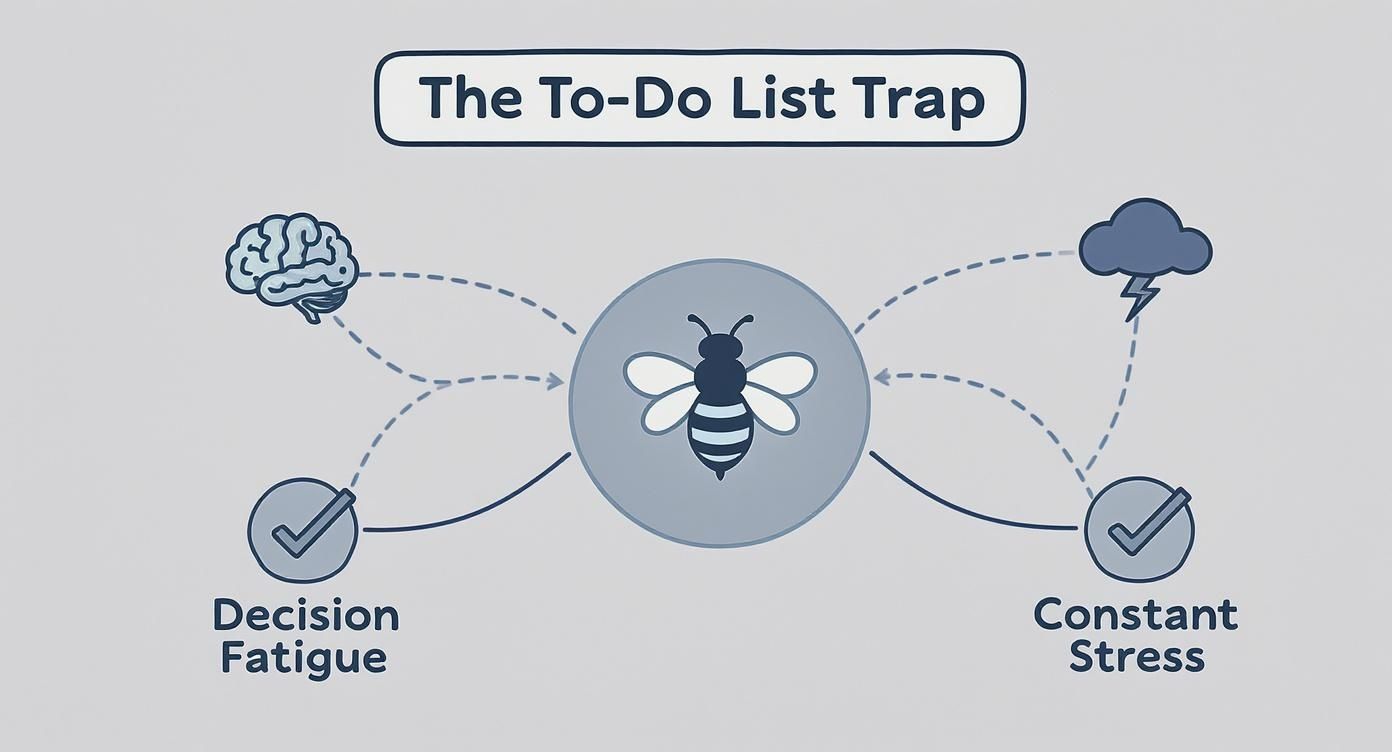
This visual nails it. An unorganized list pulls your energy toward low-impact activities that feel productive but are ultimately just distractions. The Eisenhower Matrix is the perfect antidote.
Navigating the Four Quadrants
The matrix is split into four boxes based on two criteria: importance and urgency. Simply sorting your tasks into these categories gives you immediate clarity on what your next move should be. It’s a foundational skill when learning how to prioritize work tasks.
Here’s how each quadrant breaks down and what to do with the tasks that land there:
*   **Quadrant 1: Urgent & Important (Do Now)** These are your fires, your real crises, and your hard deadlines. Think of a critical server outage or a final report for a key client that's due this afternoon. These things demand your immediate, focused attention.

*   **Quadrant 2: Not Urgent & Important (Schedule)** This is where real success is built. These are the tasks that drive long-term growth: strategic planning, learning a new skill, or building relationships with key partners. You have to be deliberate and schedule time for these, otherwise, they get swallowed by the urgent stuff.

*   **Quadrant 3: Urgent & Not Important (Delegate)** This quadrant is a productivity sinkhole. It's filled with interruptions that feel pressing but do nothing to advance your goals. Think of routine meeting requests or responding to emails that could be handled by someone else. Delegate or automate these without mercy.

*   **Quadrant 4: Not Urgent & Not Important (Eliminate)** These are the time-wasters that provide zero value. This could be anything from mindlessly scrolling through social media to organizing digital files you'll never look at again. Be ruthless here—just get rid of them.
To make this more tangible, let's look at how you might categorize some common work activities.
Applying the Eisenhower Matrix to Your Daily Tasks
| Quadrant | Description | Example Task |
|---|---|---|
| Q1: Do | Urgent and important tasks that need immediate action. | Fixing a critical bug that's impacting customers. |
| Q2: Schedule | Important but not urgent tasks that you need to plan for. | Planning the marketing strategy for the next quarter. |
| Q3: Delegate | Urgent but not important tasks that can be given to others. | Responding to a routine internal information request. |
| Q4: Eliminate | Tasks that are neither urgent nor important. | Sorting through old promotional emails. |
This table shows just how quickly you can bring order to a chaotic list.
Putting the Matrix into Action
Let’s say you’re a marketing manager. An unexpected request pops up from a salesperson who needs a one-off graphic for a small, local event—and they need it now. This feels urgent, but does it align with your larger campaign goals? Probably not. It's a classic Quadrant 3 task. The smart move is to delegate it to a junior designer.
On the other hand, blocking out two hours next Tuesday to analyze last quarter's campaign data and map out a plan for the next one is pure Quadrant 2. It’s not on fire today, but the long-term impact on your success is massive.
The real secret to powerful prioritization is spending as much time as possible working in Quadrant 2. This is how you shift from being a firefighter to an architect, preventing many of tomorrow's "urgent" problems from ever happening in the first place.
When you consistently apply this framework, you start training your brain to see past the immediate chaos of the day. You learn to put your best energy into activities that build momentum and deliver real, lasting results. It completely changes your relationship with your work.
Applying The MoSCoW Method For Team Alignment
Getting your own priorities straight is one thing. Getting an entire team to agree on what’s most important? That's a whole different ball game.
When everyone has their own version of what "priority number one" is, work grinds to a halt. Deadlines get fuzzy, and frustration starts to build. This is exactly where the MoSCoW method shines, especially when you need to get everyone on the same page.
It gives the team a common language to talk about what really needs to get done. Instead of vague arguments about what’s "important," you get clear, agreed-upon categories. It cuts through the noise and answers the big question: "What are we actually shipping right now?"
Defining The MoSCoW Categories
MoSCoW is a simple acronym that helps you sort every task or feature into one of four buckets. This framework brings instant clarity, which is a lifesaver during planning. The best way to do it is to get all the key players in a room (even a virtual one) and hash out where every single item belongs.
Here’s how it breaks down:
*   **Must-Have:** These are the non-negotiables. If you don't deliver these, the project fails. End of story. Think of core features, legal requirements, or safety essentials that are absolutely critical for launch.
*   **Should-Have:** These are still really important and add a ton of value, but they aren't deal-breakers for the initial release. The product will still work without them, but it might feel incomplete or force users into clunky workarounds.
*   **Could-Have:** You'll often hear these called "nice-to-haves." They're desirable features that would be great to include, but their impact is pretty small if they get cut. When time or resources get tight, these are the first to go.
*   **Won't-Have:** This is the most powerful—and most ignored—category. It’s a list of everything you are *explicitly not* doing right now. This is your secret weapon against scope creep. It sets firm boundaries and keeps everyone's expectations in check.
MoSCoW In A Real-World Scenario
Let's say your product team is building a new mobile banking app. During a planning meeting, you use MoSCoW to decide what makes it into the very first version.
The Must-Haves are obvious pretty quickly: user login with two-factor authentication, a screen to view account balances, and the ability to transfer money between accounts. Without these, you don't really have a banking app.
Next up, the Should-Haves. The team decides this includes features like setting up recurring payments and a searchable transaction history. The app can launch without them, but users will definitely be asking for them soon.
By clearly defining what won't be included, the team proactively prevents misunderstandings and keeps everyone focused on the agreed-upon deliverables for the current sprint or release cycle.
Then, you have the Could-Haves: maybe a dark mode option and some cool personalized spending reports. They would definitely improve the user experience, but they aren't essential for core banking tasks.
Finally, the Won't-Haves. The team agrees that cryptocurrency trading and loan applications are off the table for this launch. They’re great ideas for the future, but they're not part of this release.
This kind of collaborative exercise is a game-changer for teamwork. While MoSCoW is fantastic, it's just one of many essential prioritization techniques that can help sharpen your team's focus. It also slots perfectly into agile workflows, which is why it’s so popular. If you're looking to level up your team's process, digging into sprint planning best practices is a great next step.
Making Strategic Choices with an Impact vs. Effort Analysis
If you're looking for a dead-simple, visual way to find the smartest use of your time, the Impact vs. Effort Matrix is a fantastic tool. It cuts through the noise of "urgent" versus "important" by forcing you to weigh the potential payoff of a task against what it will actually take to get it done. This is all about prioritizing work that delivers the most value with the least friction.
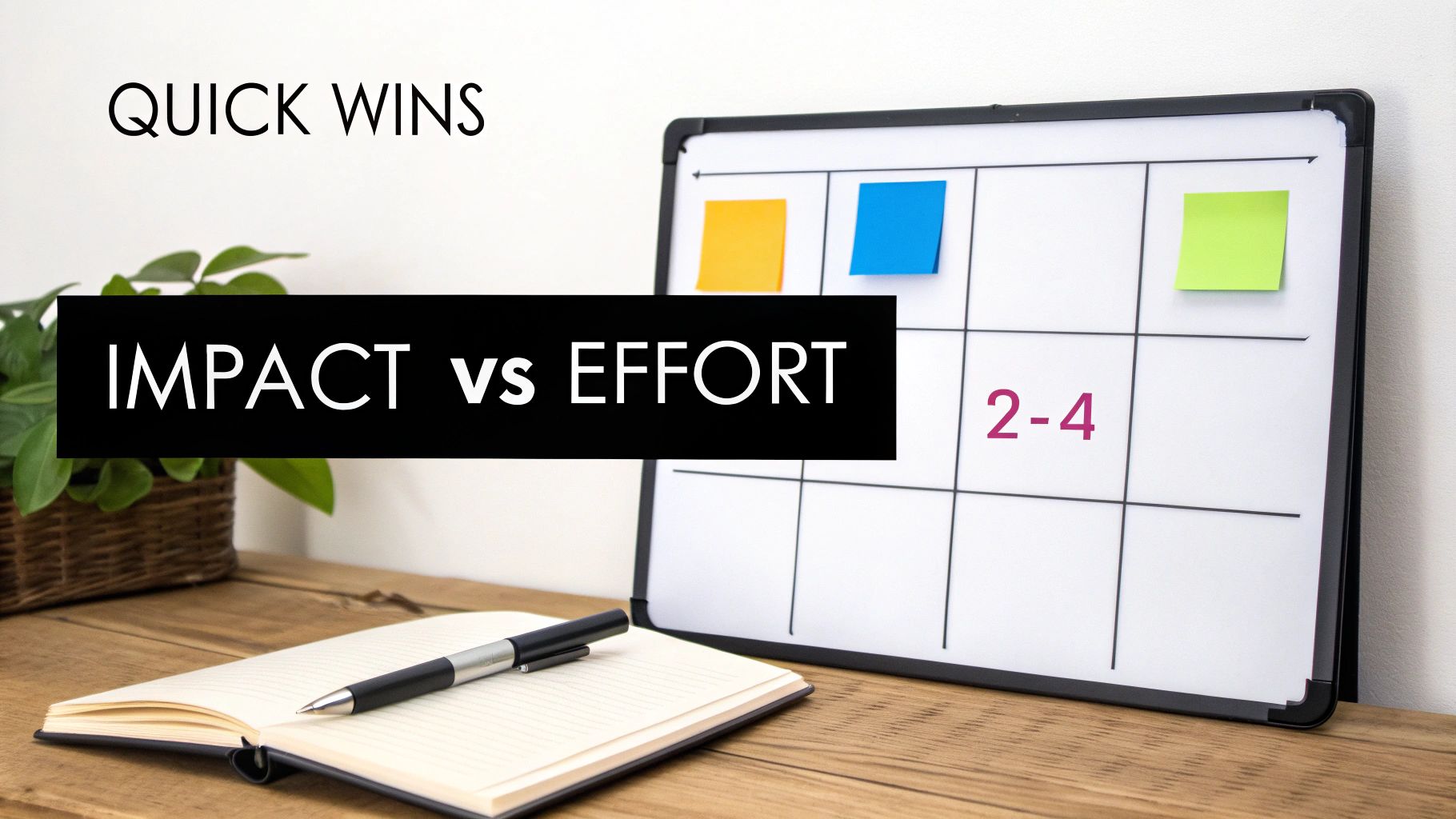
The whole idea is to plot your tasks on a simple four-quadrant grid. The vertical axis tracks potential impact (low to high), while the horizontal axis measures the effort required (low to high). Where a task lands on that grid gives you a pretty clear indication of how you should approach it.
The Four Quadrants of Strategic Action
Each quadrant in this matrix represents a different type of work, and each one points you toward a specific action. Getting a feel for these categories is how you start making smarter calls on where to spend your energy.
*   **Quick Wins (High Impact, Low Effort):** This is your priority zone. These are the tasks that give you the biggest bang for your buck and are perfect for building momentum. Think of fixing a simple bug on a high-traffic webpage or tweaking an email template that goes out to thousands of customers. Get these done first.

*   **Major Projects (High Impact, High Effort):** These are the big-ticket items that move the needle on your long-term goals but require serious planning and resources. Launching a new marketing campaign or developing a core software feature would fall in here. These need to be broken down into smaller pieces and scheduled carefully.

*   **Thankless Tasks (Low Impact, High Effort):** This quadrant is the danger zone. These are the time-sucks—tasks that eat up your energy but don't produce much value. Manually creating a detailed report that nobody actually reads is a classic example. Your goal here is to avoid, delegate, or automate these whenever you can.

*   **Fill-ins (Low Impact, Low Effort):** These are the small, miscellaneous tasks you can knock out in those little pockets of free time. Think organizing your files or replying to non-urgent internal messages. They won't change the game, but they’re easy to clear off your plate without derailing your focus on what really matters.
Putting the Matrix into Practice
Let's say you're a project manager staring down a massive to-do list. You start plotting each item. A "Quick Win" might be creating a shared project status document that immediately clears up team communication. A "Major Project" could be onboarding a new enterprise client—a complex but absolutely vital process.
On the other end, a "Thankless Task" might be overhauling an internal documentation system that only a handful of people use. The effort is massive, but the impact is tiny. And finally, a "Fill-in" could be archiving old project files from last quarter.
The real power of this matrix is its simplicity. It provides a clear, visual guide that helps you and your team quickly agree on where to invest your most valuable resource: your time.
By using this kind of analysis regularly, you stop just reacting to what's on your list and start making conscious, strategic choices. If you want to explore how structured thinking can improve your work even further, it's worth diving into various decision-making frameworks. This kind of structured approach is what ensures your daily efforts are actually pushing your most important goals forward.
Managing the Human Side of Setting Priorities
Having the perfect framework for sorting tasks is only half the battle. The real challenge? Juggling the expectations of managers, teammates, and clients.
Effective prioritization isn't just a solo activity—it’s a communication skill. It’s about protecting your focus while keeping your professional relationships strong.
This human element is where so many good intentions fall apart. The pressure to say "yes" to every single request can quickly wreck even the most organized plans. Before you know it, you're in a reactive workflow, putting out fires and serving everyone else's priorities instead of your own.
When leaders don't create an environment where it's safe to have these conversations, the fallout is severe. It’s a massive driver of burnout and disengagement. The Gallup 2025 State of the Global Workplace report found that global employee engagement has slumped to just 21%, with the U.S. hitting a decade-low of 31% in 2024.
This kind of widespread disengagement, often fueled by poor prioritization and weak management, is estimated to cost nearly 9% of total global GDP. You can dig deeper into the numbers in this detailed remote work report.
Communicating Your Priorities Effectively
Just dropping a "no" on someone is rarely the right move. The real goal is to make your current workload visible and talk through the trade-offs together.
This approach turns a potentially tense moment into a strategic conversation about shared goals. It’s about changing the script from "I can't do that" to "I can absolutely do that, but here’s what we’ll need to adjust to make it happen."
For instance, let's say your manager drops a new, urgent task on your plate. Instead of a flat-out rejection, frame the situation around your existing commitments:
"Happy to take this on. Just to be clear, my main focus right now is finishing the quarterly report, which is due Thursday. Should I pause work on the report to prioritize this new task, or would you prefer I complete the report first?"
This shows you're a team player while clearly laying out the impact of the new request. It puts the ball back in their court to make the final call on the trade-off.
Actionable Scripts for Negotiating Deadlines
Having a few go-to phrases ready can make these conversations a whole lot smoother. They help you stay professional and keep the focus on finding a solution, not just pointing out a problem.
Here are a few common scenarios and some scripts to borrow:
*   **When you're at capacity:** "That's an important project. My plate is full this week with X and Y. Can we look at my calendar for next week to find the best time to give this the focus it deserves?"
*   **When the timeline is unrealistic:** "I understand the urgency. To deliver the quality of work we both expect, I estimate this will take about 10 hours. Could we adjust the deadline to Friday, or maybe simplify the scope to fit the current timeline?"
*   **When you need more information:** "I want to make sure I understand the full impact of this task. Could you help me see where this fits in with our team’s big goals for the month?"
Using scripts like these shows you're thinking strategically about how to prioritize work tasks. You're not just trying to get out of work; you're committed to delivering results that actually matter.
How to Build Sustainable Prioritization Habits
Learning a bunch of cool frameworks is the easy part. The real challenge? Turning them into automatic, sustainable habits that stick. Building a reliable system for how you prioritize your work doesn't just happen. It's about creating a consistent routine that guides your choices, protects your focus, and frees up your mental space for the work that actually matters.
This shift toward more mindful work isn't just another productivity hack—it's a direct response to a professional landscape that's burning people out. Employees everywhere are pushing back against the culture of being constantly "on" and reactive.
A 2025 JLL Workforce Preference Barometer found that work-life balance now often beats salary, with flexible time management being a top priority for workers across 31 countries. When companies don't support this need for structured prioritization, engagement and business outcomes take a hit. You can find more workplace trends from archieapp.co.
This data really drives home the importance of building systems that foster a healthier relationship with your workload. The end game is to move from a state of constant reaction to one of intentional action.
Create Your Weekly Reset Ritual
One of the most powerful ways I've seen people build a lasting habit is by scheduling a weekly review. Block out 30 minutes every Friday afternoon or Monday morning. This isn't just about creating another to-do list; it's a strategic reset where you look back at the past week and map out the next.
During this time, ask yourself a few key questions:
*   What were my biggest wins last week?
*   What's still lingering that needs to be carried over?
*   What are the top **1-3 priorities** that will define a successful week ahead?
This simple ritual ensures you start every week with a clear, intentional plan instead of getting immediately steamrolled by a flood of incoming requests.
Defend Your Focus with Time Blocking
Once you know what your priorities are, time blocking is your best friend for defending against distractions. It’s pretty straightforward: you schedule specific blocks of time on your calendar for your most important tasks, treating them like non-negotiable appointments.
For example, if finishing that big project proposal is a major priority, block out a 90-minute slot and kill all notifications during that window. This practice signals to yourself—and to your colleagues—that your focused time is valuable and off-limits.
For engineering teams, where disciplined focus is non-negotiable, this is especially critical. You can explore more strategies for boosting productivity in engineering in our practical guide. When you consistently honor these blocks, you're essentially training your brain to drop into deep, productive work on command.
Got Questions About Prioritizing Your Work?
Even the best-laid plans run into trouble when the rubber meets the road. Frameworks are great in theory, but what happens when you’re actually in the trenches? Let's tackle some of the most common questions that pop up.
Getting clarity on these hurdles is the key to making any prioritization method actually stick.
"What's the Best First Step if I Feel Completely Overwhelmed?"
Start with a "brain dump." Seriously, just grab a piece of paper or open a blank note and write down every single thing that’s eating up your mental space. Don't organize it, don't filter it—just get it all out.
This simple act is incredibly powerful. It clears the mental clutter and gives you a full inventory of what you’re up against. Once it’s all down on paper, you can start applying a framework like the Eisenhower Matrix to sort through the noise and finally feel like you're back in control.
"How Do I Handle a New 'Urgent' Request From My Boss?"
When a new emergency task lands on your desk, your best tool is crystal-clear communication. First, take a breath and quickly assess its actual impact. Then, have a proactive chat with your manager.
Instead of just saying "yes," try framing it like this: "I can definitely get this done. To make sure it gets the attention it needs, could you help me decide if I should pause Project X or push back Report Y to make room for it?"
This approach does two things: it shows you’re on top of your current workload and it makes the trade-offs of the new request obvious to everyone.
"How Often Should I Actually Review My Priorities?"
Consistency is everything. A two-tiered rhythm usually works best, keeping you agile without getting bogged down in constant planning.
*   **Daily Check-in:** Spend just **5-10 minutes** at the start of your day. Pinpoint your top **1-3 priorities** and focus on those.
*   **Weekly Review:** Block out a more focused **20-30 minute** session once a week. This is your time to check progress on bigger projects and map out the upcoming week.
This cadence keeps you nimble day-to-day while making sure you’re still steering the ship toward your long-term goals.
Stop drowning in GitHub notifications and start merging faster. PullNotifier delivers clean, real-time pull request updates directly to Slack, cutting through the noise so your team can focus on what matters. See why over 10,000 engineers trust us to streamline their code reviews at https://pullnotifier.com.