- Published on
10 Regression Testing Best Practices for 2025
- Authors

- Name
- Gabriel
- @gabriel__xyz
In today's fast-paced development cycles, a robust regression testing strategy isn't just a safety net; it's a critical component for delivering high-quality software without slowing down innovation. As codebases grow and features evolve, the risk of introducing unintended side effects increases, making effective regression testing more important than ever. However, simply re-running old tests is inefficient and often ineffective. A poorly managed regression suite can quickly become a bottleneck, consuming valuable time and resources while providing a false sense of security.
To stay competitive, teams must adopt modern, strategic approaches that maximize defect detection while minimizing resource drain. This guide cuts through the noise to provide a detailed roundup of 10 essential regression testing best practices. We'll move beyond the basics to cover actionable techniques you can implement immediately.
You will learn how to:
*   Prioritize test cases based on risk and business impact.
*   Automate smartly to accelerate feedback loops.
*   Maintain a healthy and efficient test suite.
*   Integrate testing seamlessly into your CI/CD pipeline.
By implementing these strategies, you can prevent costly bugs from reaching production, build a more resilient testing process, and maintain a seamless user experience with every release.
1. Automated Regression Testing
Automated regression testing is a cornerstone of modern software development, using specialized tools and frameworks to execute test cases automatically. This practice is fundamental for ensuring that new code changes or bug fixes do not inadvertently break existing, previously functional features. By automating these checks, teams can eliminate the time-consuming and error-prone nature of manual testing, enabling rapid and reliable feedback within CI/CD pipelines.

This approach is one of the most effective regression testing best practices because it dramatically accelerates the development lifecycle. For example, tech giants like Google and Amazon run millions of automated tests daily to validate their complex systems, ensuring stability with every deployment. This allows for continuous delivery without sacrificing quality, making it an essential practice for any team looking to scale its testing efforts and boost overall productivity.
How to Implement Automated Regression Testing
To successfully integrate this practice, focus on a strategic, incremental approach rather than attempting to automate everything at once.
*   **Prioritize High-Risk Areas:** Start by automating tests for your application's most critical and frequently used features. This ensures you get the highest return on investment early on by stabilizing core functionality.
*   **Maintain Your Scripts:** Treat your test code like production code. Use version control (e.g., Git), follow clear naming conventions, and regularly review and refactor scripts to keep them relevant and efficient.
*   **Run Tests in Parallel:** To shorten the feedback loop, configure your test suite to run multiple tests simultaneously across different environments. This drastically reduces overall execution time.
By embracing automation, you can transform your regression testing from a bottleneck into a powerful enabler of speed and quality. Learn more about how to boost your team's productivity by automating repetitive tasks.
2. Test Case Prioritization
Test case prioritization is a strategic method of ranking regression tests based on their business impact, risk level, and frequency of use. This practice is crucial for ensuring that the most critical tests are executed first, which maximizes the chances of detecting significant defects early, especially when time and resources are limited. Instead of running an entire suite, teams can focus their efforts on tests that protect core functionalities.
This approach is one of the most practical regression testing best practices because it optimizes testing cycles for efficiency and impact. For instance, an e-commerce platform like Uber prioritizes tests for its booking, payment, and driver-matching algorithms, as failures in these areas would directly disrupt its primary business operations. This targeted approach ensures that even with limited time, the most severe potential issues are addressed first, safeguarding user experience and revenue.
How to Implement Test Case Prioritization
To effectively prioritize your test suite, focus on a risk-based strategy that aligns testing efforts with business goals.
*   **Collaborate with Product Managers:** Work closely with product and business stakeholders to identify which features are most critical to users and the business. This ensures your prioritization reflects real-world impact.
*   **Analyze Risk and Usage Data:** Use analytics and code coverage tools to determine which parts of the application are most frequently used or have historically been prone to defects. Prioritize tests covering these high-risk, high-traffic areas.
*   **Review and Adapt Continuously:** Test priorities are not static. Re-evaluate and adjust your prioritized list after each release cycle or major feature update to ensure it remains relevant to the evolving product.
3. Test Suite Maintenance and Refactoring
Regular maintenance and refactoring of your regression test suite is a critical practice to ensure it remains effective, relevant, and efficient over time. This involves systematically removing obsolete tests, consolidating redundant cases, updating scripts to reflect UI or API changes, and improving overall test code quality. A well-maintained suite is far more reliable, easier to run, and simpler to debug when failures occur.

This process is one of the most important regression testing best practices because it prevents test suite decay, where an unmanaged suite becomes slow, flaky, and untrustworthy. For example, Spotify actively consolidates similar tests to reduce maintenance overhead, while Slack performs quarterly test suite audits to remove outdated or redundant tests. This proactive approach ensures the test suite remains a valuable asset rather than a technical debt liability, directly supporting a healthy CI/CD pipeline.
How to Implement Test Suite Maintenance
To keep your regression suite in top shape, integrate maintenance into your regular development sprints and use a structured approach to identify and address issues.
*   **Schedule Regular Audits:** Dedicate time, such as during low-velocity periods or at the end of a release cycle, to review the entire test suite. Look for tests that are no longer relevant to current features.
*   **Use Code Analysis Tools:** Leverage static analysis tools to identify redundant code, overly complex tests, or areas for refactoring within your test scripts. This helps pinpoint opportunities for consolidation and simplification.
*   **Implement Clear Naming Conventions:** Adopt and enforce a strict naming convention for your tests. A clear system (e.g., `Module_Feature_TestCaseID`) makes it easier to identify, group, and manage tests as the suite grows.
By treating your test suite as a living project, you ensure it continues to provide accurate and fast feedback. Discover more about how to improve your QA processes with modern strategies.
4. Risk-Based Testing Strategy
A risk-based testing strategy is a powerful approach that prioritizes regression testing efforts on application areas with the highest probability and impact of failure. This method involves a systematic analysis of potential risks tied to new code changes, enabling teams to allocate their limited testing resources where they matter most. It combines business criticality, technical complexity, and the scope of changes to create a targeted testing plan.
This methodology is one of the most intelligent regression testing best practices because it optimizes test coverage by focusing on what could cause the most significant damage if it breaks. For example, Tesla heavily prioritizes risk-based testing for safety-critical features like its autopilot and braking systems, while financial institutions like JPMorgan Chase apply it to secure transaction processing systems. This ensures that the most crucial functionalities receive the most rigorous validation.
How to Implement a Risk-Based Testing Strategy
Adopting this strategy requires a collaborative effort to identify, assess, and mitigate risks effectively before testing begins.
*   **Establish a Risk Assessment Matrix:** Create a clear matrix that defines criteria for risk probability (e.g., low, medium, high) and impact (e.g., critical, major, minor). This provides a consistent framework for evaluating potential issues.
*   **Involve Cross-Functional Stakeholders:** Bring together developers, QA engineers, and business analysts to identify risks. This ensures a holistic view that considers technical complexity, business value, and user impact.
*   **Use Historical Data for Predictions:** Analyze past bug reports and production incidents to inform your risk assessments. This data-driven approach helps you more accurately predict which areas are prone to defects after a new release.
By focusing your testing efforts strategically, you can maximize defect detection in critical areas while minimizing wasted time. Learn more about how this fits into a broader quality assurance testing process.
5. Baseline Testing and Comparison
Baseline testing establishes a performance and functionality reference point for software, against which all subsequent regression tests are compared. This practice creates a known-good state that serves as a benchmark, making it easier to identify deviations caused by code changes. It is fundamental for detecting performance regressions, such as slower response times or increased memory usage, and subtle behavioral changes that might otherwise go unnoticed.
This approach is one of the most vital regression testing best practices because it provides an objective, data-driven way to measure the impact of new updates. For instance, major software companies like Oracle and Adobe maintain strict performance baselines across product releases. This allows them to instantly flag any new code that degrades rendering speeds in Creative Cloud or slows down database queries, ensuring a consistent user experience and preventing gradual performance decay over time.
How to Implement Baseline Testing and Comparison
To effectively integrate this practice, focus on creating a stable, well-documented benchmark and using automation to enforce comparisons consistently.
*   **Establish a Clean Baseline Environment:** Create your baseline on a stable, isolated environment that mirrors your production setup. This ensures that your reference point is reliable and free from external variables that could skew results.
*   **Document Baseline Conditions:** Comprehensively document the baseline's state, including the hardware, operating system, software versions, and specific configurations. This context is crucial for accurately interpreting future test results and reproducing the baseline if needed.
*   **Automate Comparisons:** Use automated tools to run tests and compare the results against your established baseline. Set acceptable variance thresholds for key metrics to automatically flag significant deviations and streamline the defect detection process.
6. Smoke Testing for Regression Suites
Smoke testing serves as a preliminary, lightweight regression check designed to verify that the most critical functionalities of an application are working correctly after a new build. This practice acts as a gatekeeper, preventing teams from wasting valuable time and resources on extensive test suites if the core application is unstable. By running a quick sanity check, smoke tests confirm that the build is viable for more thorough testing.
This approach is one of the most efficient regression testing best practices because it provides an immediate "go/no-go" decision. For instance, tech giants like Microsoft use smoke tests as an initial validation for every Windows feature commit, ensuring that fundamental system operations aren't broken before proceeding. This rapid feedback loop is crucial for maintaining momentum in a fast-paced CI/CD environment, catching show-stopping bugs at the earliest possible stage.
How to Implement Smoke Testing for Regression Suites
To integrate smoke testing effectively, focus on breadth over depth, ensuring the tests are fast, reliable, and cover only the most essential user journeys.
*   **Keep Suites Focused and Lightweight:** Your smoke test suite should execute in minutes. Include only tests that cover critical paths like user login, core feature navigation, and key system health checks.
*   **Execute Immediately After Build Completion:** Integrate smoke tests to run automatically as the very first step in your CI/CD pipeline after a build is deployed. This ensures instant feedback on build stability.
*   **Fail the Build on Failure:** Configure your pipeline to halt immediately if any smoke test fails. This prevents a broken build from moving further down the pipeline, saving time and preventing flawed deployments.
7. Continuous Integration and Continuous Testing
Continuous Integration and Continuous Testing (CI/CT) embed regression testing directly into the development lifecycle, automatically triggering test suites with every code commit. This practice provides immediate feedback, allowing teams to catch and fix regressions before they integrate into the main codebase. By making testing an inseparable part of the build process, CI/CT ensures that software remains stable and releasable at all times.
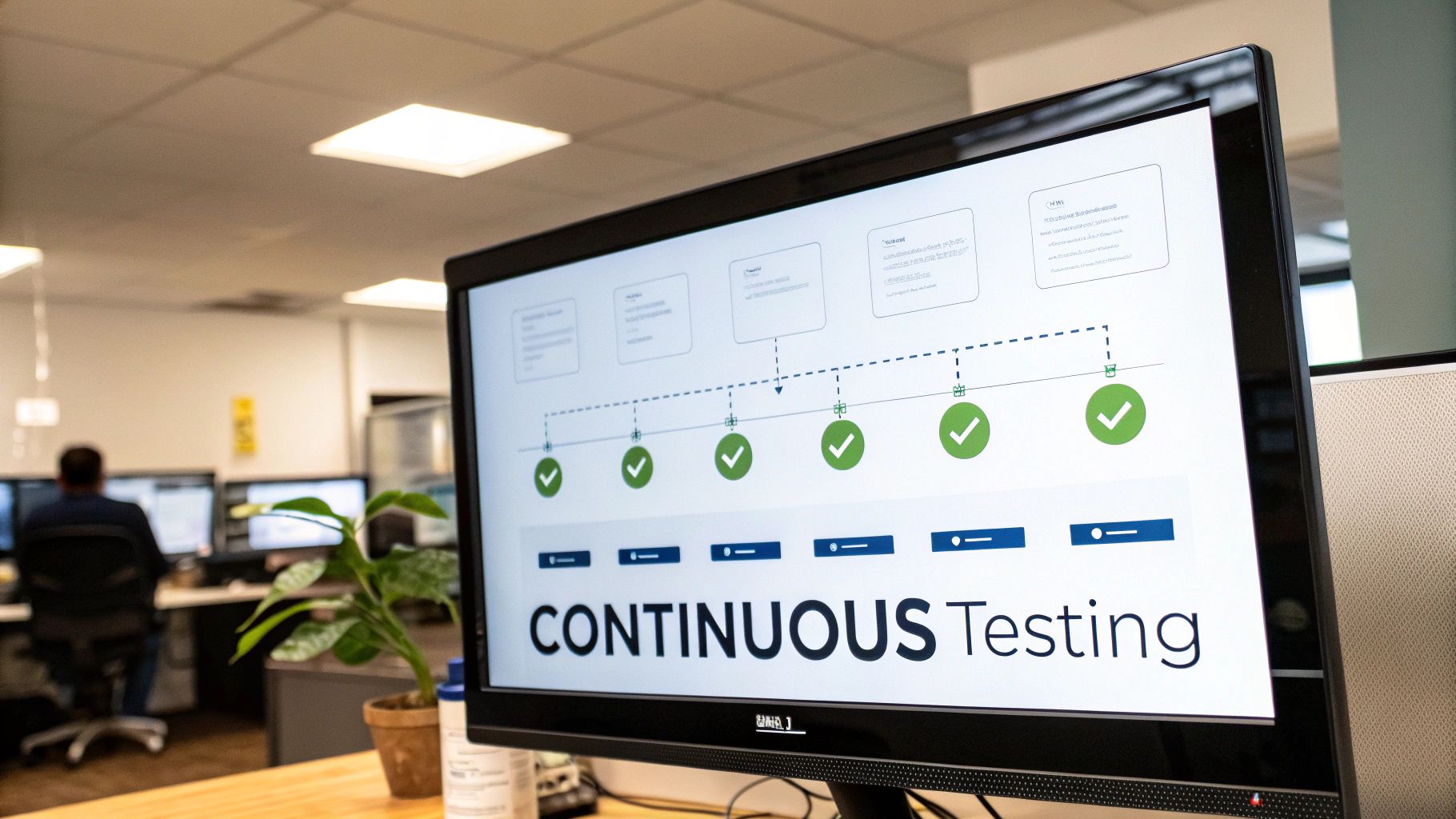
This methodology is one of the most powerful regression testing best practices for high-velocity teams. For instance, Netflix and Amazon leverage robust CI/CT pipelines to deploy thousands of changes daily with confidence, while Google’s CI system validates millions of code changes every day. This approach transforms regression testing from a separate, delayed phase into a continuous, real-time quality gate, enabling rapid and reliable software delivery.
How to Implement Continuous Integration and Continuous Testing
Successfully adopting CI/CT requires integrating your automated regression suite into your version control and build systems for seamless execution.
*   **Establish Clear Pass/Fail Criteria:** Define strict exit criteria for your builds. A single failed regression test should automatically fail the build, preventing defective code from being merged and propagated.
*   **Provide Rapid Feedback:** Aim to complete the core regression suite in under 15 minutes. Quick feedback loops enable developers to fix issues while the context is still fresh in their minds, maximizing efficiency.
*   **Create Pipeline Visibility:** Use dashboards to display build statuses, test results, and performance trends. This transparency helps the entire team stay informed about code quality and pipeline health.
By integrating regression testing into a CI/CT pipeline, you can catch defects earlier, reduce integration risks, and accelerate your time to market. Learn more about how to build a resilient testing strategy that supports continuous delivery.
8. Test Data Management and Isolation
Effective test data management is the practice of creating, maintaining, and isolating test data to ensure regression tests produce reliable and repeatable results. Flaky tests are often caused by unstable or interdependent data, making this practice essential for trustworthy test outcomes. By managing data properly, teams can prevent test failures caused by environmental contamination or data corruption, ensuring that failures point to actual defects in the code.
This approach is one of the most critical regression testing best practices because it directly impacts test reliability. For instance, financial institutions like PayPal use tokenized, anonymized transaction data to test payment flows without exposing sensitive customer information, ensuring both PCI compliance and test accuracy. Similarly, healthcare companies rely on de-identified patient data to validate their systems. This disciplined data handling guarantees that tests are deterministic and secure, a cornerstone of any mature testing strategy.
How to Implement Test Data Management and Isolation
To build a robust test data strategy, focus on creating data that is consistent, isolated, and secure from the start.
*   **Use Test Data Builders:** Implement test data factories or builders in your code to generate consistent, repeatable data sets for each test run. This avoids manual data setup and ensures predictability.
*   **Isolate Test Environments:** Never run tests against a production database. Maintain separate, isolated data environments for testing to prevent data contamination and unexpected side effects. After each test run, implement automated cleanup scripts to reset the data state.
*   **Implement Data Masking:** For tests requiring production-like data, use data masking or anonymization techniques to protect sensitive information. This is crucial for maintaining compliance with regulations like GDPR and HIPAA while still using realistic data.
By prioritizing test data management, you eliminate a major source of test flakiness and build a more stable, secure, and reliable regression suite.
9. Test Metrics and Reporting
Comprehensive test metrics and reporting are vital for understanding the effectiveness and efficiency of your regression testing efforts. This practice involves tracking key performance indicators (KPIs) like defect detection rates, test coverage, execution time, and test stability. By transforming raw data into actionable insights, teams gain clear visibility into quality trends and overall testing progress, enabling informed decisions about release readiness.
This data-driven approach is one of the most crucial regression testing best practices because it shifts quality assurance from a subjective process to an objective, measurable one. For instance, Amazon meticulously monitors test execution time and coverage trends to optimize its CI/CD pipeline, while IBM tracks defect escape rates as a core measure of quality. This allows teams to identify bottlenecks, justify resource allocation, and continuously improve their testing strategy based on concrete evidence rather than guesswork.
How to Implement Test Metrics and Reporting
To leverage this practice effectively, focus on metrics that provide meaningful feedback and drive improvement, rather than simply collecting data for its own sake.
*   **Establish a Baseline:** Before making any changes to your process, measure and record your current performance. This baseline is essential for accurately tracking the impact of future optimizations.
*   **Automate Dashboards:** Create real-time, automated dashboards using tools like Grafana or a built-in test management tool feature. This provides immediate visibility and removes the manual effort of compiling reports.
*   **Focus on Actionable KPIs:** Prioritize metrics that directly influence business outcomes, such as the percentage of critical tests passing or the number of defects found in production. Regularly review these metrics with the team to identify areas for improvement.
By implementing a robust metrics and reporting framework, you can turn your regression testing data into a powerful tool for enhancing product quality and development velocity.
10. Selective Regression Testing
Selective regression testing is a strategic approach that involves running only a subset of tests affected by recent code changes, rather than executing the entire suite. This technique analyzes the modifications, identifies dependencies, and intelligently selects the most relevant test cases. It offers a powerful middle ground between a full regression run and no testing, drastically reducing execution time while maintaining high confidence in the changed areas.
This method stands out as one of the most efficient regression testing best practices because it optimizes resource usage without compromising quality. For instance, tech giants like Microsoft and LinkedIn use sophisticated test selection algorithms for their rapid release cycles, enabling them to validate specific feature updates quickly and deploy with greater speed. This targeted validation accelerates the feedback loop, allowing teams to catch regressions in modified code almost instantly.
How to Implement Selective Regression Testing
To effectively apply this practice, you need a systematic way to map code changes to your test cases. This requires a combination of smart tooling and disciplined processes.
*   **Use Code Change Analysis Tools:** Implement tools that can analyze code commits and identify the specific application areas impacted. This helps automate the selection of relevant tests.
*   **Maintain Clear Traceability:** Establish and maintain a clear link between your code, requirements, and test cases. A traceability matrix is essential for knowing which tests to run when a particular feature is modified.
*   **Periodically Run the Full Suite:** While selective testing is efficient for daily builds, schedule periodic full regression runs (e.g., weekly or before major releases) to catch any unforeseen, indirect defects that a selective approach might miss.
By adopting selective regression testing, you can make your testing process leaner and more responsive, directly supporting agile and CI/CD workflows.
10-Point Regression Testing Comparison
| Approach | Implementation Complexity 🔄 | Resource Requirements ⚡ | Expected Outcomes 📊 | Ideal Use Cases 💡 | Key Advantages ⭐ |
|---|---|---|---|---|---|
| Automated Regression Testing | High — substantial setup, scripting & CI integration | High — tooling, infra, skilled automation engineers | High coverage, fast feedback, fewer regressions | CI/CD pipelines, large codebases, frequent releases | Scalable automation; consistent, repeatable results |
| Test Case Prioritization | Moderate — requires risk models and stakeholder alignment | Low–Medium — analysts, lightweight tooling | Faster detection of critical defects within constraints | Short test windows, release rushes, high-risk features | Focuses testing on business-critical areas for better ROI |
| Test Suite Maintenance & Refactoring | Moderate–High — ongoing audit and refactor effort | Medium — QA time and code-quality tooling | Reduced flakiness, faster execution, easier troubleshooting | Growing or legacy suites; improving test reliability | Removes redundancy; improves stability and maintainability |
| Risk-Based Testing Strategy | High — upfront risk analysis and continuous assessment | Medium — experienced QA, stakeholder involvement | Efficient defect detection aligned to business risk | Safety-critical, regulated, or high-impact systems | Prioritizes tests that reduce business and technical risk |
| Baseline Testing & Comparison | Moderate — must establish stable baselines and envs | Medium — performance tools and controlled environments | Objective regression detection; trendable performance metrics | Performance-sensitive apps, rendering, scalability testing | Detects subtle performance regressions with clear evidence |
| Smoke Testing for Regression Suites | Low — small, focused sanity checks | Low — minimal test set and quick execution | Rapid build validation; prevents wasted deeper runs | Pre-gate checks in CI; quick sanity after deploys | Fast sanity gate; low maintenance and high confidence in critical flows |
| Continuous Integration & Continuous Testing | High — pipeline integration, automation maturity needed | High — infrastructure, automation engineers, monitoring | Immediate feedback, frequent reliable deployments | High-velocity teams, microservices, frequent commits | Enables rapid, confident releases with continuous quality checks |
| Test Data Management & Isolation | High — data provisioning, masking, isolation complexity | High — storage, tooling, compliance effort | Reliable, repeatable tests with reduced flakiness | Data-sensitive or compliance-regulated domains (finance/health) | Improves test fidelity and data security; reduces environment contamination |
| Test Metrics & Reporting | Moderate — instrumentation and dashboarding effort | Medium — analytics tools and ongoing maintenance | Visibility into quality trends; data-driven decisions | Organizations tracking KPIs and continuous improvement | Objective measurement of testing effectiveness and bottlenecks |
| Selective Regression Testing | High — traceability and dependency analysis required | Medium–High — sophisticated selection tooling | Much faster test runs; targeted defect detection | Very large suites, tight time budgets, rapid feedback needs | Significantly reduces execution time while keeping relevant coverage |
Elevating Your Quality Strategy with Smarter Testing
Navigating the complexities of modern software development requires more than just a cursory check for new bugs; it demands a robust, intelligent, and proactive quality assurance framework. The regression testing best practices we have explored are not isolated tactics but interconnected pillars of a comprehensive strategy. Moving beyond a simple, brute-force "run all tests" mentality is the first step toward transforming regression testing from a resource-draining chore into a powerful, value-driving asset for your engineering team.
By weaving together automation, strategic test case prioritization, and a risk-based approach, you create a system that is both efficient and effective. This synergy ensures that your most critical user journeys and high-risk functionalities receive the rigorous attention they deserve with every code change, no matter how small. This focus maximizes your team's impact, catches significant defects earlier, and directly contributes to a more stable and reliable product.
From Practice to Culture: Key Takeaways
The journey toward mastering regression testing is continuous. To truly embed these principles into your workflow, focus on these core takeaways:
*   **Automation is the Foundation:** A well-architected automated suite is non-negotiable. It provides the speed and consistency needed to keep pace with agile development and forms the backbone of your entire quality strategy.
*   **Strategy Trumps Volume:** Running more tests is not always better. The real value comes from running the *right* tests at the *right* time. Practices like selective regression, smoke testing, and risk-based analysis are your tools for achieving this precision.
*   **Maintenance is a First-Class Citizen:** An outdated or flaky test suite is worse than no test suite at all. Treat test case maintenance and refactoring with the same seriousness as production code maintenance to ensure long-term reliability and trust.
*   **Data and Metrics Drive Improvement:** You cannot improve what you cannot measure. Consistent tracking of test metrics and clear reporting are essential for identifying bottlenecks, demonstrating ROI, and making informed decisions about where to invest your testing efforts.
Your Actionable Next Steps
Mastering these regression testing best practices is an evolutionary process, not an overnight revolution. Start by identifying the single biggest pain point in your current regression cycle. Is it slow feedback loops? Flaky tests? Inadequate coverage in critical areas?
Once identified, select one or two practices from this guide that directly address that problem. For example, if feedback is slow, focus on integrating your suite into a CI/CD pipeline and implementing a targeted smoke test. If you are unsure where the risks are, begin the process of creating a risk matrix to guide a risk-based testing strategy. By taking incremental, focused steps, you can build momentum and demonstrate value quickly, fostering buy-in for a broader cultural shift toward engineering excellence. Ultimately, a mature regression testing process empowers your team to deploy with unwavering confidence, knowing that a powerful safety net is always in place.
Tired of CI/CD noise and missed regression test failures? PullNotifier streamlines your development workflow by sending targeted, context-rich notifications directly to the right people in Slack. Integrate it with your CI system to ensure critical test results are never overlooked, helping you implement your regression testing best practices more effectively. Learn more and reduce notification fatigue at PullNotifier.