- Published on
The Ultimate Guide to Code Review Security
- Authors

- Name
- Gabriel
- @gabriel__xyz
Code review security is all about systematically checking your source code for vulnerabilities before it gets deployed. Think of it as more than just hunting for bugs; it’s a proactive defense that acts as a critical checkpoint to stop security flaws from ever making it into a live environment.
Why Code Review Security Is Your First Line of Defense
Imagine an architect reviewing building blueprints, not just for style, but for hidden structural flaws that could cause a disaster down the road. That's exactly what code review security is for software. It’s the essential practice of scrutinizing code changes to find and fix vulnerabilities before they turn into real, exploitable risks. This simple shift transforms a standard code review from a quality check into a foundational security control.

A lot of organizations lean on tools like firewalls and penetration testing to keep their applications safe. While those are definitely important, they're reactive—they catch attackers after the vulnerable "building" is already up. A solid code review security process is different. It’s proactive.
Preventing Flaws at the Source
The real magic of this practice is its timing. When you catch security issues early in the development lifecycle, you can:
*   **Slash Remediation Costs:** Fixing a vulnerability during development is exponentially cheaper than patching a live system. Production fixes often mean emergency deployments, frantic re-testing, and a whole lot of stress.
*   **Stop Supply Chain Attacks:** Insecure code can be an open door for attackers to compromise your entire software supply chain, putting all of your customers at risk. Secure reviews act as a gatekeeper against malicious code.
*   **Protect Your Brand Reputation:** A single, high-profile data breach can do irreversible damage to customer trust and your company’s reputation. Proactive security shows you're serious about protecting user data.
A secure code review is the inspection that makes sure the software you're building is safe from the ground up. It’s not about finding blame; it’s about taking collective ownership of application security.
Moving Beyond Traditional Testing
Automated scanners and QA testing are great for finding known issues and functional bugs, but they often miss the subtleties of business logic flaws. For instance, a tool might not realize that a specific user permission check is missing in a complex workflow, but a human reviewer who understands the system's intent will spot it right away.
This human-centric analysis is what makes code review security so irreplaceable. It gets to the "why" behind the code, not just the "what." This shift from a reactive to a proactive security mindset isn't a 'nice-to-have' anymore; it's an absolute must for building software that's both resilient and trustworthy. It lays the groundwork for creating a culture where security is everyone’s job.
Uncovering the Top Security Risks in Your Code
A secure code review isn't just another quality check. It's a targeted hunt for the specific kinds of weaknesses that attackers love to exploit. Think of it like this: a security reviewer is a detective, and the codebase is a crime scene. They're searching for clues—subtle mistakes in logic, insecure functions, and missing safeguards—that could open the door to a major breach.
These vulnerabilities often hide in plain sight, disguised as harmless lines of code.
Many of these critical risks are cataloged in the well-known OWASP Top 10, which serves as a practical guide for security professionals. Let's dig into some of the most common culprits reviewers are trained to spot, using a few simple analogies to make them easier to grasp.
Injection Flaws: The Deceptive Note
Imagine you ask a librarian to fetch a book titled "A Tale of Two Cities." An attacker slips a note into your request that says, "...and also unlock the restricted section." If the librarian blindly follows the entire instruction without questioning the added part, the attacker gets in.
This is exactly how an SQL Injection works. An attacker inserts malicious SQL commands into input fields, like a search bar or login form. If the application doesn't properly sanitize this input, the database might execute the attacker's command, potentially dumping sensitive user data or even deleting records.
Broken Access Control: The Master Key Left Behind
Picture a hotel where every room key can open every single door, including the manager's office and the main safe. That's Broken Access Control. It happens when an application fails to properly enforce restrictions on what authenticated users are allowed to do.
A secure code review hunts for flaws like these:
*   Can a regular user access an admin-only URL just by typing it into their browser?
*   Does the app check permissions on the server-side, or only in the client-side code that an attacker can easily manipulate?
*   Can a user view someone else's private data by changing a number in the URL (e.g., `.../profile/123` to `.../profile/124`)?
These oversights are incredibly common and can lead straight to unauthorized data exposure and privilege escalation. While they may seem like simple bugs, they can easily be confused with the poor coding habits described in our article on the 10 common code smells in pull requests.
Cross-Site Scripting: The Malicious Rumor
Think of a public bulletin board in a town square. An attacker pins a note that looks official but contains a malicious instruction: "Everyone who reads this, go to the town hall and give your house keys to the person at the front desk." Anyone who trusts the note and follows the instruction gets robbed.
Cross-Site Scripting (XSS) is the digital version of this. An attacker injects malicious scripts into a trusted website. When you visit that site, your browser executes the script, which could steal your session cookies, login credentials, or personal information. A proper security code review meticulously examines how user-supplied data is handled to ensure it's always rendered as plain text, never as executable code.
"Secure code review is a critical step in application security that substantially reduces the risk of exploitable flaws making it to production environments... organizations that implement effective secure code reviews benefit from massively reduced remediation costs—up to ten times lower compared to fixing flaws discovered post-release."
The need for these reviews is only growing. For instance, recent studies show that nearly 45% of AI-generated code contains security flaws from the OWASP Top 10. This data makes it clear that even modern development methods require rigorous human oversight to be truly secure.
Common Code Vulnerabilities and Their Impact
To better understand what reviewers are looking for, here’s a quick summary of common vulnerabilities, their causes, and the potential fallout for the business.
| Vulnerability Type (OWASP) | Common Cause in Code | Potential Business Impact |
|---|---|---|
| Injection (SQL, NoSQL) | Unsanitized user input passed directly to a database query. | Data breaches, data loss, unauthorized access, reputational damage. |
| Broken Access Control | Missing or flawed server-side permission checks. | Data theft, privilege escalation, unauthorized system modifications. |
| Cross-Site Scripting | Rendering user-supplied data as HTML without proper escaping. | Session hijacking, credential theft, malware distribution. |
| Insecure Deserialization | Processing untrusted serialized data from external sources. | Remote code execution, denial-of-service attacks, data tampering. |
Spotting these issues before they reach production is the core purpose of a security-focused code review. Each vulnerability represents a potential entry point for an attacker, and closing these gaps is non-negotiable for building secure software.
To build a truly robust security posture, it helps to understand broader principles of risk assessment, like those covered in articles about Mastering Risk Management In Software Projects. Grasping the bigger picture helps contextualize the specific vulnerabilities reviewers hunt for. After all, these seemingly small coding errors are precisely what attackers search for, turning minor oversights into major security incidents. A dedicated security review process transforms the codebase from a field of potential landmines into a fortified structure, secure from the inside out.
How to Build a Modern Secure Code Review Workflow
Building a solid secure code review workflow isn't about adding red tape and slowing everyone down. It's about creating a smart, collaborative system that weaves security into your development fabric. Think of it like a series of quality control checkpoints on an assembly line. Each station is designed to catch specific flaws before the product moves on, making sure what you ship is solid.
A modern workflow is all about teamwork—blending the lightning-fast pattern-matching of automated tools with the sharp, contextual awareness only a human can provide. The idea is to create layers of defense where each step backs up the others, beefing up your code review security without grinding your development team to a halt.
Define Clear Roles and Responsibilities
First things first: everyone needs to know their part. A classic mistake is the "someone will handle security" mindset, which usually means no one does. When you define clear roles, you create ownership and accountability.
*   **Developers:** They're the first line of defense. The developer writing the code is responsible for thinking securely from the start and giving their own code a once-over before creating a pull request.
*   **Peer Reviewers:** These are fellow developers who do the main manual review. They're looking at logic and functionality, but with a security-aware lens.
*   **Security Champions:** Think of these as your team's security gurus. They're developers with extra security training who can field tricky questions and act as the bridge to a dedicated security team.
*   **Security Engineers:** When a change is high-risk or touches sensitive code, a dedicated security engineer steps in. They do a deep-dive review focused purely on rooting out vulnerabilities.
This structure spreads the load, turning security from a bottleneck into a shared responsibility.
Establish a Multi-Stage Review Process
An effective workflow isn't a free-for-all; it follows a logical path. You let automation knock out the easy stuff so your human experts can focus on the gnarly, complex problems.
Preparation and Scoping: It all starts with the developer. They prep the pull request with a clear description of what the code does and why they did it that way. This context is gold for reviewers trying to spot subtle logic flaws.
Automated SAST Scanning: The moment a pull request is created, a Static Application Security Testing (SAST) tool should kick in and scan the code. This is your initial filter, catching common bugs like SQL injection or sketchy libraries right away. The developer gets instant feedback and can fix glaring issues before a human reviewer even sees the PR.
Manual Peer Review: This is where the magic happens. A peer reviewer isn't just looking at the code for what it does, but for what it could do. They’re hunting for business logic flaws, broken access controls, and other tricky issues that fly right under the radar of automated tools.
Security Champion or Engineer Review (If Needed): If the code touches a critical system—like authentication or payments—or if a peer reviewer flags something they're not sure about, it gets escalated. A security champion or engineer then does a deeper, specialized review.
This layered approach makes sure every change gets the right amount of attention.
The best secure code review workflows aren't about pointing fingers; they're about collaboration. The goal is to collectively build stronger, more resilient software. You have to foster a blame-free culture where security feedback is seen as coaching, not criticism.
Cultivate a Blame-Free Security Culture
Honestly, the single most important part of any code review security workflow is the culture. If developers get blasted for security mistakes, they’ll get defensive or, worse, try to hide their code. That helps no one.
Instead, you have to frame security feedback as a chance to learn. When someone finds a vulnerability, the conversation should be about understanding the root cause and sharing that knowledge with the whole team. This simple shift turns the review process from a gatekeeping chore into a powerful, ongoing training session.
When you encourage open discussion and treat security as a shared goal, you create a positive feedback loop that makes both your code and your team stronger. That collaborative spirit is what really powers a secure review workflow that lasts.
Essential Best Practices for Effective Code Review Security
Having a solid workflow is the skeleton of your security process, but the best practices are the muscle. They’re the specific, actionable habits that turn a standard code review into a powerful security checkpoint. When you adopt these practices, you empower every developer on your team to start thinking like a security professional, proactively hardening the codebase one pull request at a time.
The core idea is to shift from a reactive "bug hunt" to a proactive mindset focused on building resilient, secure-by-design software. It’s about scrutinizing code not just for what it does, but for what an attacker could make it do. This means questioning assumptions, validating every input, and enforcing strict permissions at every turn.
Prioritize Rigorous Input Validation
Never trust user input. It's the golden rule of application security for a reason. Every piece of data that enters your system from an external source—whether it’s a user form, an API call, or a file upload—is a potential attack vector. Input validation is how you ensure this data is safe and in the expected format before your application ever touches it.
Without it, you’re leaving the door wide open for injection attacks. For example, failing to sanitize a search query can lead directly to SQL Injection, where an attacker tricks your database into running malicious commands. A secure review must check that all incoming data is strictly validated against a whitelist of allowed characters and formats.
Enforce the Principle of Least Privilege
The Principle of Least Privilege (PoLP) is a foundational security concept: any user, program, or process should only have the bare minimum permissions necessary to do its job. Think of it like giving a valet a key that only starts the car, not one that also opens the trunk and glove box.
During a code review, this translates to asking critical questions:
*   Does this user account *really* need admin rights, or will read-only access work?
*   Does this service need full database access, or just access to a single table?
*   Is this API key overly permissive, granting more power than is required for its task?
By enforcing PoLP, you dramatically limit the potential damage an attacker can cause if they compromise a part of your system. It contains the blast radius of a breach.
This visual flow shows the core stages of a secure code review, from preparation and automated scanning to the critical manual review phase. 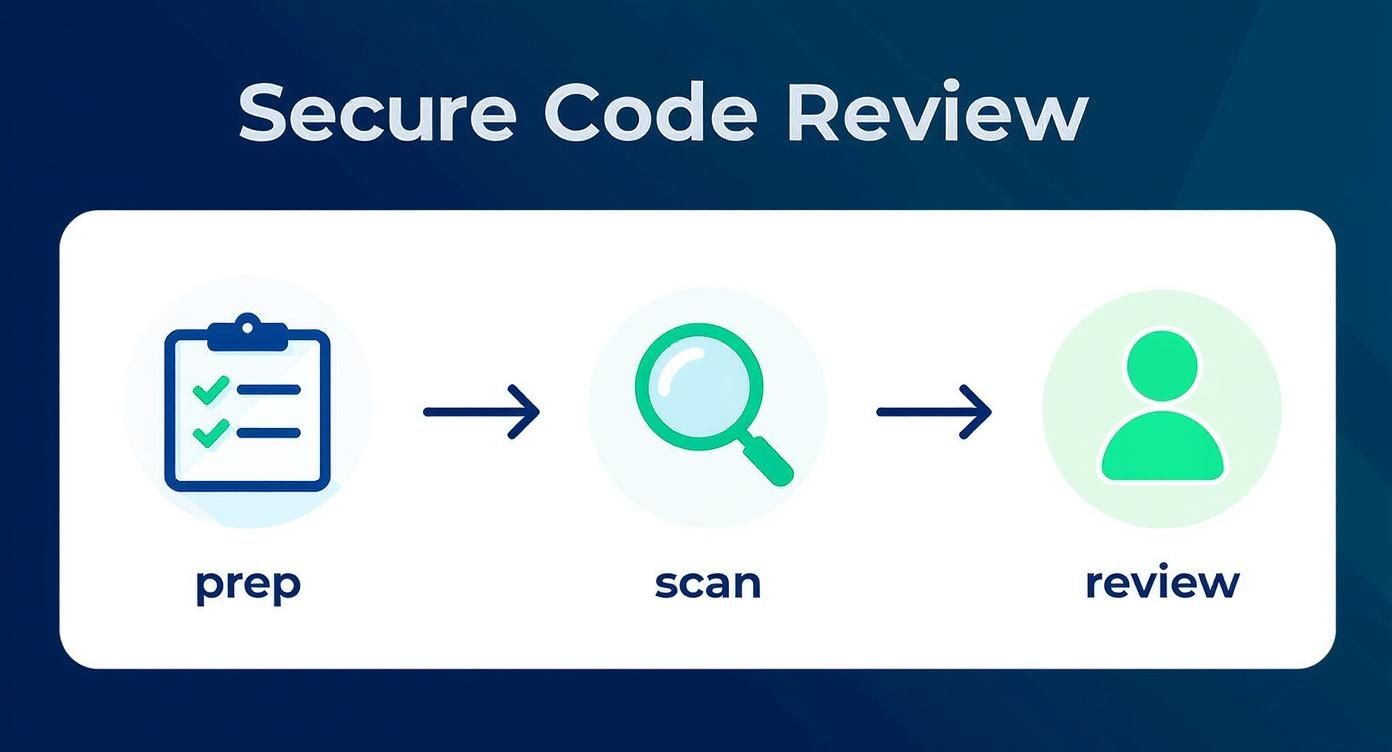 The infographic underscores that a successful process blends automated efficiency with the irreplaceable context and logic analysis of human reviewers.
The urgency for these practices is underscored by the current threat environment. In 2025, software vulnerability disclosures reached unprecedented levels, with over 21,500 CVEs reported in just the first half of the year. A staggering 38% of these were rated as High or Critical severity, highlighting why security-focused code reviews are a primary defense mechanism. Learn more about the rise in critical vulnerabilities and how they impact security strategies in this 2025 vulnerability statistics report.
Fortify Authentication and Session Management
Authentication is the front door to your application, and session management is what keeps it locked. A secure code review must meticulously inspect how your application handles these critical functions. Any flaws here can allow attackers to bypass login screens, impersonate legitimate users, or hijack active sessions.
Keep an eye out for these common red flags:
*   **Weak Password Policies:** Is the code enforcing strong, complex passwords?
*   **Insecure Session Tokens:** Are session IDs long, random, and transmitted securely?
*   **Improper Logout Functionality:** Does logging out actually invalidate the session on the server, or just on the client side?
A single mistake in these areas can undermine your entire security posture. For a structured approach, developers can lean on a detailed guide, such as this comprehensive code review checklist, to ensure all critical security points are covered.
Ensure Correct Use of Cryptography
Cryptography is powerful, but it's also notoriously easy to get wrong. Using weak or outdated encryption algorithms, improperly managing cryptographic keys, or implementing flawed custom crypto are all common—and dangerous—mistakes. A security check during code review should verify that the application is using industry-standard, well-vetted cryptographic libraries correctly.
The goal is not to invent new cryptography but to correctly implement existing, proven solutions. Never roll your own crypto—it's a recipe for disaster.
Reviewers should confirm that sensitive data like passwords and personal information is hashed (not just encrypted) and that data in transit is protected with up-to-date protocols like TLS 1.3.
When performing code reviews, paying close attention to API security is also crucial, as APIs are frequent targets. Learn more about Essential API Security Best Practices to protect these vital connections. Integrating these best practices into every review transforms your team from coders into guardians of the application, building a culture where security is a shared, proactive responsibility.
Integrating Automation to Scale Your Security Reviews
Manual code reviews are fantastic for catching tricky logic flaws and big-picture architectural problems. But let's be honest, they don't scale. As your team ships code faster and faster, relying only on human eyes creates a massive bottleneck. It’s simply impossible to scrutinize every single line of code with the depth it needs.
This is where automation becomes your secret weapon. Think of it as a tireless assistant that helps you scale your code review security efforts without burning out your team.
By weaving automated tools into your workflow, you free up your engineers to focus on the nuanced, complex issues that genuinely require a human touch. This hybrid approach doesn't replace manual reviews; it supercharges them.
The Role of SAST in Modern Workflows
The main workhorse for automated security is Static Application Security Testing (SAST). You can think of a SAST tool like an expert proofreader that scans your source code for common security bugs—the low-hanging fruit—before the application is even compiled. The best part? It’s incredibly fast and can analyze an entire codebase in minutes.
SAST tools are great at spotting common problems like:
*   Potential SQL injection vulnerabilities
*   Cross-site scripting (XSS) flaws
*   Insecure use of cryptographic functions
*   Hardcoded secrets like passwords or API keys
When you plug a SAST tool directly into your CI/CD pipeline, developers get instant feedback right in their pull request. This rapid feedback loop is crucial for fixing issues early when they're cheapest and easiest to resolve. If you're looking for options, check out our guide on the 12 best automated code review tools for 2025.
Manual Review vs Automated Scanning
So, where do manual reviews fit in a world with powerful automated tools? Each has its own strengths, and they work best when used together.
| Aspect | Manual Code Review | Automated Scanning (SAST) | Best Use Case |
|---|---|---|---|
| Speed | Slow; dependent on reviewer availability. | Extremely fast; scans code in minutes. | Automation for initial checks, manual for deep dives. |
| Scope | Focuses on logic, architecture, business context. | Finds known vulnerabilities and code patterns. | Combining both for comprehensive coverage. |
| Accuracy | High context, low false positives. | Can be noisy with false positives. | Manual review to validate and triage automated findings. |
| Scalability | Doesn't scale well with growing codebases. | Scales effortlessly across large projects. | Automation to handle volume, manual for critical logic. |
The takeaway is clear: automation handles the tedious, repetitive checks at scale, while humans tackle the complex, context-heavy issues that tools can't understand.
Managing Automation Results Effectively
While these tools are powerful, they can also be notoriously noisy, flagging tons of false positives. An unfiltered flood of alerts quickly leads to "alert fatigue," where developers just start ignoring the results entirely. The real key to making automation work is managing its output.
The goal of automation is not just to find every possible issue, but to surface the right issues to the right people at the right time. Prioritization is everything.
Start by tuning your tools. You can often disable entire categories of checks that aren't relevant to your tech stack or risk profile. Then, set up a clear process for triaging alerts. High-severity, high-confidence findings should automatically block a build, while lower-priority issues can be logged for later review. This way, you stop critical vulnerabilities immediately without grinding development to a halt over minor problems.
Looking Beyond Your Own Code with SCA
Your application isn't just the code your team writes. It’s also built on a mountain of open-source libraries and third-party dependencies. That's where Software Composition Analysis (SCA) comes in. SCA tools automatically identify all these components and check them against databases of known vulnerabilities.
This is more important than ever. Research shows that about 35% of GitHub repositories are public, and a shocking 61% of organizations have exposed secrets like cloud credentials within them. An SCA scan is a non-negotiable part of any serious code review security strategy.
By combining SAST for your own code and SCA for your dependencies, you create a powerful, automated first line of defense. This allows your human reviewers to spend their valuable time on what they do best: finding the subtle, context-dependent flaws that automated tools will always miss.
A Few Common Questions About Code Review Security
Diving into a more structured security process for your code reviews naturally brings up some practical questions. How do you actually fit this in without blowing past deadlines? Who's ultimately on the hook for signing off on security? Let's tackle the most common questions teams have.
A lot of teams worry that adding a security lens to code reviews will grind their development velocity to a halt. While it does add another checkpoint, the goal is actually to make things more efficient, not to become a roadblock. The whole idea is to pull security considerations as early as possible into the development process, a practice you'll often hear called "shifting left."
Think of it this way: by using automated tools (like SAST) for an initial pass, developers can catch and fix the low-hanging fruit before a human reviewer even lays eyes on the code. This front-loads the security effort, freeing up your senior engineers to hunt for complex logic flaws instead of common syntax errors. This approach prevents those last-minute, all-hands-on-deck security fire drills that are far more disruptive than proactive reviews.
How Does a Security Code Review Differ from a Standard One?
While a standard code review is focused on functionality, readability, and style guides, a security code review looks at the code through an adversarial lens. It’s not just about asking, “Does this work?” It’s about asking, “How could someone break this?”
Here’s a simple way to think about the difference:
*   **Standard Review:** Checks for things like clean variable names, efficient algorithms, and helpful comments. The goal is to produce code that is maintainable and works as intended.
*   **Security Review:** Actively hunts for vulnerabilities—things like potential injection flaws, broken access controls, or insecure ways of handling data. The goal is to produce code that is resilient and hardened against attack.
Essentially, a security review adds a critical layer of threat modeling to the process. The reviewer is constantly thinking like an attacker, trying to find ways to exploit the new changes. That's a very different mindset from a standard quality check.
Who Is Responsible for Code Security?
This is a classic point of confusion, but the answer is pretty straightforward: security is a shared responsibility. It's not some task that gets tossed over the fence to a siloed security team at the end of a sprint. It’s a collaborative effort with clearly defined roles.
Ultimately, the engineering team owns the security of the code they write. While security engineers provide expert guidance and final sign-offs on high-risk changes, developers are the first and most important line of defense.
A modern security culture empowers developers to become security champions. They are responsible for writing secure code from the get-go, and peer reviewers are responsible for holding each other to that high standard. The dedicated security team then acts as a specialist resource, available for consultations and deep-dive analysis on critical features, but they don't carry the entire burden alone. This shared ownership model is what makes a code review security process truly scale and stick.
Ready to streamline your code reviews and get rid of notification chaos? PullNotifier plugs right into Slack to give you clean, real-time pull request updates. It helps your team stay focused, cut through the noise, and ship faster. Check it out at pullnotifier.com.