- Published on
Master Clean Code Principles for Developers
- Authors

- Name
- Gabriel
- @gabriel__xyz
Clean code isn't some abstract, academic concept. It's a collection of principles and real-world practices for writing software that's easy to read, understand, and most importantly, maintain. At its core, it’s about writing code for humans first and computers second. Why? Because you—or someone else on your team—will have to come back to it later.
Why Clean Code Is Your Most Valuable Skill

Think of your codebase as a city. A project built with clean code principles is like a well-planned grid. The street signs are clear, the zoning is logical, and anyone new can find their way around without much trouble. Adding a new building is a predictable, straightforward process.
On the other hand, a messy codebase is a chaotic sprawl. It's a maze of confusing one-way streets and unlabeled buildings. Making one small change can cause traffic jams and unexpected problems clear across town.
This isn't just about making things look nice; it's about professional survival. Writing clean code is the most direct way to fight technical debt—that silent killer that suffocates projects by making every single change slow, risky, and expensive. Adopting these habits turns your work from a short-term sprint into a sustainable marathon.
The Pragmatic Benefits of Writing Clean Code
The value of clean code isn't theoretical; it shows up in tangible results that impact everything from team morale to the company’s bottom line. For starters, a well-organized codebase drastically cuts down the time it takes for new developers to get up to speed. They can start contributing meaningful work almost immediately instead of spending weeks just trying to decipher cryptic logic.
This efficiency ripples through the entire development lifecycle:
- Reduced Friction: Clean code minimizes confusion, which means your team can focus on solving actual problems instead of debating what a piece of code is supposed to do.
- Painless Onboarding: New hires can grasp the project architecture and start adding value much, much faster.
- Increased Resilience: Well-structured software is simply less brittle. Small updates are far less likely to cause unexpected, system-wide failures.
To put some real numbers on it, here's a look at the measurable impact these practices can have.
The Real-World Impact of Clean Code
| Area of Impact | Improvement Metric |
|---|---|
| Development Cost | 20-40% reduction in overall project costs |
| Debugging Time | Up to 50% less time spent hunting down bugs |
| Onboarding Speed | New developers become productive 30-50% faster |
| Feature Velocity | Teams can ship new features more quickly and predictably |
| Developer Morale | Reduced frustration and higher job satisfaction |
These aren't just vanity metrics; they translate directly into cost and time savings. A comprehensive analysis highlights these benefits clearly. You can learn more about the financial impact of clean code from Kodexo Labs.
Adopting these practices directly translates to significant cost and time savings. A comprehensive analysis shows that applying clean code principles can lead to a 20-40% reduction in development costs and cut time spent on debugging by up to 50%.
Ultimately, mastering these skills is an investment in your projects and your career. It’s what separates professional developers who build robust, scalable systems from those who just write code that works—for now.
Decoding the Core Principles of Clean Code
To get from messy, tangled code to software that's a joy to maintain, you need a game plan. The core principles of clean code are exactly that—a set of philosophies that guide your decisions, helping you build systems that are logical, tough, and easy for the next developer to pick up. Don't think of them as rigid laws, but more like the foundational pillars holding up a well-built house.
We're going to break down four of the most powerful acronyms you'll hear in software development: SOLID, DRY, KISS, and YAGNI. Each one tackles a different angle of code quality, from how you structure your classes to why you shouldn't build features you might need someday. Getting a real handle on these is the first big leap toward writing code like a pro.
SOLID: The Blueprint for Robust Systems
The SOLID principles are a classic set of five design guidelines that started in the object-oriented world, but their wisdom stretches far beyond it. They're the architectural blueprint for creating software that you can actually extend and maintain without pulling your hair out.
Picture building something with LEGOs. A SOLID design means each brick (your code module) is self-contained and connects to others in a predictable, stable way. You can snap on new features (more bricks) without having to dismantle the whole thing.
- Single Responsibility Principle (SRP): A class or module should have one job and do it well. A "Swiss Army knife" object that tries to handle user authentication, data validation, and sending emails is a nightmare to change because everything is tangled together.
- Open/Closed Principle (OCP): Your code should be open for extension but closed for modification. The goal is to add new functionality without having to touch existing, battle-tested code.
- Liskov Substitution Principle (LSP): Subtypes should be perfectly swappable for their base types. If you have a
Birdclass, anOstrichsubclass needs to be able to do everything a genericBirdcan without breaking the program. - Interface Segregation Principle (ISP): Don't force clients to depend on interfaces they don't actually use. It’s much better to have several small, specific interfaces than one massive, do-it-all interface.
- Dependency Inversion Principle (DIP): High-level modules shouldn't depend on low-level ones; both should depend on abstractions. This simple idea decouples your code, making it dramatically more flexible.
DRY: Eliminating Wasteful Repetition
DRY stands for Don't Repeat Yourself. It's a simple concept with deep implications: every piece of knowledge in a system should have one, and only one, clear representation. The moment you copy and paste code, you've created two sources of truth. If you find a bug or a business rule changes, you now have to hunt down and fix it in every single spot.
Repetitive code is a breeding ground for bugs. A change in one location is often forgotten in another, leading to inconsistent behavior and hours of frustrating debugging. This is one of the most common issues that leads to what developers call "code smells."
This principle is all about avoiding the kind of duplication that almost guarantees errors down the line. To see how this and other common problems crop up, check out this guide on the 10 common code smells found in pull requests and how to fix them.
The infographic below shows how clear naming—a huge part of writing DRY code—is built on a foundation of self-descriptive names, consistent patterns, and good old-fashioned context.
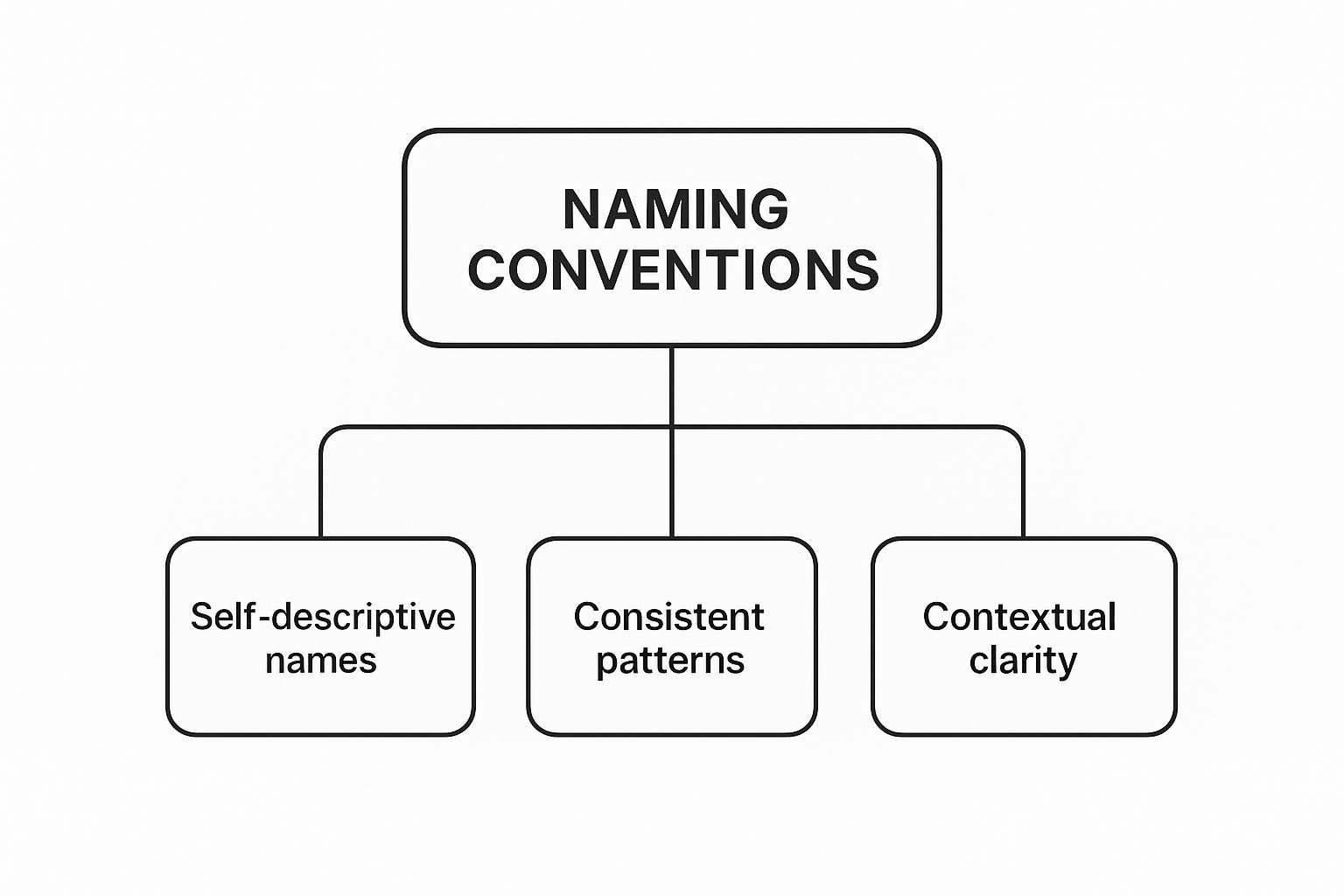
This hierarchy makes it clear: effective naming isn't just one skill but a stack of practices that, together, make your code vastly easier for everyone to understand and work with.
KISS and YAGNI: The Art of Simplicity
Finally, we have two principles that are all about minimalism and focus. KISS, or Keep It Simple, Stupid, is a timeless reminder that the most elegant solution is almost always the most straightforward one. Unnecessary complexity is a developer’s worst enemy.
Working hand-in-hand with this is YAGNI, which stands for You Aren't Gonna Need It. This principle is a direct counter to the temptation to over-engineer solutions for a hypothetical future. Focus on solving today's problems, not the ones you think you might have six months from now. Following YAGNI keeps your codebase lean, focused, and free of speculative junk that will likely never get used.
Crafting Self-Explanatory Code Day to Day
 Knowing the theory behind clean code is one thing, but putting it into practice day in and day out is where the real magic happens. If you can build just two habits, make them these: choosing meaningful names and writing small, focused functions.
Getting these right turns your code from a cryptic mess into a clear story that anyone on your team can pick up and run with. The ultimate goal is to write code that reveals its own intent, making comments almost unnecessary. Think of your variables and functions as characters in a narrative—if their names are vague, the plot is lost.
The Power of Meaningful Names
This sounds simple, but choosing good names is arguably one of the toughest and most important things we do as developers. A great name makes the code immediately obvious. A bad one creates ambiguity and forces the next person to waste time just figuring out what you meant.
Just look at the difference a name can make:
- Vague:
let d;// What is 'd'? Days? Data? A dictionary? Who knows. - Slightly Better:
let elapsedTime;// Okay, but in what unit? Milliseconds? Hours? - Clear and Explicit:
let elapsedTimeInDays;// Perfect. The name tells you everything you need to know.
The same logic applies to functions. processData() is a mystery box. Something like fetchAndValidateUserData(), on the other hand, communicates exactly what it does and what it works on. Nailing this level of clarity is a cornerstone of clean code.
The name of a variable, function, or class should answer all the big questions. It should tell you why it exists, what it does, and how it is used. If a name requires a comment, then the name does not reveal its intent.
Functions That Do One Thing Well
Another crucial daily practice is keeping your functions small and laser-focused. This is basically the Single Responsibility Principle, but applied at the function level. If you have a function that fetches data, parses the JSON, and updates the UI, it's doing at least three things.
That kind of do-it-all function is a nightmare to test, a pain to reuse, and nearly impossible to debug when something goes wrong. The fix? Break it down.
fetchUserData(userId)parseUserApiResponse(response)updateUserProfileUI(userData)
Each function now has exactly one job. This makes them easy to understand, test in isolation, and reuse somewhere else. It’s a simple change that makes the entire system more modular and resilient.
Big tech companies like Google and Microsoft have found that keeping functions under 50 lines of code is a good rule of thumb for comprehensibility. Their internal studies often show that inconsistent naming and bloated functions are massive sources of friction.
Of course, building these habits takes time and consistent effort. The best way to reinforce them is through regular practice and solid feedback during code reviews. Using a structured checklist can get your whole team on the same page. For a great starting point, you might find our code review checklist useful for establishing team-wide standards.
After all, writing clean code is a team sport. Clear guidelines ensure everyone is playing by the same rules, which leads to a codebase that’s actually a pleasure to work with.
Using Comments and Formatting to Guide the Reader
Let's talk about two of the most heated topics in clean code: comments and formatting. While the ultimate dream is to write code so clear it's self-documenting, that doesn't make comments obsolete. It just changes their job. Good code tells you what it's doing; a good comment tells you why.
Think of a comment as a trail marker. You don’t need one on a straight, obvious path. But when the logic takes a sharp, unexpected turn because of a weird business rule or a system quirk, that’s exactly where you need a signpost. Use comments to explain the context the code can’t. Avoid comments that just repeat what the code is already saying—they're just noise and will inevitably go stale.
Why Consistent Formatting Is Non-Negotiable
If comments are the signposts, consistent formatting is the map itself. It makes the entire codebase feel familiar, predictable, and easy to navigate. When indentation, spacing, and brace styles are all over the place, it creates cognitive friction. You end up wasting mental energy just trying to parse the structure instead of focusing on what the code actually does.
The style of the code should be so consistent that it looks like a single person wrote it, even when dozens of developers have contributed. This visual harmony makes the codebase approachable and significantly reduces the mental overhead required to understand it.
Clean formatting isn't a matter of personal taste; it's about team efficiency. It sets a professional standard and kills an entire category of pointless arguments during code reviews.
Automating Readability with Linters and Formatters
Trying to enforce formatting rules by hand is a miserable, error-prone chore. This is where automated tools become a developer's best friend. When you build linters and formatters into your workflow, consistent style becomes an automatic part of the process, not something you tack on at the end.
These tools enforce a shared rulebook across the entire project, so every single commit looks and feels the same. Here’s how they work their magic:
- Linters: Scan your code for stylistic mistakes, potential bugs, and bad practices. They're like a grammar checker for your code.
- Formatters: Automatically rewrite your code to match a predefined style guide. They handle all the tedious stuff like indentation, line spacing, and where the curly braces go.
By automating this part of the clean code principles, you free up a ton of time and mental bandwidth in code reviews. Instead of nitpicking over semicolons, your team can focus on what actually matters: whether the logic is sound. Readability becomes a built-in feature of your workflow.
Tackling Technical Debt with Smart Refactoring
 Let's be real—no codebase stays perfect. Every shortcut you take, every "I'll fix it later" patch, adds to technical debt. It’s the invisible cost of rework you pay for choosing the easy solution now instead of the right one.
Think of it like a credit card. A little debt can help you move faster, but if you ignore it, the interest piles up until you're completely stuck. This is where smart refactoring saves the day, bridging the gap between clean code theory and the messy reality of development.
Refactoring isn't about giant, risky rewrites. It's the small, continuous habit of improving code's internal structure without changing what it does on the outside. This idea is perfectly captured by the "Boy Scout Rule."
The Boy Scout Rule: "Always leave the campground cleaner than you found it." In code, this means every time you touch a file, you leave it a little better. Rename a vague variable, break up a long function, or add a missing comment.
This simple rule transforms debt management from a massive, dreaded project into a sustainable, everyday practice.
Identifying and Addressing Code Smells
So, how do you know what to fix? You learn to spot code smells—those subtle hints that suggest deeper design problems. They aren't bugs, but they're warning signs that your codebase is getting brittle and hard to maintain.
Common code smells include:
- Long Methods: Functions that have grown into monsters trying to do way too many things.
- Duplicate Code: The same logic copied and pasted all over the place, screaming for a DRY fix.
- Mysterious Names: Variables or functions named so poorly they give you zero clues about their purpose.
- Large Classes: Those infamous "God objects" that know too much and do too much, making them impossible to work with.
When you spot a smell, you apply a small, safe refactoring technique to fix it. For a long method, you might use "Extract Method" to pull a chunk of logic into its own new, clearly named function. These tiny, consistent wins are how you keep technical debt from spiraling out of control. For a deeper dive, check out our guide on how to manage technical debt before it sinks your team. https://blog.pullnotifier.com/blog/how-to-manage-technical-debt-before-it-sinks-your-team
Why This Matters for the Future
Paying down technical debt isn't just a "nice to have." It's a strategic move. By 2030, a predicted global shortage of 85.2 million tech workers will force development teams to do more with less. Clean, manageable code will be the only way smaller teams can handle complex systems without burning out.
By making refactoring a core part of your clean code discipline, you ensure your project stays healthy and adaptable. To learn more, there are tons of great strategies to reduce technical debt that can help you reclaim your codebase.
Answering Your Questions About Clean Code
Look, knowing the principles is one thing. Applying them under pressure with deadlines looming and legacy code staring you in the face? That's a completely different ballgame. The theory is clean, but the reality of software development is often messy.
Let’s get into the nitty-gritty and tackle the real-world questions that pop up when you're actually trying to ship clean, maintainable code.
Are Clean Code Principles Universal Across All Languages?
Absolutely. The core philosophy is 100% language-agnostic. Principles like DRY (Don't Repeat Yourself) or KISS (Keep It Simple, Stupid) are all about clear communication and logical structure, not syntax.
Whether you're writing Python, Java, or C#, the goal is the same: build software that another human can actually read and maintain without pulling their hair out. Think of these principles as the universal rules of good architecture. You wouldn't build a house with a shaky foundation, regardless of whether you're using brick or wood. The material changes, but the principles of structural integrity don't.
How Can I Convince My Team to Adopt Clean Code Practices?
You can't just preach it; you have to prove it. The best way to get buy-in is to lead by example. Start applying these principles to your own work, religiously. When your code is consistently easier to review, debug, and build upon, people will notice.
During code reviews, frame your suggestions around the long-term win. Instead of saying, "This function is too long," try something like, "If we split this into two smaller functions, it'll be way easier to test and we won't have to touch it again next time we add a feature." It’s no longer criticism; it's a collaborative strategy for making everyone's life easier down the road.
Here are a few practical steps to get the ball rolling:
- Show, Don't Just Tell: Let your clean, well-tested, and easy-to-review pull requests do the talking.
- Share Metrics: If you have the data, show how cleaner code leads to fewer bugs or faster feature development. Numbers don't lie.
- Start Small: Don't try to boil the ocean. Introduce one small thing at a time, like an automated code formatter. Small, easy wins build momentum.
When Is It Okay to Break the Rules of Clean Code?
Clean code principles are guidelines, not gospel. There are rare moments when a pragmatic deviation is the right call. The classic example is a performance-critical hot path where a less "clean" but highly optimized solution is necessary to hit a specific performance target.
But here’s the catch: these exceptions must be intentional and rare. And if you’re going to break a rule, you have to follow a new one: document the hell out of it.
The decision to deviate from clean code principles should be a conscious trade-off, not a lazy shortcut. When you make this choice, your responsibility is to leave a clear explanation for the next developer, turning a potential code smell into an understandable engineering decision.
Leave a detailed comment explaining why the deviation was necessary, what trade-offs you made, and what the measurable performance gain was. This turns a potential landmine into a well-documented engineering decision, saving the next person hours of confusion.
Stop drowning in pull request noise and start shipping faster. PullNotifier integrates directly with Slack to cut through the clutter, delivering clear, actionable PR updates that keep your team in sync. Reduce your code review delays and try PullNotifier for free today!