- Published on
What Is Cross Functional Collaboration? A Practical Guide
- Authors

- Name
- Gabriel
- @gabriel__xyz
You've probably heard the term cross-functional collaboration thrown around, but what does it actually mean in practice?
Think of it as the strategic assembly of people from different corners of your company—like engineering, marketing, and sales—to tackle a specific project together. It’s about ditching the old-school, assembly-line approach and creating a unified team where diverse skills come together to build better products, faster.
What Is Cross Functional Collaboration Really?
Let’s get real. In a traditional, siloed company, work moves like a relay race. The product team does their part and hands the baton to engineering. Engineering then passes it to marketing, who finally hands it off to sales. Each team is stuck in its own lane, with very little insight into what came before or what’s coming next.
Cross-functional collaboration flips that model on its head.
Forget the relay race; picture a soccer match instead. Everyone is on the field at the same time, playing different positions—defender, midfielder, striker—but they’re all working towards a single goal. The defender (maybe that's your engineering team) can see the entire field and pass the ball directly to the striker (your sales team), with quick input from the midfielder (marketing). It’s dynamic, responsive, and everyone shares the same objective.
This image really drives the point home, showing how specialists from different departments can break down those classic organizational walls to form a single, focused team.
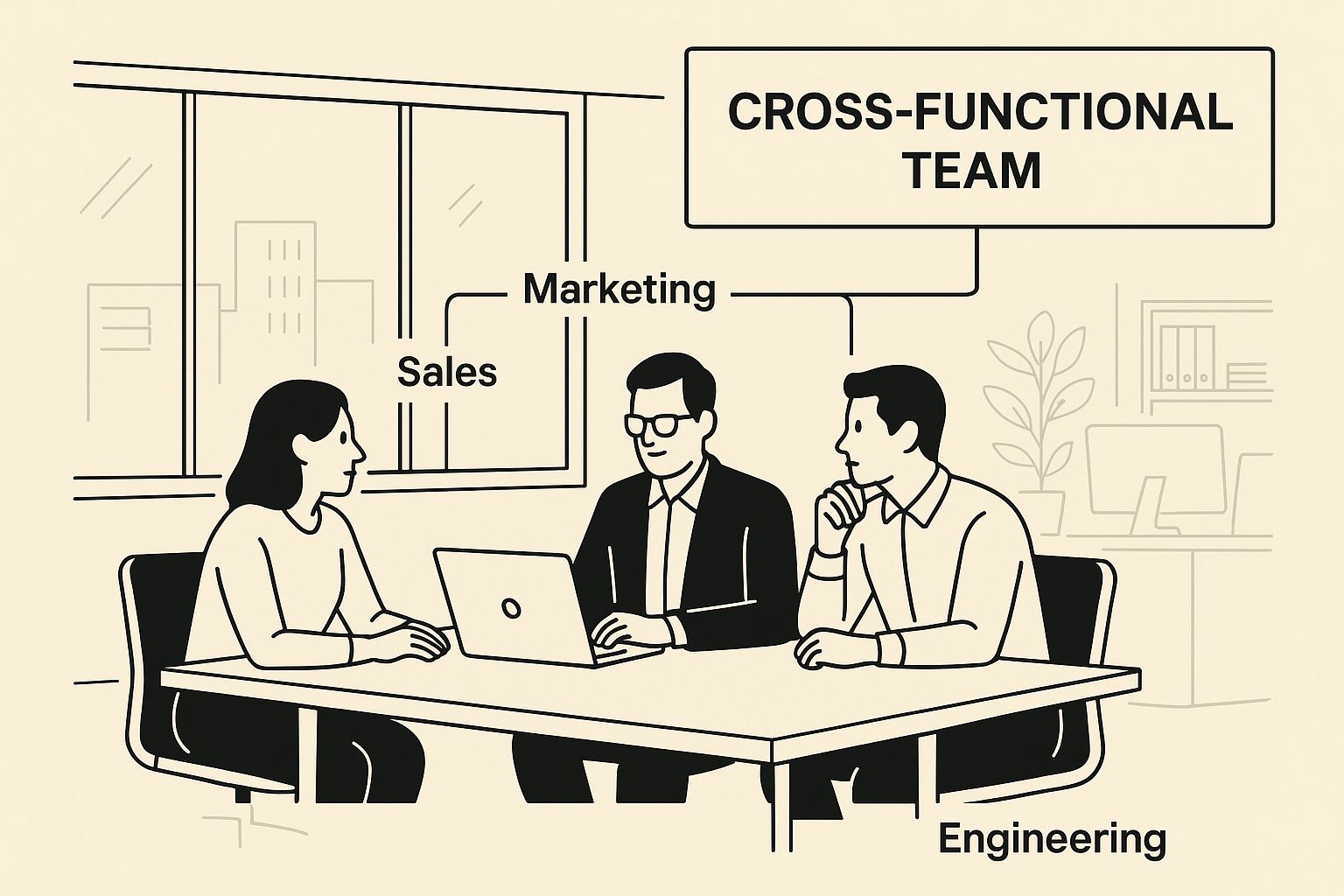
The big takeaway here is that genuine collaboration isn’t just about mixing departments. It's about creating a brand-new, temporary unit laser-focused on a shared outcome.
The Core Idea Behind Collaboration
At its heart, this approach is all about breaking down the invisible walls inside a company. It’s not about adding more meetings to everyone’s calendar; it's about intentionally bringing diverse perspectives to the table from day one.
When you get this alignment right from the start, teams can spot potential roadblocks sooner, make smarter decisions, and build things that no single department could ever dream of achieving alone.
The goal is to blend specialized knowledge into a powerful, cohesive force. When an engineer understands marketing’s goals and a designer understands technical limitations, the final product is inherently stronger and more aligned with customer needs.
To make this concept crystal clear, let's break down the essential pieces that make this approach work.
Core Components of Cross Functional Collaboration
This table gives a quick summary of the key elements that define true cross-functional collaboration.
| Component | Description | Example |
|---|---|---|
| Diverse Expertise | Team members are pulled from different functional areas (e.g., engineering, design, marketing). | A new feature launch team includes a backend developer, a UI/UX designer, a content marketer, and a sales lead. |
| Shared Goal | The entire team is aligned around a single, clear, and measurable objective. | The team's collective goal is to increase user sign-ups by 15% in the next quarter, not just to ship code or run a campaign. |
| Unified Authority | The team has the autonomy to make decisions related to the project without constant external approvals. | The team can decide on the final UI design without needing to escalate the decision up multiple chains of command. |
| Open Communication | Information flows freely and transparently among all team members, regardless of their department. | Daily stand-ups and a shared Slack channel are used to keep everyone, from engineering to marketing, in the loop. |
Each of these components is critical. Miss one, and you risk falling back into old, siloed habits.
Why It Matters More Than Ever
In today's fast-moving markets, speed and adaptability are everything. Cross-functional teams can pivot and react to changes far more quickly than siloed organizations ever could.
Instead of a painfully slow, sequential approval process, problems are flagged and solved in real-time by the people with the right expertise at the table. But—and this is a big but—this approach demands sharp management and a solid structure.
In fact, without the right support, cross-functional collaboration has a staggering 75% failure rate, often due to conflicting departmental priorities and messy communication. You can find more insights on why these initiatives can struggle on infeedo.ai. By getting ahead of these common pitfalls, you can build a framework that sets your teams up for success.
So, what's the real payoff when you tear down those departmental walls? Let's move past the theory. When you get cross-functional collaboration right, it becomes a powerful engine for business growth, changing how work gets done and directly boosting the bottom line. It’s the difference between a slow, clunky hand-off process and a dynamic, real-time problem-solving machine.
When you bring different skill sets to the table from day one, you create a kind of synergy that no single department could ever dream of achieving on its own. Problems that would typically grind a project to a halt—like a technical snag discovered way too late in the marketing phase—get spotted and solved instantly because the right people are already in the room.

This proactive style doesn't just make project workflows smoother; it does wonders for morale and engagement. Team members finally see how their individual contributions plug into the bigger picture, which builds a much stronger sense of ownership and shared purpose.
Accelerating Innovation and Speed to Market
One of the biggest wins from breaking down silos is a massive cut in time-to-market. Instead of teams waiting around for handoffs, they work in parallel. This compresses timelines and lets you launch products or features way faster.
That accelerated pace is a huge competitive advantage. While your rivals are stuck navigating their own internal red tape, your cross-functional teams are already shipping value to customers. This speed is powered by better, more well-rounded decision-making.
In fact, research shows that diverse teams working this way make better decisions 87% of the time simply by bringing multiple viewpoints into the mix and avoiding tunnel vision. You can dig into more data on how collaboration improves team performance on teamhood.com.
By uniting different perspectives, a cross-functional team can anticipate customer needs, identify market gaps, and innovate more effectively than any siloed group ever could.
Boosting Efficiency and Customer Satisfaction
This collaborative model also unlocks some serious operational efficiencies. When marketing, engineering, and sales are all on the same page, resources get used more effectively, which means less rework and wasted effort. For example:
- Marketing actually understands the tech's capabilities and limits, so they can create campaigns that are realistic and impactful.
- Engineering gets direct feedback from the teams talking to customers, helping them prioritize features that people actually want.
- Sales knows exactly what's on the product roadmap and can set the right expectations with potential customers.
This kind of alignment directly benefits the end user. The products are more intuitive, the marketing messages hit the mark, and the entire customer experience just feels more seamless. When every department is reading from the same playbook, you get a better product and a happier, more loyal customer base. And ultimately, that synergy translates straight into stronger revenue growth and a healthier business.
Navigating the Common Collaboration Roadblocks
While the benefits are clear, the path to great cross-functional collaboration is rarely a straight line. Teams often hit the same predictable roadblocks that can stall even the most promising projects.
Knowing what these challenges are is the first step to navigating around them.
One of the most common friction points is the good old clash of departmental priorities. Picture a product launch: marketing is chomping at the bit for a quick release to jump on a market trend. Meanwhile, engineering needs more time to squash bugs and ensure the product is actually stable.
Both goals are perfectly valid, but they create a natural tension. Without a single, unified objective everyone buys into, these competing priorities can easily devolve into finger-pointing and blown deadlines.
Misaligned Communication and Goals
Another huge hurdle is simple communication breakdown. Every department has its own language, its own acronyms, and its own definition of success. What "done" means to a developer is often wildly different from what it means to a product manager.
This disconnect creates gaps in understanding that can spiral out of control. If the sales team, for example, promises a client a feature that engineering hasn’t even started building, it puts everyone in a tough spot. It’s a classic example of why clear, shared goals and transparent communication are absolutely non-negotiable.
A lack of shared understanding is the root cause of so many project failures. When teams operate with different assumptions, they aren't collaborating; they're just working near each other.
To get ahead of this, you have to establish a common language and a single source of truth for project status right from the start.
Unclear Ownership and Accountability
Finally, fuzzy ownership can bring a cross-functional team to a screeching halt. When nobody is sure who has the final say on a decision or who's on the hook for a specific task, work just... stops.
This ambiguity leads to tasks falling through the cracks or critical decisions getting stuck in an endless debate cycle.
- Priority Clashes: Marketing’s need for speed often goes head-to-head with engineering’s need for stability.
- Communication Gaps: Different departmental jargon and metrics lead to constant confusion.
- Ownership Ambiguity: A lack of clear roles causes indecision and frustrating delays.
These aren't just minor annoyances; they directly kneecap the team's ability to deliver and can seriously damage the overall developer experience. You can learn more about building a better environment in our guide on how to improve developer experience.
And as teams become more global, clear communication is even more critical. Building essential cross-cultural communication skills can help bridge these gaps and make sure everyone on the team feels heard and understood.
A Blueprint for Building High-Performing Teams
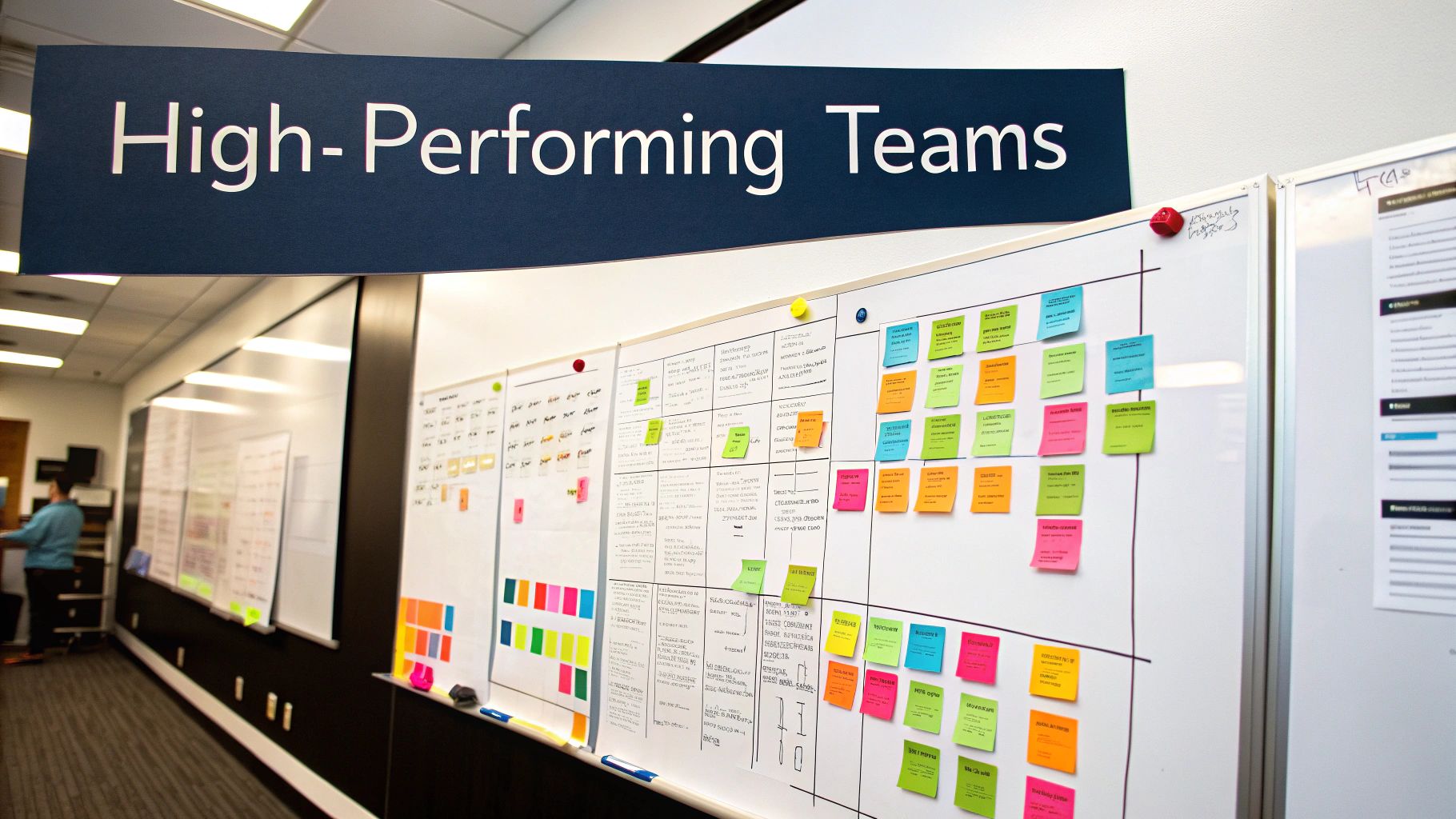
Putting collaboration theory into practice isn’t magic—it requires a solid, actionable framework. You can’t just throw a bunch of smart people in a room and hope for the best. High-performing cross-functional teams are built intentionally, brick by brick, on a foundation of shared goals, clear roles, and psychological safety.
Think of this as the essential blueprint for turning a group of individual specialists into a single, unstoppable unit.
Establish a Single Unifying Goal
First things first: you need one, non-negotiable goal that the entire team obsesses over. This isn't about departmental metrics or checking boxes. It has to be a specific business outcome, something like, "increase new user retention by 15% in Q3."
This shared goal becomes the team's North Star. It’s the tie-breaker. When marketing wants to move fast but engineering needs to ensure stability, that single goal provides the context for making the right trade-offs together.
When everyone is rowing toward the same shore, disagreements about the best way to row become productive discussions, not territorial disputes. The shared goal is the ultimate tiebreaker.
Define Roles and Responsibilities with Precision
With a clear goal in place, the next step is to kill any ambiguity around who does what. It's a common misconception that in cross functional collaboration, everyone should be a generalist. That's not it at all. Specialists are your strength.
The trick is clarity. Every single person needs to know exactly what they’re responsible for and who has the final say. No more tasks falling through the cracks. No more stalemates because nobody knows who can make the final call.
- Who owns what? Assign clear ownership for every part of the project.
- Who makes the final call? Designate decision-makers for different areas to keep things moving.
- How will we communicate progress? Set up a consistent way to share updates so everyone stays in sync.
This structure lets your experts do what they do best, knowing their work will fit perfectly with everyone else's. You're not trying to erase specializations; you're orchestrating them. And when done right, this is a massive lever for boosting productivity in engineering and every other department involved.
Cultivate Psychological Safety
This might be the most crucial—and most frequently ignored—piece of the puzzle: psychological safety. It's the shared belief that you can take risks, ask "dumb" questions, or challenge an idea without getting shut down or punished. It's an environment where a junior designer feels just as comfortable speaking up as a senior engineer.
Without it, real collaboration is dead on arrival. People will hold back brilliant ideas, avoid flagging potential problems, and hide their mistakes. That fear just kills innovation and guarantees you'll end up with a mediocre result.
This is where leadership has to step up. Leaders need to model vulnerability, encourage healthy debate, and frame failures as learning opportunities, not blame games. When they build this culture from the top down, they create the space for a cross-functional team to do more than just function—they create the conditions for it to truly thrive.
Essential Tools to Power Your Collaborative Engine
Even the sharpest cross-functional teams will hit a wall without the right tech. Good tools act as the digital connective tissue, bridging the gaps between departments, time zones, and working styles—especially when you're working remote or hybrid. They're not just software; they are the shared spaces where collaboration actually happens.
Winning teams run on a stack of tools built for specific jobs. It's less about picking a popular brand and more about choosing platforms that solve your team's unique collaboration headaches. Think of it like building a custom toolkit for your crew's specific workflow.
Creating a Single Source of Truth
The most common point of failure is a lack of shared information. When teams are working from different versions of a plan, you get chaos. That's where project management platforms become essential for creating a single source of truth that everyone can trust.
These tools give everyone a clear view of who is doing what, and by when.
- Project Management Platforms (e.g., Asana, Jira): These create a central hub for tasks, deadlines, and project progress, making sure everyone is looking at the same master plan.
- Shared Document Repositories (e.g., Google Drive, Notion): This is how you end the nightmare of version control. The entire team gets access to the latest documents, plans, and research.
By centralizing information, these platforms get rid of the guesswork and the endless "status update" meetings, freeing up your team to do the actual work.
Facilitating Real-Time Communication
Alongside a central hub for tasks, teams need a space for dynamic, real-time conversation. This is where dedicated communication tools become non-negotiable, pulling critical discussions out of siloed email inboxes and into transparent, accessible channels.
Communication hubs like Slack or Microsoft Teams are fantastic for quick feedback loops and spontaneous problem-solving. But the noise can be a killer. This is where specialized automation tools become incredibly powerful for what is cross functional collaboration.
A tool's real value isn't just in the features it offers, but in its ability to reduce friction. The goal is to make collaboration the path of least resistance.
For instance, a tool like PullNotifier can automate a critical workflow by instantly pinging a marketing or QA channel in Slack the moment a developer merges a new feature.
This is a perfect example of how automation can bridge departmental divides.
This screenshot shows how PullNotifier delivers concise, real-time updates from GitHub directly into Slack, keeping non-technical teams in the loop without any manual effort. This targeted alert system ensures marketing can prep launch content and QA can start testing immediately, all triggered by a single developer action. You can see how a tight GitHub Slack integration improves code reviews and keeps the entire team synchronized. It transforms a key development event into an actionable signal for the entire cross-functional team, keeping the engine of collaboration running smoothly and efficiently.
Alright, you've seen the what, the why, and the "what could go wrong" of cross-functional collaboration. Now it's time to roll up your sleeves and actually make it happen.
Let's be clear: this isn't about sending out a memo and calling it a day. We're talking about a real cultural shift. You can't just mandate great collaboration; you have to build an environment where it can thrive.
It all starts with three non-negotiables. First, get everyone—and I mean everyone—aiming at the same target, a single goal that matters more than any team's individual KPIs. Second, spell out who does what with crystal clarity. No gray areas, no confusion, just pure ownership. Finally, you have to create a space where people feel safe to speak up, even when it's tough. Every voice needs to be heard.
Taking Your First Steps
Don't try to boil the ocean. A massive, top-down overhaul is a recipe for disaster. The real secret is to start small, prove the concept, and let the results speak for themselves.
Your goal is to create a small, undeniable win that showcases the power of this collaborative model. This initial success will become the catalyst for broader adoption across the organization.
Look for a high-impact project that's currently stuck in the mud because of silos and communication breakdowns. That's your pilot. Use it as your testing ground for everything we've talked about. Get the team together, make the mission clear, and give them the tools and freedom they need to knock it out of the park.
By showing the value of what is cross functional collaboration on a single, manageable project, you build an ironclad case for change. That first success story creates a ripple effect, inspiring other teams to follow suit. That's how you transform an entire organization—one project at a time.
Got Questions? We've Got Answers
Even when the big picture is clear, a few questions always pop up. Let's tackle some of the most common ones to help you nail the practical side of bringing cross-functional collaboration to your team.
What’s the Difference Between a Cross-Functional Team and a Regular Team?
Think of a regular team—often called a functional team—as a group of specialists from the same department. Imagine a room full of backend engineers or a squad of nothing but graphic designers. They all share a similar skillset and report up the same management chain.
A cross-functional team, on the other hand, is like assembling the Avengers. You intentionally pull in experts from different corners of the business—engineering, marketing, sales, design—and unite them around a single mission or project. The magic isn't just in the mix of skills; it's in the diversity of perspectives they bring to the table.
How Do You Actually Measure the Success of Cross-Functional Collaboration?
This is a big one. Success here isn't just about "feeling" more collaborative. You need to measure it with a mix of project-level results and bigger-picture business metrics. The key is to define your key performance indicators (KPIs) before the project kicks off, so everyone knows what you're aiming for.
- Project Metrics: Did you hit your deadlines? Did you stay on budget? Is the final product high-quality? These are your table stakes.
- Organizational Metrics: Now for the good stuff. Are you shipping products faster? Are you seeing a bump in innovation, like launching more new features? Are customer satisfaction scores climbing? And just as important, are your employees more engaged?
The best metrics tie directly to business outcomes, not just checking boxes. Success isn't just launching a feature; it's seeing that feature drive a real, measurable lift in customer retention or revenue.
What's the Ideal Size for a Cross-Functional Team?
There's no single magic number, but the general consensus is to keep it small. Smaller teams are more agile, communicate better, and make decisions faster.
A great rule of thumb is the "two-pizza rule," which famously comes from Amazon: if you can't feed the entire team with two pizzas, your team is too big. In practice, this usually means a team of 5 to 10 people. That’s small enough to stay nimble but large enough to pack in all the different skills you need to get the job done.
Keep your teams perfectly in sync with automated, real-time updates. PullNotifier closes the gap between GitHub and Slack, making sure every stakeholder—from engineering to marketing—stays in the loop without the noise. Start streamlining your cross-functional workflows today at https://pullnotifier.com.